
Mapa mental
Mechanisms
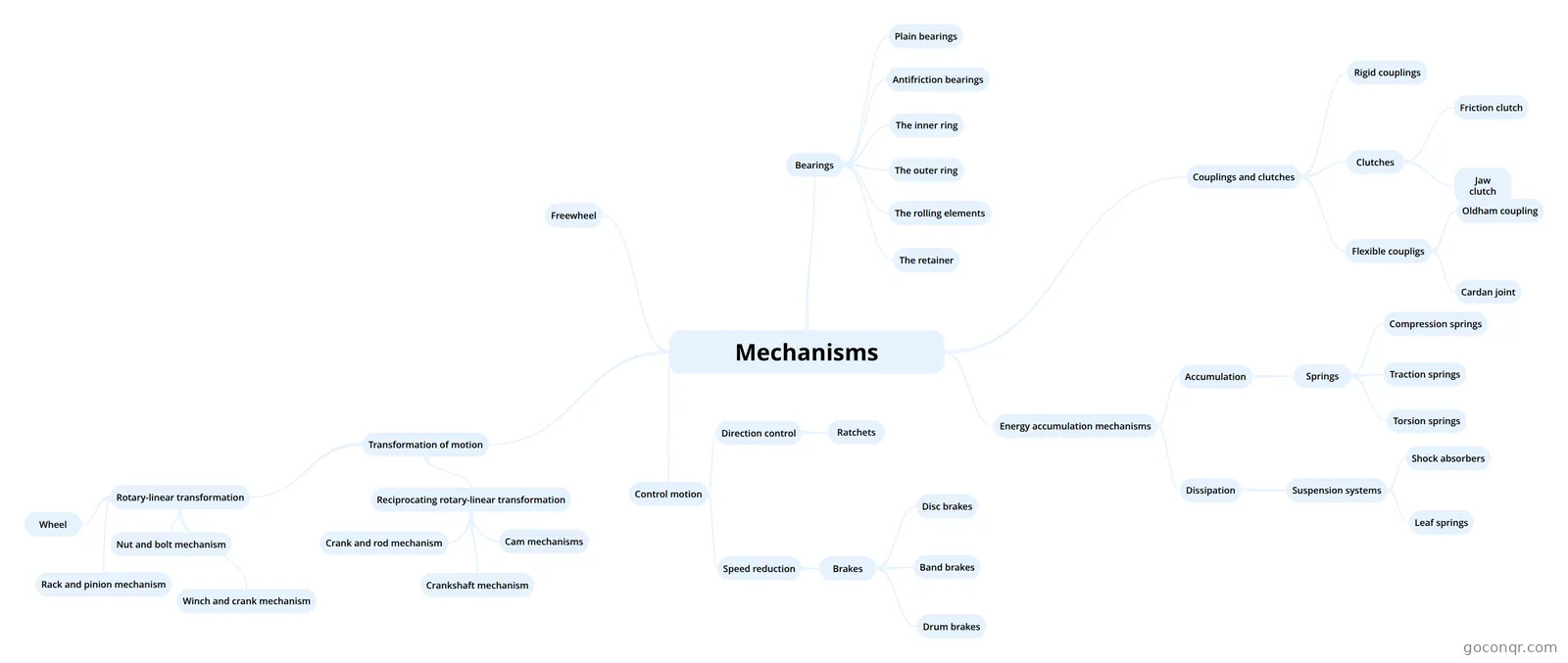
Mind map: Mechanisms
Contenido del mapa
Mechanisms
Transformation of motion
- Rotary-linear transformation
- Wheel
- Wheels let us move more easily because they reduce our contact with the ground and decrease friction.
- Rack and pinion mechanism
- The rack is a bar with many teeth and the pinion is a gear with teeth that interlock with the rack.
- Nut and bolt mechanism
- A nut and bolt mechanism transforms rotary motion into linear motion.
- Winch and crank mechanism
- A winch is a cylinder that rotates around a horizontal axis. The crank increases the force and the winch transforms rotary motion into linear motion
- Wheel
- Reciprocating rotary-linear transformation
- Crank and rod mechanism
- The piston moves a rod forwrd and backward. This rod turns the first wheel. The second wheel turns because it is connected to the first wheel.
- Crankshaft mechanism
- A crankshaft mechanism can synchronise the movements of various parts, such as the multiple pistons of a car engine.
- Cam mechanisms
- A cam is an irregularly shaped device that rotates on a shaft.
- Crank and rod mechanism
- Rotary-linear transformation
Control motion
- Direction control
- Ratchets
- A ratchet is mechanism that controls the direction of motion. It allows motion in one direction.
- Ratchets
- Speed reduction
- Brakes
- Brakes use friction to reduce speed.
- Disc brakes
- A disc is connected to an axle. Brake pads apply pressure to the disc.
- Band brakes
- Brakes were used in carriages and they depended on the strength of the driver.
- Drum brakes
- A drum is connected to the axle. A pair of brake shoes apply pressure to the inside of the drum.
- Brakes
- Direction control
Energy accumulation mechanisms
- Accumulation
- Springs
- Springs are flexible devices that absorb energy when we apply force to them.
- Compression springs
- Traction springs
- Torsion springs
- Springs
- Dissipation
- Suspension systems
- Are useful because they absorb and dissipate motion when the road is bumpy.
- Shock absorbers
- Leaf springs
- Suspension systems
- Accumulation
Couplings and clutches
- Rigid couplings
- Form a permanent connection between two shafts.
- Clutches
- Form a rigid connection which isn´t permanent.
- Friction clutch
- The ends of two shafts come into contact. When one shaft turns, there is friction.
- Jaw clutch
- The ends of two shafts are connected by interlocking teeth. A jaw clutch is more reliable because it doesn´t slip easily.
- Flexible coupligs
- Are also useful
- Oldham coupling
- Is used to connect shafts that are not perfectly aligned.
- Cardan joint
- Connects two shafts that are at an angle to each other.
- Rigid couplings
Bearings
- Plain bearings
- Antifriction bearings
- The inner ring
- The outer ring
- The rolling elements
- The retainer
Freewheel
- A freewheel transmits motion in one direction, and turns freely in the opposite direction.
Información
- Descripción
- 3º de ESO Tecnología Mapa Mental sobre Mechanisms, creado por Nuria Moya Vergara el 09/02/2019.
- Creado por
- Nuria Moya Vergara
- Visitas
- 1
- Historial
-
- Creado por Nuria Moya Vergara · 9 feb 2019
- Copiado por Nuria Moya Vergara · 9 feb 2019
- Valoración
Más sobre Motion Transmission and Transformation