
Mapa mental
The kidneys
Contenido del mapa
The kidneys
Overview
- Kidneys are organs of excretion
- They excrete waste products and regulate water potential
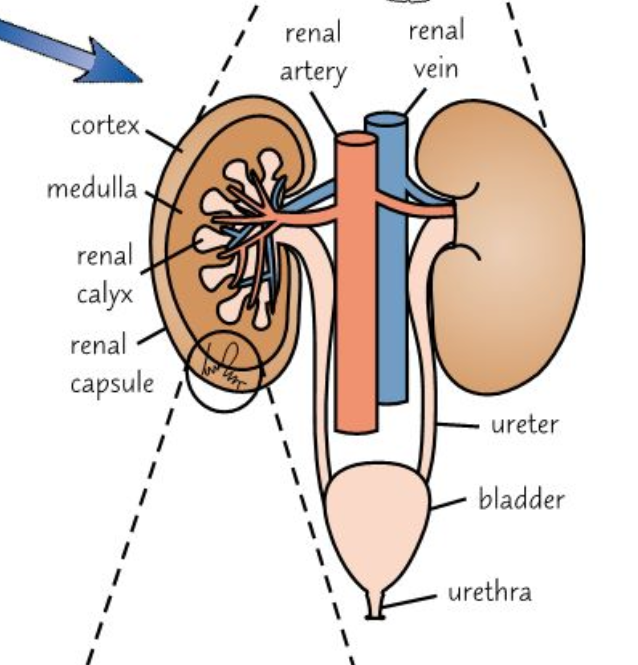
- 1) Blood enters the kidney through the renal artery and then passes through the capillaries in the cortex of the kidneys
- 2) As blood passes through the capillaries, substances are filtered out the blood and into long tubules that surround the capillaries - called ultrafiltration
- 3) Useful substances are reabsorbed back into the blood from the tubules in the medulla and cortex - selective reabsorbtion
- 4) The remaining unwanted substances eg urea pass along the tubules, then along the ureter to the bladder where it is expelled as urine
- 5) The filtered blood passes out of the kidneys through the renal vein
Nephron filtration
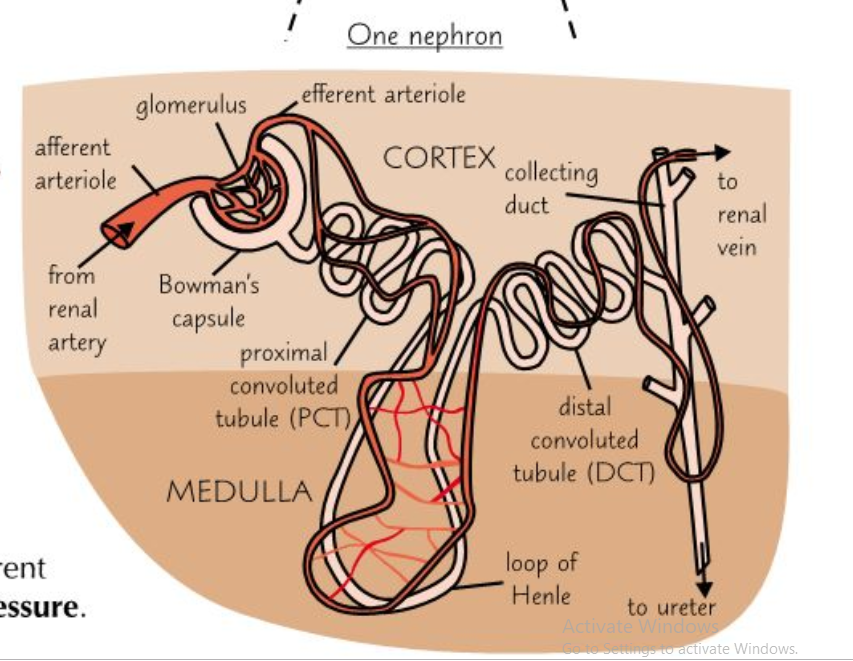
- Nephrons are long tubules with bundles of capillaries where the blood is filtered
- 1) Blood from renal artery enters smaller arterioles in the cortex
- 2) Each arteriole splits into a glomerulus - a bundle of capillaries looped inside a hollow ball called the bowmans capsule - which is where ultrafiltration takes place
- The arteriole that takes blood into the glomerulus is called the afferent arteriole and the arteriole that takes blood out is called the efferent arteriole
- Efferent arteriole is much smaller in diameter than afferent, so blood in glomerulus is at high pressure
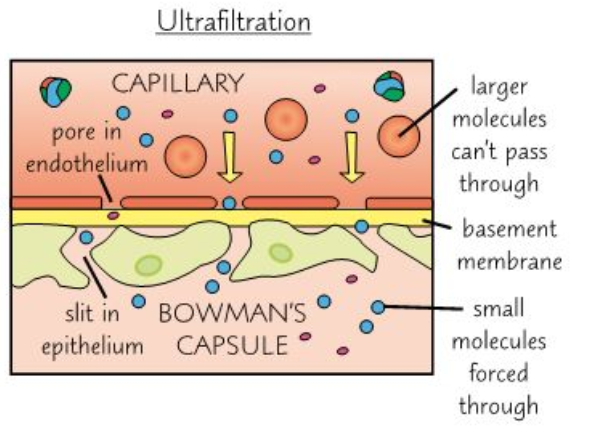
- 3) High pressure in the efferent arteriole forces liquid and small molecules in the blood out of the capillary and into the bowmans capsule
- 4) The small molecules pass through 3 layers to get to the bowmans capsule
- The capillary wall
- the basement membrane
- the epithelium of the bowmans capsule
- 5) The liquid and small molecules now called filtrate, pass along the rest of the nephron and useful substances are reabsorbed on the way
- 6) Finally filtrate travels through collecting duct and passes out of the kidney along the ureter
Nephron reabsorbtion
- Selective reabsorption occurs as the filtrate flows along the PCT (proximal convoluted tubule), through the loop of Henle and along the DCT (distal convoluted tubule)
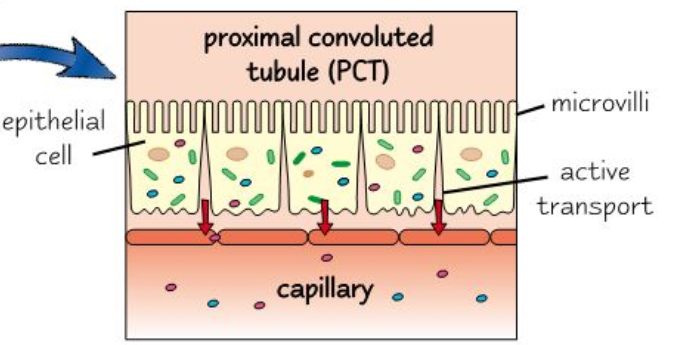
- Useful substances leave the tubules of the nephrons and enter the capillary network that wrapped around them by diffusion
- The epithelium of the PCT has microvilli to increase SA for the reabsorption of useful chemicals from the filtrate into the blood
- Most solutes are taken up by fascilitated diffusion and active transport along the PCT
- Water enters the blood by osmosis due to a more negative water potential in the blood
- The filtrate that remains is urine, which passes along the ureter to the bladder
- Urine is made of
- Water and dissolved salts
- Urea
- Other substances like hormones and excess vitamins
- Urine doesnt normally contain
- Proteins and blood cells
- Glucose, amino acids and vitamins
Controlling water potential
- The kidneys regulate the water potential in the blood so the body has just the right amount of water
- Water is lost from pissing, breathing and sweating
- Dehydrated
- If the water potential of the blood is too low, more water is reabsorbed by osmosis into the blood from the tubules of the nephrons - which results in more concentrated urine, and less water lost during excretion
- Overhydrated
- If the water potential of the blood is too high, less water is reabsorbed by osmosis into the blood from the tubules of the nephrons - this results in more dilute urine, so more water is lost during excretion
- Loop of henle
- Counter current multiplier mechanism
- 1) Near the top of the ascending limb, Na+ and Cl- are actively pumped out into the medulla. The ascending limb is impermeable to water, so it stays in the tubule which creates a low water potential in the medulla, due to the high concentration of ions
- 2) Due to the lower water potential in the medulla, than in the descending limb, so water moves out by osmosis, which makes the filtrate more concentrated - the water is reabsorbed in the blood through the capillary network
- 3) Near the bottom of the ascending limb Na+ and Cl- ions diffuse out into the medulla, further lowering the water potential in the medulla, (the ascending limb is impermeable to water, so it stays in the tubule)
- 4) The first 3 stages increases the ion concentration in the medulla, which lowers the water potential - this causes water to move out of the collecting duct by osmosis and the water in the medulla is reabsorbed into the blood through the capillary network
- The volume of water taken up can be adjusted by changing the permeability of the collecting duct
- Counter current multiplier mechanism
- ADH
- The water potential of the blood is monitored by cells called osmoreceptors in the hypothalamus
- When the osmoreceptors are stimulated by low water potential in the blood, the hypothalamus sends an impulse to the pituitary gland to make it release ADH
- ADH makes the walls of the DCT and collecting duct more permeable to water
- So more ADH = more water absorbed due to higher permeability
- Blood ADH rises when your dehydrated
- 1) water content of blood drops, so does water potential
- 2) This is detected my osmoreceptors in the hypothalamus
- 3) The posterior pituitary gland is stimulated to release more ADH into the blood
- 4) More ADH means that the DCT and collecting duct are more permeable, so more water is reabsorbed into the blood by osmosis
- 5) A small amount of concentrated urine is produced so less water is lost
- Blood ADH falls when youre hydrated
- 1) The water content of the blood rises, so does water potential
- 2) This is detected by osmoreceptors in the hypothalamus
- 3) The posterior pituitary gland releases less ADH into the blood
- 4) Less ADH means that the DCT and collecting duct are less permeable, so less water is reabsorbed into the blood by osmosis
- 5) A large amount of dilute urine is produced and more water is lost
Kidney failure
- Kidney failure is when the kidneys stop working properly
- Kidney failure is detected by measuring GFR (glomerular filtration rate)
- Can be caused by
- Kidney infections
- High blood pressure
- Problems it causes:
- Waste products that the kidneys would normally remove build up in the blood
- Fluid starts to accumulate in the tissues because kidneys cant remove excess water
- The balance of electrolytes (ions) becomes unbalanced
- Anaemia - lack of hameoglobin in the blood
- Treatments
- Renal dialysis
- A machine is used to filter a patients blood
- Patients need multiple long sessions every week and inbetween waste builds up and the patient feels worse
- Mainly used to keep someone alive until a transplant is available
- Very expensive and inconvenient for the patient
- Kidney transplants
- A new kidney transplanted into your body to replace a damaged one
- The kidney has to be compatible - eg same blood type, same tissue type
- Advantages
- Cheaper
- More convenient for patient
- Patients dont feel unwell between dialysis sessions
- Disadvantages
- Major risky operation
- The immune system may reject the transplant, so patient has to take drugs to suppress it
- Renal dialysis
Urine tests
- Urine can be used to test for drug use and pregnancy
- Pregnancy
- They detect the hormone hCG thats only found in urine of pregnant baby
- A test strip has antibodies for hCG bound to a coloured bead
- When urine is applied any hCG will bind to the antibodies on the beads
- Urine moves up the test strip, carrying the beads with it where more antibodies are immobilised
- If hCG is present the strip turns blue because the immobilised antibody binds to any hCG attach to the blue beads, which concentrates the blue beads making it blue
- If no hCG is present the beads will pass through the area without binding to anything
- Steroids
- Steroids are found by detecting steroids or the compounds they are broken down into
- They are detected by using gas chromotography and mass spectroscopy
- Chromotography separates out compounds in the urine
- Mass spectroscopy is used to analyse what compounds are present by converting them into ions
- The results are then compared to results for known substances
- Recreational drugs
- they use test strips to test for most drugs with antibodies thatll bind to the drug or the compounds it is broken into
- If a certain amount of the drug is present a colour change will occur
Imágenes y archivos del mapa
Información
- Descripción
- Mapa Mental sobre The kidneys, creado por Fin Carson el 24/02/2019.
- Creado por
- Fin Carson
- Visitas
- 0
- Valoración