
Mapa mental
Personnel Selection
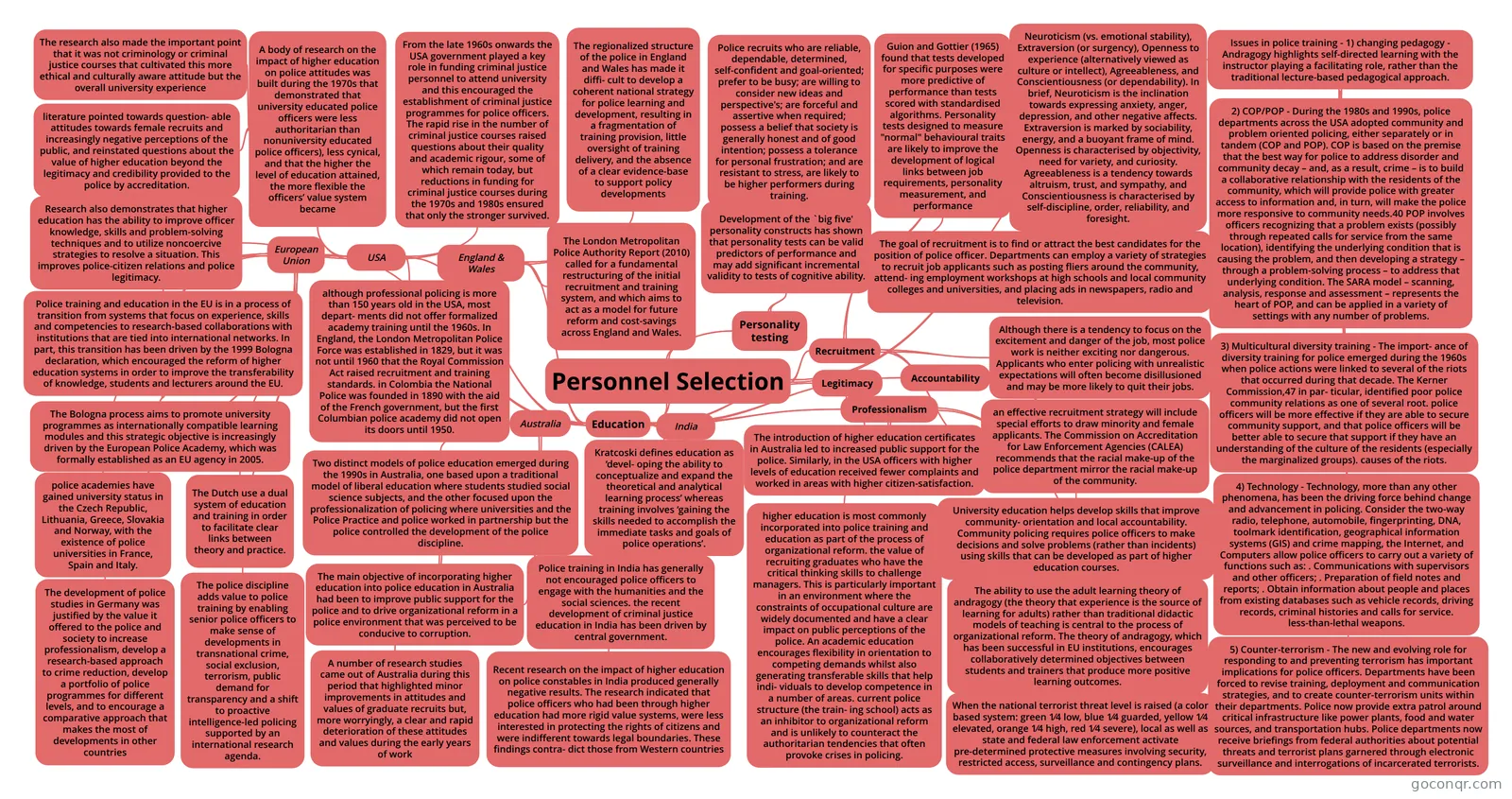
Mind map: Personnel selection in policing
Contenido del mapa
Personnel Selection
Personality testing
- Development of the `big five' personality constructs has shown that personality tests can be valid predictors of performance and may add significant incremental validity to tests of cognitive ability.
- Guion and Gottier (1965) found that tests developed for specific purposes were more predictive of performance than tests scored with standardised algorithms. Personality tests designed to measure "normal" behavioural traits are likely to improve the development of logical links between job requirements, personality measurement, and performance
- Neuroticism (vs. emotional stability), Extraversion (or surgency), Openness to experience (alternatively viewed as culture or intellect), Agreeableness, and Conscientiousness (or dependability). In brief, Neuroticism is the inclination towards expressing anxiety, anger, depression, and other negative affects. Extraversion is marked by sociability, energy, and a buoyant frame of mind. Openness is characterised by objectivity, need for variety, and curiosity. Agreeableness is a tendency towards altruism, trust, and sympathy, and Conscientiousness is characterised by self-discipline, order, reliability, and foresight.
- Police recruits who are reliable, dependable, determined, self-confident and goal-oriented; prefer to be busy; are willing to consider new ideas and perspective's; are forceful and assertive when required; possess a belief that society is generally honest and of good intention; possess a tolerance for personal frustration; and are resistant to stress, are likely to be higher performers during training.
- Development of the `big five' personality constructs has shown that personality tests can be valid predictors of performance and may add significant incremental validity to tests of cognitive ability.
Education
- England & Wales
- The London Metropolitan Police Authority Report (2010) called for a fundamental restructuring of the initial recruitment and training system, and which aims to act as a model for future reform and cost-savings across England and Wales.
- The regionalized structure of the police in England and Wales has made it diffi- cult to develop a coherent national strategy for police learning and development, resulting in a fragmentation of training provision, little oversight of training delivery, and the absence of a clear evidence-base to support policy developments
- Kratcoski defines education as ‘devel- oping the ability to conceptualize and expand the theoretical and analytical learning process’ whereas training involves ‘gaining the skills needed to accomplish the immediate tasks and goals of police operations’.
- USA
- From the late 1960s onwards the USA government played a key role in funding criminal justice personnel to attend university and this encouraged the establishment of criminal justice programmes for police officers. The rapid rise in the number of criminal justice courses raised questions about their quality and academic rigour, some of which remain today, but reductions in funding for criminal justice courses during the 1970s and 1980s ensured that only the stronger survived.
- A body of research on the impact of higher education on police attitudes was built during the 1970s that demonstrated that university educated police officers were less authoritarian than nonuniversity educated police officers), less cynical, and that the higher the level of education attained, the more flexible the officers’ value system became
- The research also made the important point that it was not criminology or criminal justice courses that cultivated this more ethical and culturally aware attitude but the overall university experience
- literature pointed towards question- able attitudes towards female recruits and increasingly negative perceptions of the public, and reinstated questions about the value of higher education beyond the legitimacy and credibility provided to the police by accreditation.
- Research also demonstrates that higher education has the ability to improve officer knowledge, skills and problem-solving techniques and to utilize noncoercive strategies to resolve a situation. This improves police-citizen relations and police legitimacy.
- although professional policing is more than 150 years old in the USA, most depart- ments did not offer formalized academy training until the 1960s. In England, the London Metropolitan Police Force was established in 1829, but it was not until 1960 that the Royal Commission Act raised recruitment and training standards. in Colombia the National Police was founded in 1890 with the aid of the French government, but the first Columbian police academy did not open its doors until 1950.
- European Union
- Police training and education in the EU is in a process of transition from systems that focus on experience, skills and competencies to research-based collaborations with institutions that are tied into international networks. In part, this transition has been driven by the 1999 Bologna declaration, which encouraged the reform of higher education systems in order to improve the transferability of knowledge, students and lecturers around the EU.
- The Bologna process aims to promote university programmes as internationally compatible learning modules and this strategic objective is increasingly driven by the European Police Academy, which was formally established as an EU agency in 2005.
- police academies have gained university status in the Czech Republic, Lithuania, Greece, Slovakia and Norway, with the existence of police universities in France, Spain and Italy.
- The Dutch use a dual system of education and training in order to facilitate clear links between theory and practice.
- The development of police studies in Germany was justified by the value it offered to the police and society to increase professionalism, develop a research-based approach to crime reduction, develop a portfolio of police programmes for different levels, and to encourage a comparative approach that makes the most of developments in other countries
- The police discipline adds value to police training by enabling senior police officers to make sense of developments in transnational crime, social exclusion, terrorism, public demand for transparency and a shift to proactive intelligence-led policing supported by an international research agenda.
- Police training and education in the EU is in a process of transition from systems that focus on experience, skills and competencies to research-based collaborations with institutions that are tied into international networks. In part, this transition has been driven by the 1999 Bologna declaration, which encouraged the reform of higher education systems in order to improve the transferability of knowledge, students and lecturers around the EU.
- Australia
- Two distinct models of police education emerged during the 1990s in Australia, one based upon a traditional model of liberal education where students studied social science subjects, and the other focused upon the professionalization of policing where universities and the Police Practice and police worked in partnership but the police controlled the development of the police discipline.
- A number of research studies came out of Australia during this period that highlighted minor improvements in attitudes and values of graduate recruits but, more worryingly, a clear and rapid deterioration of these attitudes and values during the early years of work
- The main objective of incorporating higher education into police education in Australia had been to improve public support for the police and to drive organizational reform in a police environment that was perceived to be conducive to corruption.
- Two distinct models of police education emerged during the 1990s in Australia, one based upon a traditional model of liberal education where students studied social science subjects, and the other focused upon the professionalization of policing where universities and the Police Practice and police worked in partnership but the police controlled the development of the police discipline.
- India
- Police training in India has generally not encouraged police officers to engage with the humanities and the social sciences. the recent development of criminal justice education in India has been driven by central government.
- Recent research on the impact of higher education on police constables in India produced generally negative results. The research indicated that police officers who had been through higher education had more rigid value systems, were less interested in protecting the rights of citizens and were indifferent towards legal boundaries. These findings contra- dict those from Western countries
- Professionalism
- higher education is most commonly incorporated into police training and education as part of the process of organizational reform. the value of recruiting graduates who have the critical thinking skills to challenge managers. This is particularly important in an environment where the constraints of occupational culture are widely documented and have a clear impact on public perceptions of the police. An academic education encourages flexibility in orientation to competing demands whilst also generating transferable skills that help indi- viduals to develop competence in a number of areas. current police structure (the train- ing school) acts as an inhibitor to organizational reform and is unlikely to counteract the authoritarian tendencies that often provoke crises in policing.
- The ability to use the adult learning theory of andragogy (the theory that experience is the source of learning for adults) rather than traditional didactic models of teaching is central to the process of organizational reform. The theory of andragogy, which has been successful in EU institutions, encourages collaboratively determined objectives between students and trainers that produce more positive learning outcomes.
- Accountability
- University education helps develop skills that improve community- orientation and local accountability. Community policing requires police officers to make decisions and solve problems (rather than incidents) using skills that can be developed as part of higher education courses.
- Legitimacy
- The introduction of higher education certificates in Australia led to increased public support for the police. Similarly, in the USA officers with higher levels of education received fewer complaints and worked in areas with higher citizen-satisfaction.
- England & Wales
Recruitment
- The goal of recruitment is to find or attract the best candidates for the position of police officer. Departments can employ a variety of strategies to recruit job applicants such as posting fliers around the community, attend- ing employment workshops at high schools and local community colleges and universities, and placing ads in newspapers, radio and television.
- Although there is a tendency to focus on the excitement and danger of the job, most police work is neither exciting nor dangerous. Applicants who enter policing with unrealistic expectations will often become disillusioned and may be more likely to quit their jobs.
- an effective recruitment strategy will include special efforts to draw minority and female applicants. The Commission on Accreditation for Law Enforcement Agencies (CALEA) recommends that the racial make-up of the police department mirror the racial make-up of the community.
Issues in police training - 1) changing pedagogy - Andragogy highlights self-directed learning with the instructor playing a facilitating role, rather than the traditional lecture-based pedagogical approach.
- 2) COP/POP - During the 1980s and 1990s, police departments across the USA adopted community and problem oriented policing, either separately or in tandem (COP and POP). COP is based on the premise that the best way for police to address disorder and community decay – and, as a result, crime – is to build a collaborative relationship with the residents of the community, which will provide police with greater access to information and, in turn, will make the police more responsive to community needs.40 POP involves officers recognizing that a problem exists (possibly through repeated calls for service from the same location), identifying the underlying condition that is causing the problem, and then developing a strategy – through a problem-solving process – to address that underlying condition. The SARA model – scanning, analysis, response and assessment – represents the heart of POP, and can be applied in a variety of settings with any number of problems.
- 3) Multicultural diversity training - The import- ance of diversity training for police emerged during the 1960s when police actions were linked to several of the riots that occurred during that decade. The Kerner Commission,47 in par- ticular, identified poor police community relations as one of several root. police officers will be more effective if they are able to secure community support, and that police officers will be better able to secure that support if they have an understanding of the culture of the residents (especially the marginalized groups). causes of the riots.
- 4) Technology - Technology, more than any other phenomena, has been the driving force behind change and advancement in policing. Consider the two-way radio, telephone, automobile, fingerprinting, DNA, toolmark identification, geographical information systems (GIS) and crime mapping, the Internet, and Computers allow police officers to carry out a variety of functions such as: . Communications with supervisors and other officers; . Preparation of field notes and reports; . Obtain information about people and places from existing databases such as vehicle records, driving records, criminal histories and calls for service. less-than-lethal weapons.
- 5) Counter-terrorism - The new and evolving role for responding to and preventing terrorism has important implications for police officers. Departments have been forced to revise training, deployment and communication strategies, and to create counter-terrorism units within their departments. Police now provide extra patrol around critical infrastructure like power plants, food and water sources, and transportation hubs. Police departments now receive briefings from federal authorities about potential threats and terrorist plans garnered through electronic surveillance and interrogations of incarcerated terrorists.
- When the national terrorist threat level is raised (a color based system: green 1⁄4 low, blue 1⁄4 guarded, yellow 1⁄4 elevated, orange 1⁄4 high, red 1⁄4 severe), local as well as state and federal law enforcement activate pre-determined protective measures involving security, restricted access, surveillance and contingency plans.
Información
- Descripción
- Bachelor Policing Systems & Practice Mapa Mental sobre Personnel Selection, creado por caramelcarl el 28/11/2014.
- Creado por
- caramelcarl
- Visitas
- 4
- Valoración