
Mapa mental
PRODUCT: COAT
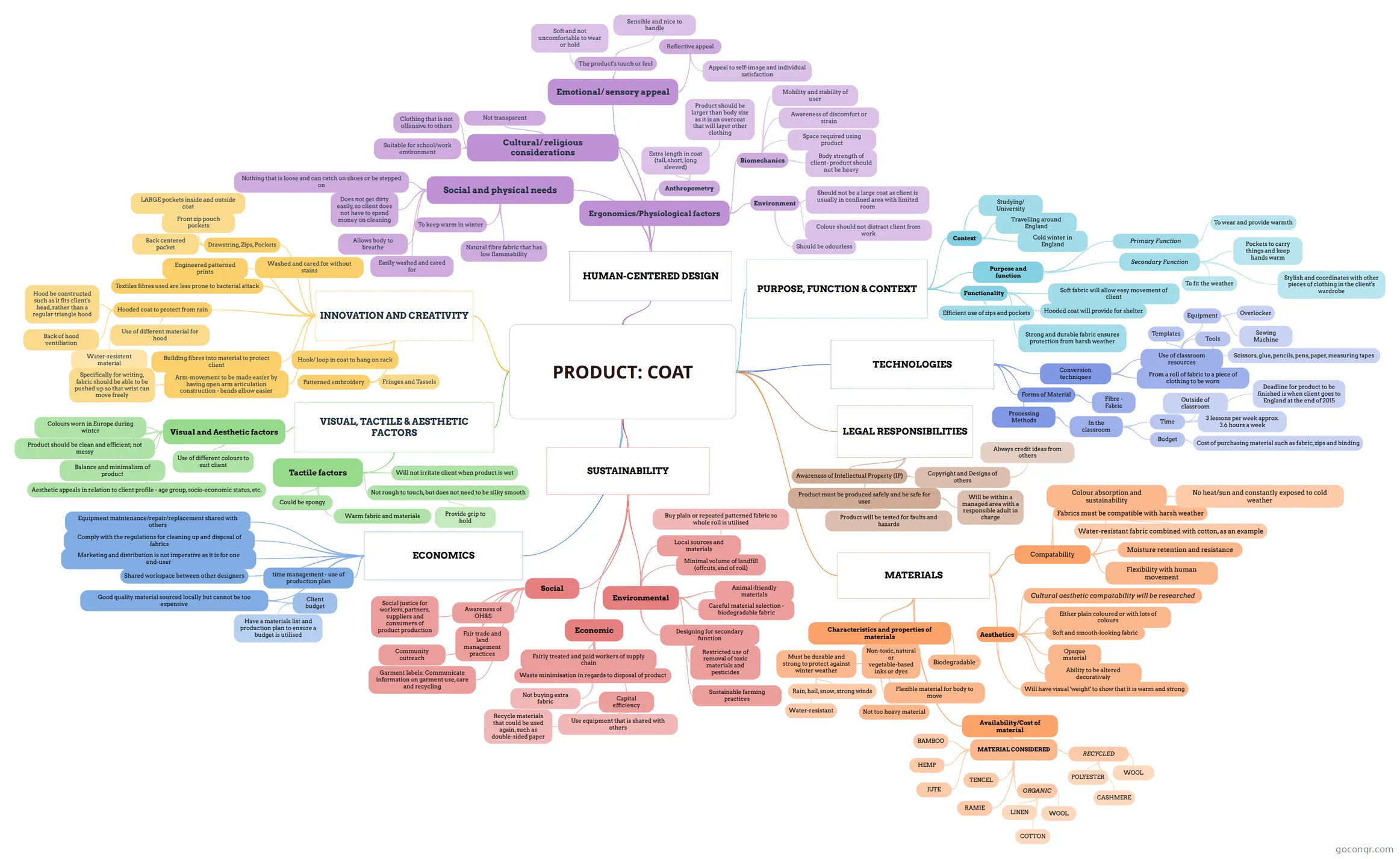
Mind map: Product coat design
Contenido del mapa
PRODUCT: COAT
INNOVATION AND CREATIVITY
- Engineered patterned prints
- Drawstring, Zips, Pockets
- Front zip pouch pockets
- Back centered pocket
- LARGE pockets inside and outside coat
- Textiles fibres used are less prone to bacterial attack
- Building fibres into material to protect client
- Washed and cared for without stains
- Hooded coat to protect from rain
- Use of different material for hood
- Water-resistent material
- Back of hood ventiliation
- Hood be constructed such as it fits client's head, rather than a regular triangle hood
- Use of different material for hood
- Arm-movement to be made easier by having open arm articulation construction - bends elbow easier
- Specifically for writing, fabric should be able to be pushed up so that wrist can move freely
- Patterned embroidery
- Fringes and Tassels
- Hook/ loop in coat to hang on rack
HUMAN-CENTERED DESIGN
- Ergonomics/Physiological factors
- Anthropometry
- Product should be larger than body size as it is an overcoat that will layer other clothing
- Extra length in coat (tall, short, long sleeved)
- Biomechanics
- Awareness of discomfort or strain
- Body strength of client- product should not be heavy
- Mobility and stability of user
- Space required using product
- Environment
- Colour should not distract client from work
- Should be odourless
- Should not be a large coat as client is usually in confined area with limited room
- Anthropometry
- Cultural/ religious considerations
- Clothing that is not offensive to others
- Not transparent
- Suitable for school/work environment
- Emotional/ sensory appeal
- The product's touch or feel
- Sensible and nice to handle
- Soft and not uncomfortable to wear or hold
- Reflective appeal
- Appeal to self-image and individual satisfaction
- The product's touch or feel
- Social and physical needs
- To keep warm in winter
- Allows body to breathe
- Nothing that is loose and can catch on shoes or be stepped on
- Easily washed and cared for
- Does not get dirty easily, so client does not have to spend money on cleaning
- Natural fibre fabric that has low flammability
- Ergonomics/Physiological factors
PURPOSE, FUNCTION & CONTEXT
- Purpose and function
- Primary Function
- To wear and provide warmth
- Secondary Function
- Pockets to carry things and keep hands warm
- To fit the weather
- Stylish and coordinates with other pieces of clothing in the client's wardrobe
- Primary Function
- Functionality
- Efficient use of zips and pockets
- Soft fabric will allow easy movement of client
- Hooded coat will provide for shelter
- Strong and durable fabric ensures protection from harsh weather
- Context
- Cold winter in England
- Travelling around England
- Studying/ University
- Purpose and function
VISUAL, TACTILE & AESTHETIC FACTORS
- Visual and Aesthetic factors
- Aesthetic appeals in relation to client profile - age group, socio-economic status, etc.
- Balance and minimalism of product
- Product should be clean and efficient; not messy
- Colours worn in Europe during winter
- Use of different colours to suit client
- Tactile factors
- Warm fabric and materials
- Will not irritate client when product is wet
- Not rough to touch, but does not need to be silky smooth
- Provide grip to hold
- Could be spongy
- Visual and Aesthetic factors
SUSTAINABILITY
- Social
- Awareness of OH&S
- Social justice for workers, partners, suppliers and consumers of product production
- Community outreach
- Fair trade and land management practices
- Garment labels: Communicate information on garment use, care and recycling
- Economic
- Fairly treated and paid workers of supply chain
- Waste minimisation in regards to disposal of product
- Not buying extra fabric
- Capital efficiency
- Use equipment that is shared with others
- Recycle materials that could be used again, such as double-sided paper
- Environmental
- Sustainable farming practices
- Animal-friendly materials
- Minimal volume of landfill (offcuts, end of roll)
- Buy plain or repeated patterned fabric so whole roll is utilised
- Careful material selection - biodegradable fabric
- Restricted use of removal of toxic materials and pesticides
- Local sources and materials
- Designing for secondary function
- Social
ECONOMICS
- Good quality material sourced locally but cannot be too expensive
- Client budget
- Have a materials list and production plan to ensure a budget is utilised
- Client budget
- Shared workspace between other designers
- Comply with the regulations for cleaning up and disposal of fabrics
- Marketing and distribution is not imperative as it is for one end-user
- Equipment maintenance/repair/replacement shared with others
- time management - use of production plan
- Good quality material sourced locally but cannot be too expensive
LEGAL RESPONSIBILITIES
- Awareness of Intellectual Property (IP)
- Copyright and Designs of others
- Always credit ideas from others
- Copyright and Designs of others
- Product must be produced safely and be safe for user
- Will be within a managed area with a responsible adult in charge
- Product will be tested for faults and hazards
- Awareness of Intellectual Property (IP)
MATERIALS
- Characteristics and properties of materials
- Must be durable and strong to protect against winter weather
- Rain, hail, snow, strong winds
- Water-resistant
- Non-toxic, natural or vegetable-based inks or dyes
- Flexible material for body to move
- Not too heavy material
- Biodegradable
- Must be durable and strong to protect against winter weather
- Aesthetics
- Either plain coloured or with lots of colours
- Soft and smooth-looking fabric
- Opaque material
- Ability to be altered decoratively
- Will have visual 'weight' to show that it is warm and strong
- Cultural aesthetic compatability will be researched
- Availability/Cost of material
- MATERIAL CONSIDERED
- RECYCLED
- CASHMERE
- WOOL
- POLYESTER
- ORGANIC
- LINEN
- WOOL
- COTTON
- RAMIE
- TENCEL
- HEMP
- JUTE
- BAMBOO
- RECYCLED
- MATERIAL CONSIDERED
- Compatability
- Fabrics must be compatible with harsh weather
- Water-resistant fabric combined with cotton, as an example
- Moisture retention and resistance
- Flexibility with human movement
- Colour absorption and sustainability
- No heat/sun and constantly exposed to cold weather
- Fabrics must be compatible with harsh weather
- Characteristics and properties of materials
TECHNOLOGIES
- Conversion techniques
- Use of classroom resources
- Templates
- Tools
- Scissors, glue, pencils, pens, paper, measuring tapes
- Equipment
- Overlocker
- Sewing Machine
- From a roll of fabric to a piece of clothing to be worn
- Use of classroom resources
- Forms of Material
- Fibre - Fabric
- Processing Methods
- In the classroom
- Time
- Outside of classroom
- 3 lessons per week approx. 3.6 hours a week
- Deadline for product to be finished is when client goes to England at the end of 2015
- Budget
- Cost of purchasing material such as fabric, zips and binding
- Time
- In the classroom
- Conversion techniques
Información
- Descripción
- Mapa Mental sobre PRODUCT: COAT, creado por adrina.apple el 16/12/2014.
- Creado por
- adrina.apple
- Visitas
- 1
- Valoración