
Mapa mental
COLOUR & FORM PROCESSING
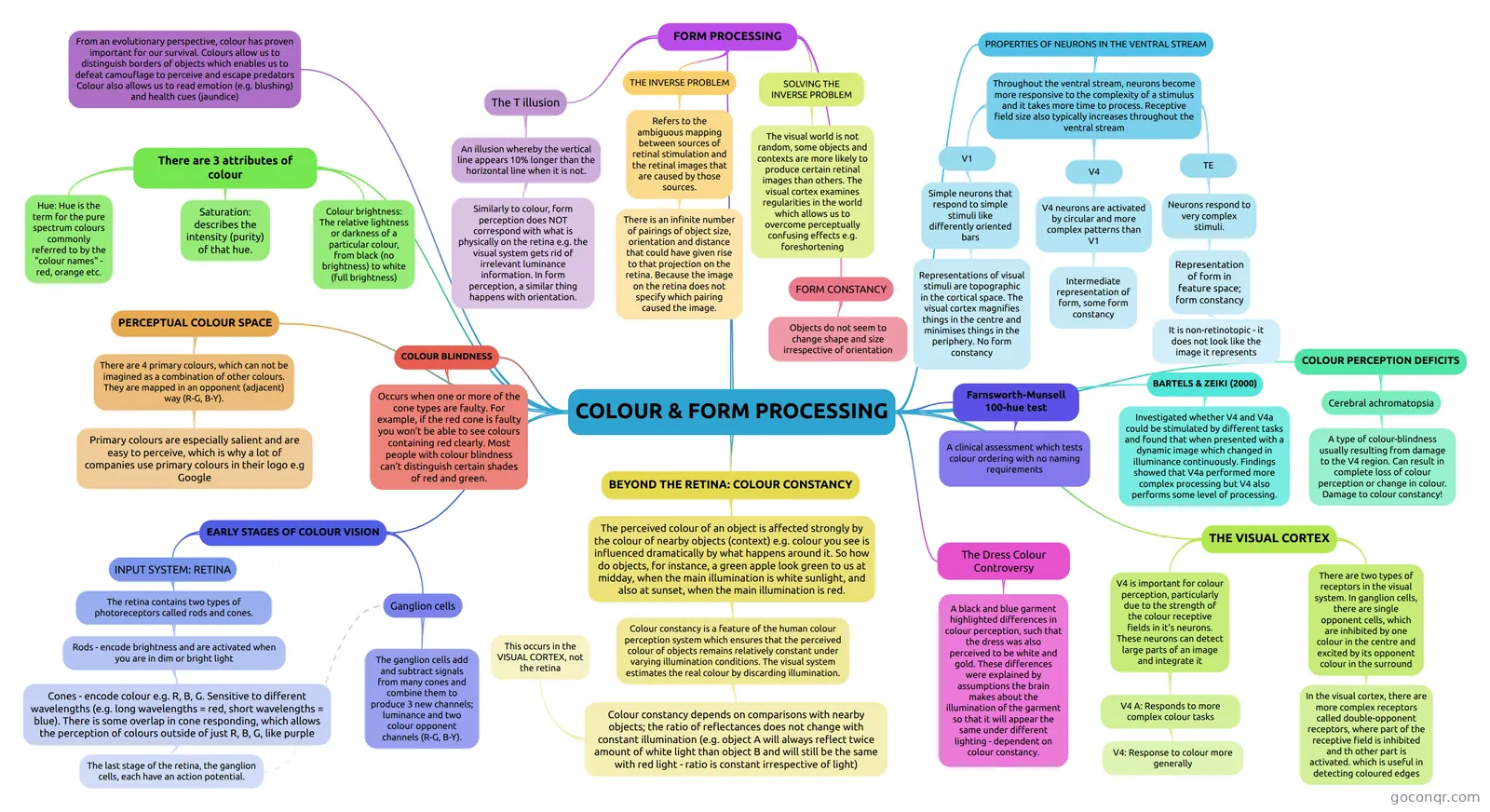
Mind map: Colour and form processing
Contenido del mapa
COLOUR & FORM PROCESSING
From an evolutionary perspective, colour has proven important for our survival. Colours allow us to distinguish borders of objects which enables us to defeat camouflage to perceive and escape predators Colour also allows us to read emotion (e.g. blushing) and health cues (jaundice)
There are 3 attributes of colour
- Hue: Hue is the term for the pure spectrum colours commonly referred to by the "colour names" - red, orange etc.
- Saturation: describes the intensity (purity) of that hue.
- Colour brightness: The relative lightness or darkness of a particular colour, from black (no brightness) to white (full brightness)
PERCEPTUAL COLOUR SPACE
- There are 4 primary colours, which can not be imagined as a combination of other colours. They are mapped in an opponent (adjacent) way (R-G, B-Y).
- Primary colours are especially salient and are easy to perceive, which is why a lot of companies use primary colours in their logo e.g Google
- There are 4 primary colours, which can not be imagined as a combination of other colours. They are mapped in an opponent (adjacent) way (R-G, B-Y).
EARLY STAGES OF COLOUR VISION
- INPUT SYSTEM: RETINA
- The retina contains two types of photoreceptors called rods and cones.
- Rods - encode brightness and are activated when you are in dim or bright light
- Cones - encode colour e.g. R, B, G. Sensitive to different wavelengths (e.g. long wavelengths = red, short wavelengths = blue). There is some overlap in cone responding, which allows the perception of colours outside of just R, B, G, like purple
- The last stage of the retina, the ganglion cells, each have an action potential.
- Cones - encode colour e.g. R, B, G. Sensitive to different wavelengths (e.g. long wavelengths = red, short wavelengths = blue). There is some overlap in cone responding, which allows the perception of colours outside of just R, B, G, like purple
- Rods - encode brightness and are activated when you are in dim or bright light
- The retina contains two types of photoreceptors called rods and cones.
- Ganglion cells
- The ganglion cells add and subtract signals from many cones and combine them to produce 3 new channels; luminance and two colour opponent channels (R-G, B-Y).
- INPUT SYSTEM: RETINA
COLOUR BLINDNESS
- Occurs when one or more of the cone types are faulty. For example, if the red cone is faulty you won’t be able to see colours containing red clearly. Most people with colour blindness can’t distinguish certain shades of red and green.
BEYOND THE RETINA: COLOUR CONSTANCY
- The perceived colour of an object is affected strongly by the colour of nearby objects (context) e.g. colour you see is influenced dramatically by what happens around it. So how do objects, for instance, a green apple look green to us at midday, when the main illumination is white sunlight, and also at sunset, when the main illumination is red.
- Colour constancy is a feature of the human colour perception system which ensures that the perceived colour of objects remains relatively constant under varying illumination conditions. The visual system estimates the real colour by discarding illumination.
- Colour constancy depends on comparisons with nearby objects; the ratio of reflectances does not change with constant illumination (e.g. object A will always reflect twice amount of white light than object B and will still be the same with red light - ratio is constant irrespective of light)
- This occurs in the VISUAL CORTEX, not the retina
- Colour constancy depends on comparisons with nearby objects; the ratio of reflectances does not change with constant illumination (e.g. object A will always reflect twice amount of white light than object B and will still be the same with red light - ratio is constant irrespective of light)
- Colour constancy is a feature of the human colour perception system which ensures that the perceived colour of objects remains relatively constant under varying illumination conditions. The visual system estimates the real colour by discarding illumination.
- The perceived colour of an object is affected strongly by the colour of nearby objects (context) e.g. colour you see is influenced dramatically by what happens around it. So how do objects, for instance, a green apple look green to us at midday, when the main illumination is white sunlight, and also at sunset, when the main illumination is red.
The Dress Colour Controversy
- A black and blue garment highlighted differences in colour perception, such that the dress was also perceived to be white and gold. These differences were explained by assumptions the brain makes about the illumination of the garment so that it will appear the same under different lighting - dependent on colour constancy.
THE VISUAL CORTEX
- V4 is important for colour perception, particularly due to the strength of the colour receptive fields in it's neurons. These neurons can detect large parts of an image and integrate it
- V4 A: Responds to more complex colour tasks
- V4: Response to colour more generally
- V4 A: Responds to more complex colour tasks
- There are two types of receptors in the visual system. In ganglion cells, there are single opponent cells, which are inhibited by one colour in the centre and excited by its opponent colour in the surround
- In the visual cortex, there are more complex receptors called double-opponent receptors, where part of the receptive field is inhibited and th other part is activated. which is useful in detecting coloured edges
- V4 is important for colour perception, particularly due to the strength of the colour receptive fields in it's neurons. These neurons can detect large parts of an image and integrate it
BARTELS & ZEIKI (2000)
- Investigated whether V4 and V4a could be stimulated by different tasks and found that when presented with a dynamic image which changed in illuminance continuously. Findings showed that V4a performed more complex processing but V4 also performs some level of processing.
COLOUR PERCEPTION DEFICITS
- Cerebral achromatopsia
- A type of colour-blindness usually resulting from damage to the V4 region. Can result in complete loss of colour perception or change in colour. Damage to colour constancy!
- Cerebral achromatopsia
Farnsworth-Munsell 100-hue test
- A clinical assessment which tests colour ordering with no naming requirements
FORM PROCESSING
- The T illusion
- An illusion whereby the vertical line appears 10% longer than the horizontal line when it is not.
- Similarly to colour, form perception does NOT correspond with what is physically on the retina e.g. the visual system gets rid of irrelevant luminance information. In form perception, a similar thing happens with orientation.
- An illusion whereby the vertical line appears 10% longer than the horizontal line when it is not.
- THE INVERSE PROBLEM
- Refers to the ambiguous mapping between sources of retinal stimulation and the retinal images that are caused by those sources.
- There is an infinite number of pairings of object size, orientation and distance that could have given rise to that projection on the retina. Because the image on the retina does not specify which pairing caused the image.
- Refers to the ambiguous mapping between sources of retinal stimulation and the retinal images that are caused by those sources.
- SOLVING THE INVERSE PROBLEM
- The visual world is not random, some objects and contexts are more likely to produce certain retinal images than others. The visual cortex examines regularities in the world which allows us to overcome perceptually confusing effects e.g. foreshortening
- FORM CONSTANCY
- Objects do not seem to change shape and size irrespective of orientation
- The T illusion
PROPERTIES OF NEURONS IN THE VENTRAL STREAM
- Throughout the ventral stream, neurons become more responsive to the complexity of a stimulus and it takes more time to process. Receptive field size also typically increases throughout the ventral stream
- V1
- Simple neurons that respond to simple stimuli like differently oriented bars
- Representations of visual stimuli are topographic in the cortical space. The visual cortex magnifies things in the centre and minimises things in the periphery. No form constancy
- Simple neurons that respond to simple stimuli like differently oriented bars
- V4
- V4 neurons are activated by circular and more complex patterns than V1
- Intermediate representation of form, some form constancy
- V4 neurons are activated by circular and more complex patterns than V1
- TE
- Neurons respond to very complex stimuli.
- Representation of form in feature space; form constancy
- It is non-retinotopic - it does not look like the image it represents
- Representation of form in feature space; form constancy
- Neurons respond to very complex stimuli.
- V1
- Throughout the ventral stream, neurons become more responsive to the complexity of a stimulus and it takes more time to process. Receptive field size also typically increases throughout the ventral stream
Información
- Descripción
- Mapa Mental sobre COLOUR & FORM PROCESSING, creado por seasider 01 el 13/05/2019.
- Creado por
- seasider 01
- Visitas
- 0
- Valoración