
Mapa mental
PSYA1: Memory
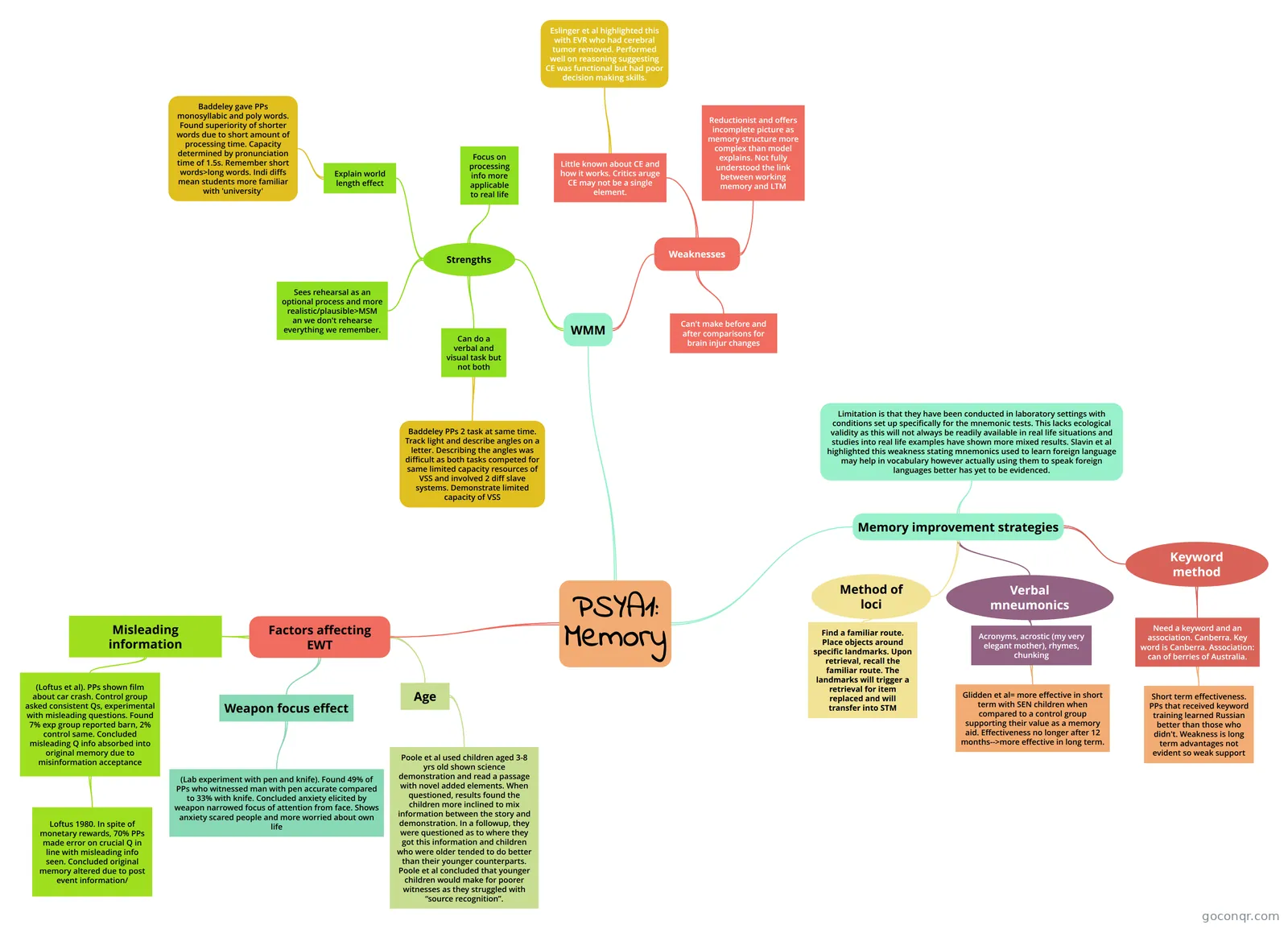
Mind map: PSYA1 memory
Contenido del mapa
PSYA1: Memory
WMM
- Strengths
- Can do a verbal and visual task but not both
- Baddeley PPs 2 task at same time. Track light and describe angles on a letter. Describing the angles was difficult as both tasks competed for same limited capacity resources of VSS and involved 2 diff slave systems. Demonstrate limited capacity of VSS
- Sees rehearsal as an optional process and more realistic/plausible>MSM an we don't rehearse everything we remember.
- Explain world length effect
- Baddeley gave PPs monosyllabic and poly words. Found superiority of shorter words due to short amount of processing time. Capacity determined by pronunciation time of 1.5s. Remember short words>long words. Indi diffs mean students more familiar with 'university'
- Focus on processing info more applicable to real life
- Can do a verbal and visual task but not both
- Weaknesses
- Little known about CE and how it works. Critics aruge CE may not be a single element.
- Eslinger et al highlighted this with EVR who had cerebral tumor removed. Performed well on reasoning suggesting CE was functional but had poor decision making skills.
- Reductionist and offers incomplete picture as memory structure more complex than model explains. Not fully understood the link between working memory and LTM
- Can't make before and after comparisons for brain injur changes
- Little known about CE and how it works. Critics aruge CE may not be a single element.
- Strengths
Memory improvement strategies
- Method of loci
- Find a familiar route. Place objects around specific landmarks. Upon retrieval, recall the familiar route. The landmarks will trigger a retrieval for item replaced and will transfer into STM
- Verbal mneumonics
- Acronyms, acrostic (my very elegant mother), rhymes, chunking
- Glidden et al= more effective in short term with SEN children when compared to a control group supporting their value as a memory aid. Effectiveness no longer after 12 months-->more effective in long term.
- Acronyms, acrostic (my very elegant mother), rhymes, chunking
- Keyword method
- Need a keyword and an association. Canberra. Key word is Canberra. Association: can of berries of Australia.
- Short term effectiveness. PPs that received keyword training learned Russian better than those who didn't. Weakness is long term advantages not evident so weak support
- Need a keyword and an association. Canberra. Key word is Canberra. Association: can of berries of Australia.
- Limitation is that they have been conducted in laboratory settings with conditions set up specifically for the mnemonic tests. This lacks ecological validity as this will not always be readily available in real life situations and studies into real life examples have shown more mixed results. Slavin et al highlighted this weakness stating mnemonics used to learn foreign language may help in vocabulary however actually using them to speak foreign languages better has yet to be evidenced.
- Method of loci
Factors affecting EWT
- Age
- Poole et al used children aged 3-8 yrs old shown science demonstration and read a passage with novel added elements. When questioned, results found the children more inclined to mix information between the story and demonstration. In a followup, they were questioned as to where they got this information and children who were older tended to do better than their younger counterparts. Poole et al concluded that younger children would make for poorer witnesses as they struggled with “source recognition”.
- Weapon focus effect
- (Lab experiment with pen and knife). Found 49% of PPs who witnessed man with pen accurate compared to 33% with knife. Concluded anxiety elicited by weapon narrowed focus of attention from face. Shows anxiety scared people and more worried about own life
- Misleading information
- (Loftus et al). PPs shown film about car crash. Control group asked consistent Qs, experimental with misleading questions. Found 7% exp group reported barn, 2% control same. Concluded misleading Q info absorbed into original memory due to misinformation acceptance
- Loftus 1980. In spite of monetary rewards, 70% PPs made error on crucial Q in line with misleading info seen. Concluded original memory altered due to post event information/
- (Loftus et al). PPs shown film about car crash. Control group asked consistent Qs, experimental with misleading questions. Found 7% exp group reported barn, 2% control same. Concluded misleading Q info absorbed into original memory due to misinformation acceptance
- Age
Información
- Descripción
- Mapa Mental sobre PSYA1: Memory, creado por Sami Raza el 23/12/2014.
- Creado por
- Sami Raza
- Visitas
- 17
- Valoración