
Mapa mental
Religious Language
Contenido del mapa
Religious Language
Cognitive Language
- When we speak about God cognitively, our statement is either true or false and it properly describes God.
- Univocal: The words we use mean exactly the same to God as when we use them for humans.
- E.g. God loves me, my boyfriend loves me.
- Equivocal: The words we use mean different things when applied to God.
- E.g. God loves me, my hamster loves me.
Non-cognitive Language
- Statements about God are not based on a true or false principle but include moral or emotive language.
Logical Postivism
- Scientific knowledge and logical intelligence is the only factual knowledge.
- Moritz Schlick created logical positivism and was a member of the Vienna Circle.
- The philosophers of the Vienna Circle noticed that scientists became really focused within their studies and so they decided to apply this to philosophy - i.e. not worrying about philosophical language.
- 1920's in Vienna.
- The Vienna Circle came up the with Verification Principle.
The Verification Principle
- The Weak Verification Principle
- A.J.Ayer saw problems presented by historlcal and scientific statements and so created the Weak Verification Principle.
- Ayer accepts S.A.M but didn't deny the claim that statements like 'God answers my prayers' have meaning, they simply don't have factual significance and they are unverificable.
- Things can be possibly true, you just have to go find evidence that put them beyond reasonable doubt; its about provability.
- The weak verification principle is itself unverifiable and it is not a tautology and no evidence can show its truth.
- "falls on its own sword".
- "God can verify his own existence" - Keith Ward.
- Eschatological Verification (verified in death). John Hick's allegory of the Celestial City explains that, if two men (one beliver and one non-believer) walk down two paths parallel to each other but with the same destination, in death is when we can verify God's existence. However only the beliber will have his beliefs verified because the non-believer believes that there is nothing to be verified.
- A principle for ruling out all metaphysical studies on the basis that they are 'meaningless'.
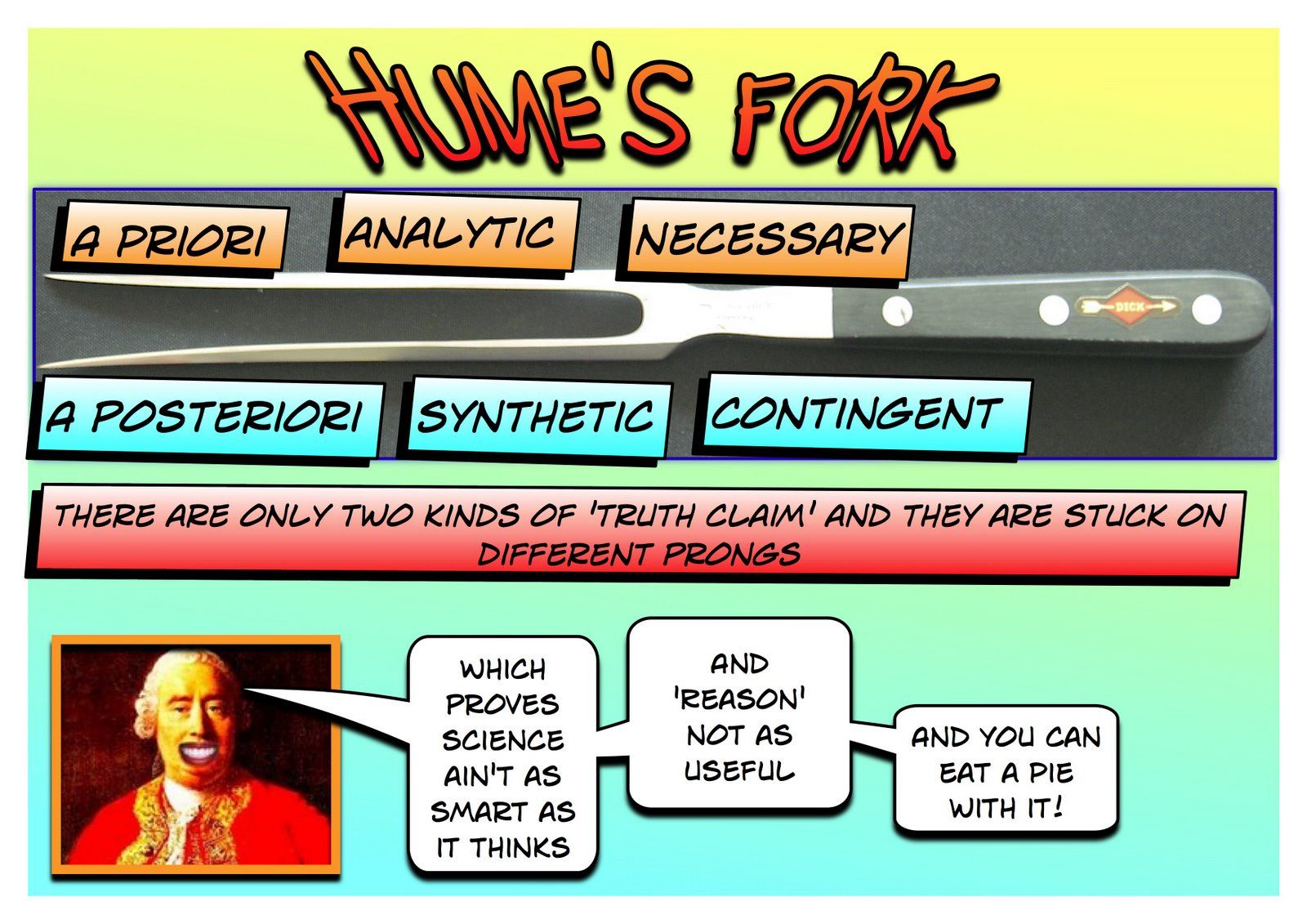
- Adds to Hume's Fork
- Religious language has to fit into S.A.M in order for it to be meaningful.
- Synthetic: A posteriori statements that can be verified or falsified and so all statements are meaningless unless they are impossible to verify.
- Analytic: A prior statements as they have their definition within them.
- Mathematic: A.J.Ayer observed that apparent inconsistences in mathematical calculations are down to human error as all mathematical statements are meaningful.
- The verification principle is too rigid as it excludes the majority of human language on the premise that it is 'meaningless'.
- The verification principle would regard historical statements as meaningless; this is a major flaw as our societies' principles rely on events of the past.
- Causes ethics to fail as ethical statements cannot be proved meaningful through S.A.M.
- Love is regarded meaningless.
- The Weak Verification Principle
Falsification Principle
- Anthony Flew
- Wisdom's Gardener Parable illustrates that people stick to their beliefs in spite to there being evidence of the contrary.
- Influenced by Karl Popper who argued that science was based on falsification.
- "We can't understand God's love for us. It is incomprehensible".
- Argues that if statements about God can be made to fit into any circumstance, then religious believers move the goal posts to re-qualify the previous statement.
- If believers statements about God can be made to fit into any circumstances then the God they describe has..
- "died the death of a thousand qualifications".
- Statements can become synthetic if you say how a statement can be falsified.
- A statement can only be regarded as meaningful if something can be pointed to that will falsify the statement should it actually occur.
- R.M.Hare argues that a statement can still hold meaning even if it can't be falsified because the meaning can change a persons life.
- Basil Mitchel argues that a person will make a statement as meaningful of trust, therefore prior faith maintains that trust even if evidence tries to undermine it.
- Richard Swinburne argues that statements can still be meaningful without there being a way to falsify them.
- Anthony Flew
Via Negativa
- The Principle of Negation - by ruling out what he is not, we will discover what he is.
- Supporters claim human language is unable to describe God so by using this principle, we avoid the problems that arise from tying to.
- "By denying all description of God, you get insight and experience of God" - Peter Cole in 'Philosophy of Religion'.
- When language is applied to God is it equivocal.
- Plotinus had early ideas about the via negative; he disagreed with the Gnostics who an understanding of God could be obtained through secret knowledge; God's goodness is separate to the world and unknowable.
- Pseudo-Dionysius was a Christian supporter of the via negative; he argued that God is 'beyond assertion (description)' and said that we can only make negative statements about God because positive statements anthropomorphise God.
- Moses Maimonides was a Jewish supporter of the via negative and said in 'Guide for the perplexed' that making positive statements about God anthropomorphises God and this is disrestpectful; there is only one positive statement that can be made about God: God exists.
- Only the via negative adequately conveys the transcendence of God.
- It is not a true reflection of how religious people talk about God. They do not talk in the negative but rather seek positive knowledge of what God is.
Analogy
- Non-cognitive approach that all religious language is an useful analogy.
- Analogy of Attribution
- The qualities we ascribe to one another reflect God's qualities.
- To use human attributes such as wisdom, goodness, love etc do have meaning because when we see these attributes in others, we are able to make analogies with the attributes of God as he was the creator.
- Analogy of Proportion
- Meanings change in proportion to the nature of the being that is described.
- 'God is faithful' is only meaningful when you aren't using it literally but proportionally.
- Hick
- The incarnation of God in Jesus shows us God's attitudes and character so human attributes used in analogies must work.
- Analogy enables us to make some statements about God and still preserve the important mystery present in Judaeo-Christian thinking.
- Gives value to religious language and provides some understanding of God.
- Duns Scotus (13th Century): Analogy is too vague.
- Aquinas rejects the literal meaning of words applied to God, does this disregard half the descriptions in the Bible?
- Swinburne counters this by arguing that sometimes words can be used univocally for God.
Non-cognitive Language Game Theory
- Wittgenstein argues we cannot understand language without understanding the ways in which language is used and how it interacts with how we live and what we do.
- Meaning is learned from the rules governing the use of the word.
- There is a distinction between surface grammer and depth grammer: words or sentences in one context describing objects or an event may be similar on the surface to ones that in another context do nothing of the sort.
- Wittgenstein says that a language game is the speaking part of a 'form of life'. A form of life is far broader than any specific language game; it is the foundation out which language games grow.
- Religious language contains many different language games and can be considered that its forming a game in its own right - displayed in the analysis of its depth grammer.
- Wittgenstein argues that the statement 'God exists' is not a statement of fact, but it is a belief and a way of life.
- "A religious belief could only be something like a passionate commitment to system of reference".
- If we look at how the statement is used, what it expresses for people who believe it, we can see that it is not used as a description, but to express a form of commitment.
- To understand religious language is to understand the place of certain statements and the nature of religious belief shows that these statements are not factual.
- Strenght
- The non-cognitive language game theory protects religious language as it argues that it has meaning. Religious beliefs cannot be criticised on the grounds that they are not true because this suggests that religious language is factual - which it isn't!
- Weakness
- The non-cognitive approach cuts religion off very harshly as it makes us look out of touch with our most trusted methods for establishing truth and meaning. Many religious people argue that propositions such as 'God exists' can be shown to be factual.
Symbolism
- Religious statements do not give us literal, true facts about God, however they are symbolic and are cognitive statements which provide us with some degree of understanding of God.
- Religious language is symbolic, not part of our empirical world.
- Analogy is closer to literal meaning whereas symbols seem more able to express different meanings.
- Symbols unlock "hidden depths of our own being".
- Symbols cannot be made up randomly or invented; instead they grow out of the individual or the collective conscious.
- There is a difference between signs (directs us to that which it points) and symbols (participates in that which it points).
- Tillich argues that any attempt to describe God by means of concepts will be inadequate "God is love", God is beyond description and ineffable.
- Symbols have a limited lifespan as they can grow in power and meaning but yet they can also die out.
- Many thinkers suggest that it is unclear as to what Tillich means in suggesting that symbols participate in that to which they point. How does a flag convey the strength and power of a nation? Would burning it weaken the nation?
- Tillich's ideas can be seen as a little vague. J.H.Randall Jr argued that we aren't able to gain pure knowledge about God because he is transcendant.
- According to Tillich, everything participates in 'being-itself', it is difficult to see how he can argue that symbols participate in a special way.
- Tillich's idea that a symbol unlocks something within our soul works a lot better in his example of the arts; he is presupposing a link between the aesthetic and the religious.
- Supporters of Tillich's account argue that it is only by taking a symbolic view of religious statements that's the transcendence of God and the mystery of his essense can ultimately be preserved.
Myth
- Rudolf Bultmann
- Describes myth as the use of imagery from the physical world to discuss and communicate information about the metaphysical.
- We need to 'demythologize' myth - taking out the 'mythical' elements in order to arrive at the true meaning of Christianity.
- Some scholars reject his ideas by saying that the supernatural elements aren't just later additions, they are what happens and give the meaning to the stories.
- Christianity rests on the assumption that the resurrection occurred and if the resurrection is no more that a symbolic story used to show God's power, then where does religion stand?
- Comes from an anti-realist stance arguing that taking a myth literally can be disproved by science, however it is the message that is important.
- David Jenkins
- Agreed with Bultmann and held an anti-realist stance.
- The resurrection was...
- "more that just a conjuring trick with bones"
- ...implying that in actual fact the resurrection is a myth with a deeper meaning.
- "more that just a conjuring trick with bones"
- Nothing is physical, everything is metaphysical.
- He was banned from the Church because it implies that Jesus is not the Son of God, he was merely an ordinary man.
- Armstrong
- Originally a nun.
- Myth is not a factual event.
- "Mythology is not an early attempt at history and does not claim its facts are objective facts".
- Acts as a guide to help us develop our lives at a deeper level of meaning.
- Humans have two parts the logos (our logical, scientific and pragmatic self which came about in the stone age to help us hunt) and myth (our spiritual self).
- For myth to be properly understood it needs rituals, hence why it is a guide.
- In all cultures myths include flight and ascent and this expresses a universal desire of transcendence and liberation from the human condition is not to be taken literally.
- Does this mean Jesus ascending to heaven is not to be taken literally?
- Weaknesses
- Trivializes religion.
- It is difficult to distinguish between truth and fact. How do we know how and what to demythologise?
- It is anachronistic, belongs to a pre-scientific age which we cannot relate to.
- Stengths
- Can convey a meaning which can be conveyed in no other manner.
- According to Armstrong, without myth you lose a key part of yourself - it is not a holistic approach to life.
- Provides commentary for discussing the metaphysical world alongside the physical.
- Rudolf Bultmann
Imágenes y archivos del mapa
Información
- Descripción
- A-level Philosophy A2 Mapa Mental sobre Religious Language, creado por hollyhocks18 el 02/01/2015.
- Creado por
- hollyhocks18
- Visitas
- 5
- Valoración