
Mapa mental
EVOLUTION IN FOSSIL RECORD
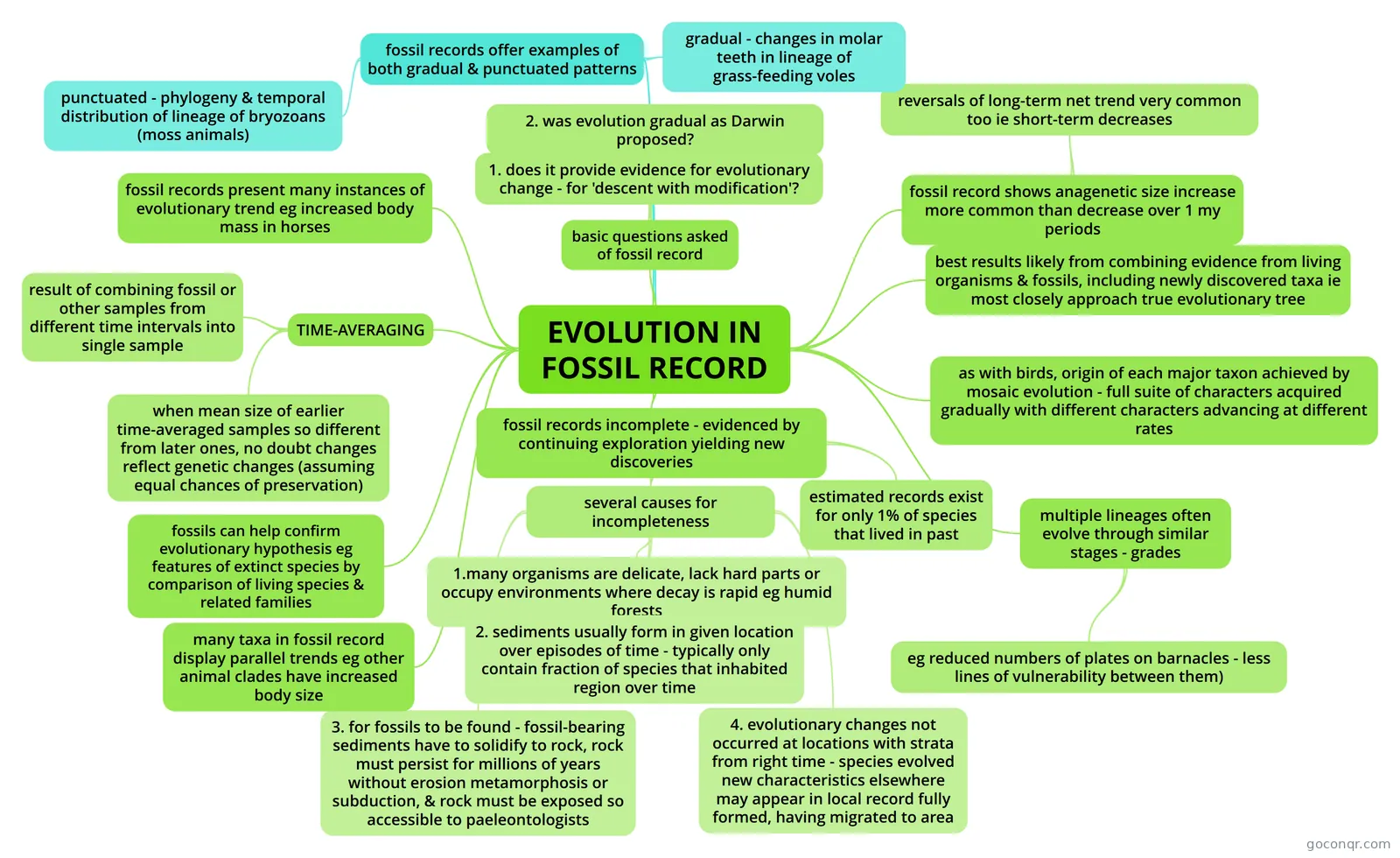
Mind map: evolution in fossil record
Contenido del mapa
EVOLUTION IN FOSSIL RECORD
fossil records incomplete - evidenced by continuing exploration yielding new discoveries
- several causes for incompleteness
- 1.many organisms are delicate, lack hard parts or occupy environments where decay is rapid eg humid forests
- 2. sediments usually form in given location over episodes of time - typically only contain fraction of species that inhabited region over time
- 3. for fossils to be found - fossil-bearing sediments have to solidify to rock, rock must persist for millions of years without erosion metamorphosis or subduction, & rock must be exposed so accessible to paeleontologists
- 4. evolutionary changes not occurred at locations with strata from right time - species evolved new characteristics elsewhere may appear in local record fully formed, having migrated to area
- estimated records exist for only 1% of species that lived in past
- several causes for incompleteness
basic questions asked of fossil record
- 1. does it provide evidence for evolutionary change - for 'descent with modification'?
- 2. was evolution gradual as Darwin proposed?
as with birds, origin of each major taxon achieved by mosaic evolution - full suite of characters acquired gradually with different characters advancing at different rates
best results likely from combining evidence from living organisms & fossils, including newly discovered taxa ie most closely approach true evolutionary tree
fossils can help confirm evolutionary hypothesis eg features of extinct species by comparison of living species & related families
fossil records present many instances of evolutionary trend eg increased body mass in horses
many taxa in fossil record display parallel trends eg other animal clades have increased body size
multiple lineages often evolve through similar stages - grades
- eg reduced numbers of plates on barnacles - less lines of vulnerability between them)
fossil record shows anagenetic size increase more common than decrease over 1 my periods
- reversals of long-term net trend very common too ie short-term decreases
TIME-AVERAGING
- result of combining fossil or other samples from different time intervals into single sample
- when mean size of earlier time-averaged samples so different from later ones, no doubt changes reflect genetic changes (assuming equal chances of preservation)
fossil records offer examples of both gradual & punctuated patterns
- punctuated - phylogeny & temporal distribution of lineage of bryozoans (moss animals)
- gradual - changes in molar teeth in lineage of grass-feeding voles
Información
- Descripción
- Mapa Mental sobre EVOLUTION IN FOSSIL RECORD, creado por tomking304 el 01/09/2013.
- Creado por
- tomking304
- Visitas
- 57
- Valoración
Más sobre Evidence for Evolution