
Mapa mental
Identifications
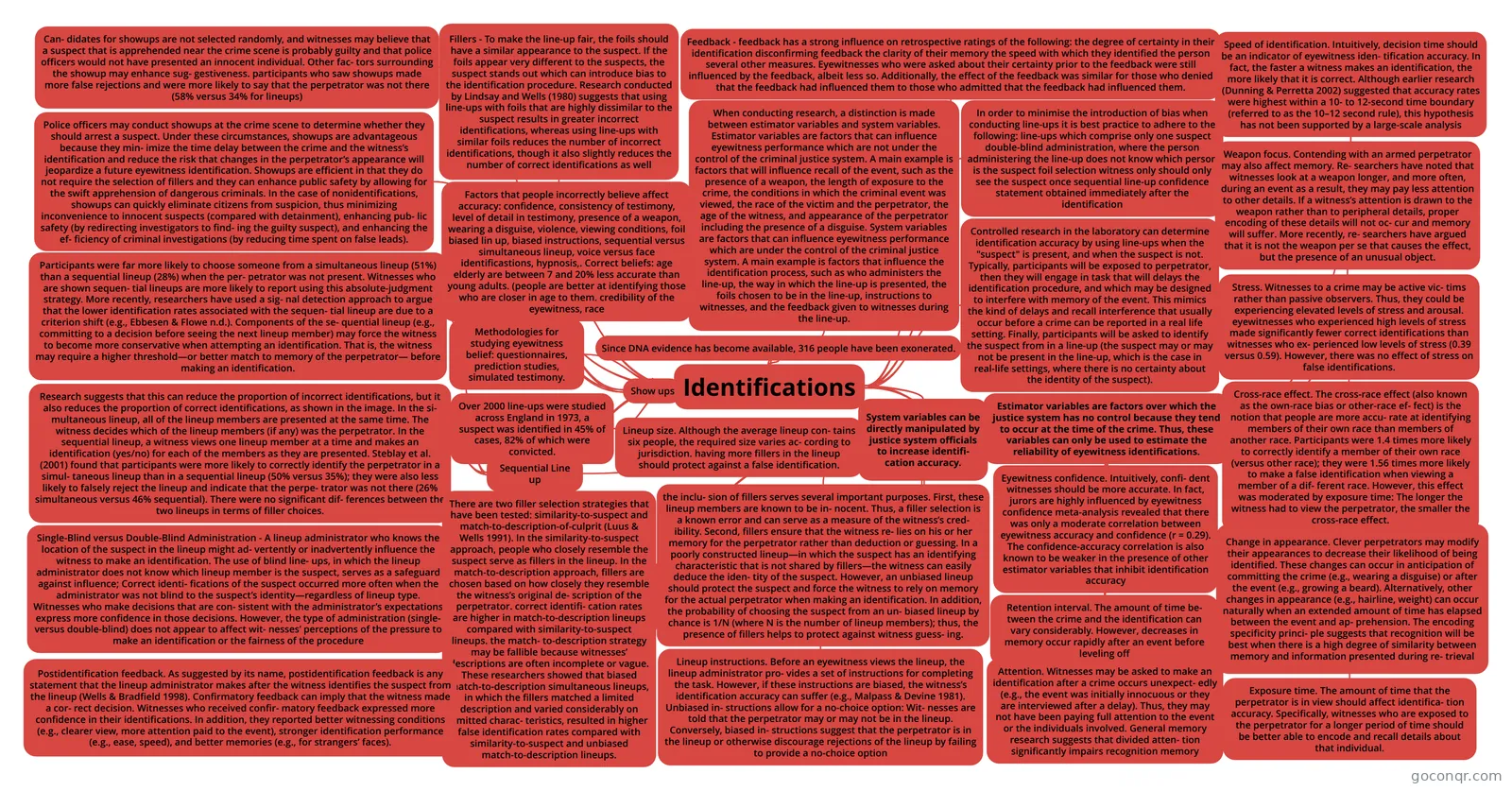
Mind map: eyewitness identifications
Contenido del mapa
Identifications
Since DNA evidence has become available, 316 people have been exonerated.
Controlled research in the laboratory can determine identification accuracy by using line-ups when the "suspect" is present, and when the suspect is not. Typically, participants will be exposed to perpetrator, then they will engage in task that will delays the identification procedure, and which may be designed to interfere with memory of the event. This mimics the kind of delays and recall interference that usually occur before a crime can be reported in a real life setting. Finally, participants will be asked to identify the suspect from in a line-up (the suspect may or may not be present in the line-up, which is the case in real-life settings, where there is no certainty about the identity of the suspect).
When conducting research, a distinction is made between estimator variables and system variables. Estimator variables are factors that can influence eyewitness performance which are not under the control of the criminal justice system. A main example is factors that will influence recall of the event, such as the presence of a weapon, the length of exposure to the crime, the conditions in which the criminal event was viewed, the race of the victim and the perpetrator, the age of the witness, and appearance of the perpetrator including the presence of a disguise. System variables are factors that can influence eyewitness performance which are under the control of the criminal justice system. A main example is factors that influence the identification process, such as who administers the line-up, the way in which the line-up is presented, the foils chosen to be in the line-up, instructions to witnesses, and the feedback given to witnesses during the line-up.
In order to minimise the introduction of bias when conducting line-ups it is best practice to adhere to the following: line-ups which comprise only one suspect double-blind administration, where the person administering the line-up does not know which person is the suspect foil selection witness only should only see the suspect once sequential line-up confidence statement obtained immediately after the identification
Fillers - To make the line-up fair, the foils should have a similar appearance to the suspect. If the foils appear very different to the suspects, the suspect stands out which can introduce bias to the identification procedure. Research conducted by Lindsay and Wells (1980) suggests that using line-ups with foils that are highly dissimilar to the suspect results in greater incorrect identifications, whereas using line-ups with similar foils reduces the number of incorrect identifications, though it also slightly reduces the number of correct identifications as well
Single-Blind versus Double-Blind Administration - A lineup administrator who knows the location of the suspect in the lineup might ad- vertently or inadvertently influence the witness to make an identification. The use of blind line- ups, in which the lineup administrator does not know which lineup member is the suspect, serves as a safeguard against influence; Correct identi- fications of the suspect occurred more often when the administrator was not blind to the suspect’s identity—regardless of lineup type. Witnesses who make decisions that are con- sistent with the administrator’s expectations express more confidence in those decisions. However, the type of administration (single- versus double-blind) does not appear to affect wit- nesses’ perceptions of the pressure to make an identification or the fairness of the procedure
Feedback - feedback has a strong influence on retrospective ratings of the following: the degree of certainty in their identification disconfirming feedback the clarity of their memory the speed with which they identified the person several other measures. Eyewitnesses who were asked about their certainty prior to the feedback were still influenced by the feedback, albeit less so. Additionally, the effect of the feedback was similar for those who denied that the feedback had influenced them to those who admitted that the feedback had influenced them.
Estimator variables are factors over which the justice system has no control because they tend to occur at the time of the crime. Thus, these variables can only be used to estimate the reliability of eyewitness identifications.
- Exposure time. The amount of time that the perpetrator is in view should affect identifica- tion accuracy. Specifically, witnesses who are exposed to the perpetrator for a longer period of time should be better able to encode and recall details about that individual.
- Change in appearance. Clever perpetrators may modify their appearances to decrease their likelihood of being identified. These changes can occur in anticipation of committing the crime (e.g., wearing a disguise) or after the event (e.g., growing a beard). Alternatively, other changes in appearance (e.g., hairline, weight) can occur naturally when an extended amount of time has elapsed between the event and ap- prehension. The encoding specificity princi- ple suggests that recognition will be best when there is a high degree of similarity between memory and information presented during re- trieval
- Cross-race effect. The cross-race effect (also known as the own-race bias or other-race ef- fect) is the notion that people are more accu- rate at identifying members of their own race than members of another race. Participants were 1.4 times more likely to correctly identify a member of their own race (versus other race); they were 1.56 times more likely to make a false identification when viewing a member of a dif- ferent race. However, this effect was moderated by exposure time: The longer the witness had to view the perpetrator, the smaller the cross-race effect.
- Attention. Witnesses may be asked to make an identification after a crime occurs unexpect- edly (e.g., the event was initially innocuous or they are interviewed after a delay). Thus, they may not have been paying full attention to the event or the individuals involved. General memory research suggests that divided atten- tion significantly impairs recognition memory
- Retention interval. The amount of time be- tween the crime and the identification can vary considerably. However, decreases in memory occur rapidly after an event before leveling off
- Eyewitness confidence. Intuitively, confi- dent witnesses should be more accurate. In fact, jurors are highly influenced by eyewitness confidence meta-analysis revealed that there was only a moderate correlation between eyewitness accuracy and confidence (r = 0.29). The confidence-accuracy correlation is also known to be weaker in the presence of other estimator variables that inhibit identification accuracy
- Stress. Witnesses to a crime may be active vic- tims rather than passive observers. Thus, they could be experiencing elevated levels of stress and arousal. eyewitnesses who experienced high levels of stress made significantly fewer correct identifications than witnesses who ex- perienced low levels of stress (0.39 versus 0.59). However, there was no effect of stress on false identifications.
- Weapon focus. Contending with an armed perpetrator may also affect memory. Re- searchers have noted that witnesses look at a weapon longer, and more often, during an event as a result, they may pay less attention to other details. If a witness’s attention is drawn to the weapon rather than to peripheral details, proper encoding of these details will not oc- cur and memory will suffer. More recently, re- searchers have argued that it is not the weapon per se that causes the effect, but the presence of an unusual object.
- Speed of identification. Intuitively, decision time should be an indicator of eyewitness iden- tification accuracy. In fact, the faster a witness makes an identification, the more likely that it is correct. Although earlier research (Dunning & Perretta 2002) suggested that accuracy rates were highest within a 10- to 12-second time boundary (referred to as the 10–12 second rule), this hypothesis has not been supported by a large-scale analysis
System variables can be directly manipulated by justice system officials to increase identifi- cation accuracy.
- Sequential Line up
- Research suggests that this can reduce the proportion of incorrect identifications, but it also reduces the proportion of correct identifications, as shown in the image. In the si- multaneous lineup, all of the lineup members are presented at the same time. The witness decides which of the lineup members (if any) was the perpetrator. In the sequential lineup, a witness views one lineup member at a time and makes an identification (yes/no) for each of the members as they are presented. Steblay et al. (2001) found that participants were more likely to correctly identify the perpetrator in a simul- taneous lineup than in a sequential lineup (50% versus 35%); they were also less likely to falsely reject the lineup and indicate that the perpe- trator was not there (26% simultaneous versus 46% sequential). There were no significant dif- ferences between the two lineups in terms of filler choices.
- Participants were far more likely to choose someone from a simultaneous lineup (51%) than a sequential lineup (28%) when the per- petrator was not present. Witnesses who are shown sequen- tial lineups are more likely to report using this absolute-judgment strategy. More recently, researchers have used a sig- nal detection approach to argue that the lower identification rates associated with the sequen- tial lineup are due to a criterion shift (e.g., Ebbesen & Flowe n.d.). Components of the se- quential lineup (e.g., committing to a decision before seeing the next lineup member) may force the witness to become more conservative when attempting an identification. That is, the witness may require a higher threshold—or better match to memory of the perpetrator— before making an identification.
- Lineup instructions. Before an eyewitness views the lineup, the lineup administrator pro- vides a set of instructions for completing the task. However, if these instructions are biased, the witness’s identification accuracy can suffer (e.g., Malpass & Devine 1981). Unbiased in- structions allow for a no-choice option: Wit- nesses are told that the perpetrator may or may not be in the lineup. Conversely, biased in- structions suggest that the perpetrator is in the lineup or otherwise discourage rejections of the lineup by failing to provide a no-choice option
- the inclu- sion of fillers serves several important purposes. First, these lineup members are known to be in- nocent. Thus, a filler selection is a known error and can serve as a measure of the witness’s cred- ibility. Second, fillers ensure that the witness re- lies on his or her memory for the perpetrator rather than deduction or guessing. In a poorly constructed lineup—in which the suspect has an identifying characteristic that is not shared by fillers—the witness can easily deduce the iden- tity of the suspect. However, an unbiased lineup should protect the suspect and force the witness to rely on memory for the actual perpetrator when making an identification. In addition, the probability of choosing the suspect from an un- biased lineup by chance is 1/N (where N is the number of lineup members); thus, the presence of fillers helps to protect against witness guess- ing.
- There are two filler selection strategies that have been tested: similarity-to-suspect and match-to-description-of-culprit (Luus & Wells 1991). In the similarity-to-suspect approach, people who closely resemble the suspect serve as fillers in the lineup. In the match-to-description approach, fillers are chosen based on how closely they resemble the witness’s original de- scription of the perpetrator. correct identifi- cation rates are higher in match-to-description lineups compared with similarity-to-suspect lineups. the match- to-description strategy may be fallible because witnesses’ descriptions are often incomplete or vague. These researchers showed that biased match-to-description simultaneous lineups, in which the fillers matched a limited description and varied considerably on omitted charac- teristics, resulted in higher false identification rates compared with similarity-to-suspect and unbiased match-to-description lineups.
- Lineup size. Although the average lineup con- tains six people, the required size varies ac- cording to jurisdiction. having more fillers in the lineup should protect against a false identification.
- Postidentification feedback. As suggested by its name, postidentification feedback is any statement that the lineup administrator makes after the witness identifies the suspect from the lineup (Wells & Bradfield 1998). Confirmatory feedback can imply that the witness made a cor- rect decision. Witnesses who received confir- matory feedback expressed more confidence in their identifications. In addition, they reported better witnessing conditions (e.g., clearer view, more attention paid to the event), stronger identification performance (e.g., ease, speed), and better memories (e.g., for strangers’ faces).
- Sequential Line up
Show ups
- Police officers may conduct showups at the crime scene to determine whether they should arrest a suspect. Under these circumstances, showups are advantageous because they min- imize the time delay between the crime and the witness’s identification and reduce the risk that changes in the perpetrator’s appearance will jeopardize a future eyewitness identification. Showups are efficient in that they do not require the selection of fillers and they can enhance public safety by allowing for the swift apprehension of dangerous criminals. In the case of nonidentifications, showups can quickly eliminate citizens from suspicion, thus minimizing inconvenience to innocent suspects (compared with detainment), enhancing pub- lic safety (by redirecting investigators to find- ing the guilty suspect), and enhancing the ef- ficiency of criminal investigations (by reducing time spent on false leads).
- Can- didates for showups are not selected randomly, and witnesses may believe that a suspect that is apprehended near the crime scene is probably guilty and that police officers would not have presented an innocent individual. Other fac- tors surrounding the showup may enhance sug- gestiveness. participants who saw showups made more false rejections and were more likely to say that the perpetrator was not there (58% versus 34% for lineups)
Methodologies for studying eyewitness belief: questionnaires, prediction studies, simulated testimony.
Over 2000 line-ups were studied across England in 1973, a suspect was identified in 45% of cases, 82% of which were convicted.
Factors that people incorrectly believe affect accuracy: confidence, consistency of testimony, level of detail in testimony, presence of a weapon, wearing a disguise, violence, viewing conditions, foil biased lin up, biased instructions, sequential versus simultaneous lineup, voice versus face identificastions, hypnosis,. Correct beliefs: age elderly are between 7 and 20% less accurate than young adults. (people are better at identifying those who are closer in age to them. credibility of the eyewitness, race
Información
- Descripción
- Bachelor Policing Systems & Practice Mapa Mental sobre Identifications, creado por caramelcarl el 23/01/2015.
- Creado por
- caramelcarl
- Visitas
- 0
- Valoración