
Mapa mental
Patents
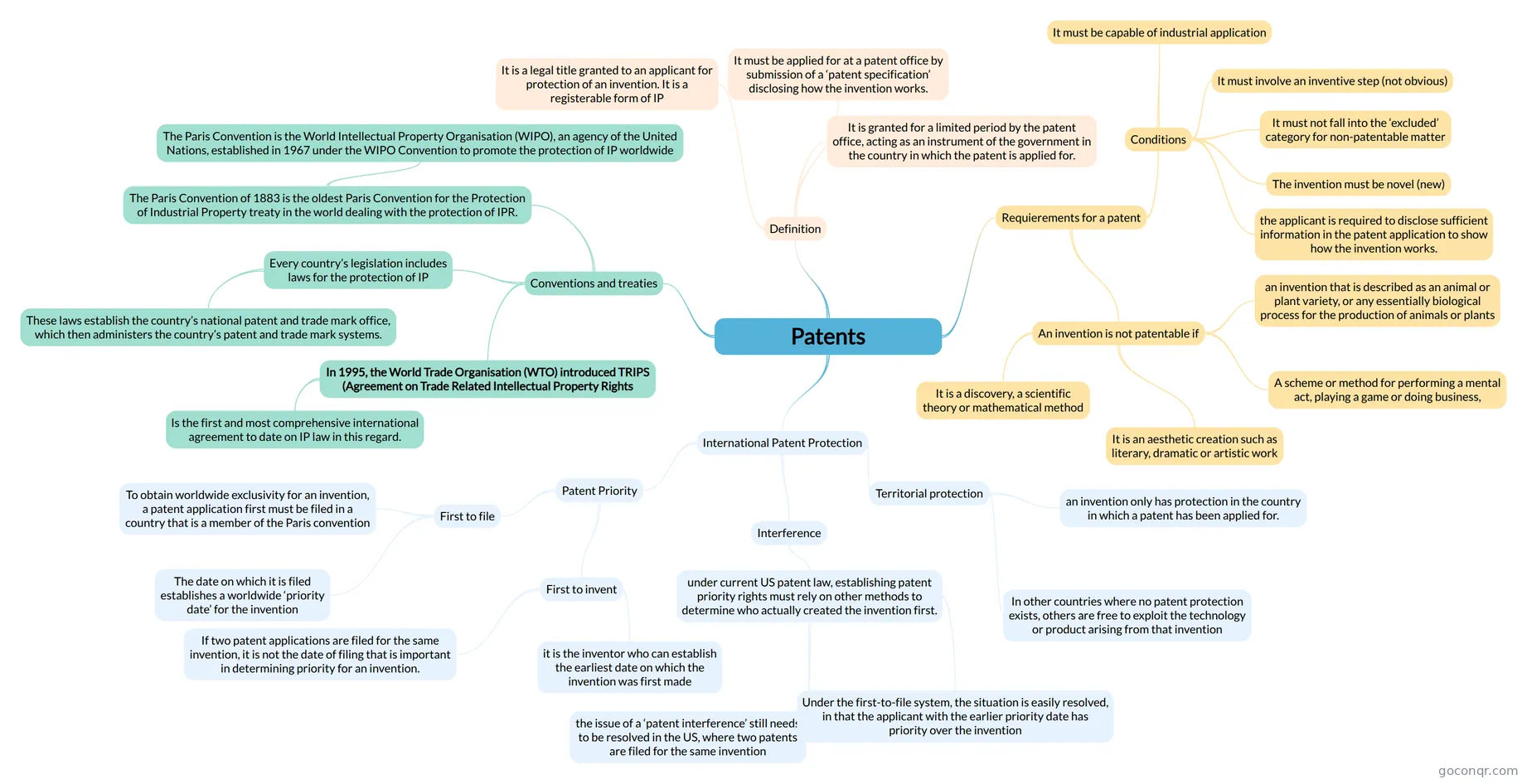
Mind map: Patents
Contenido del mapa
Patents
Definition
- It is a legal title granted to an applicant for protection of an invention. It is a registerable form of IP
- It must be applied for at a patent office by submission of a ‘patent specification’ disclosing how the invention works.
- It is granted for a limited period by the patent office, acting as an instrument of the government in the country in which the patent is applied for.
Conventions and treaties
- Every country’s legislation includes laws for the protection of IP
- These laws establish the country’s national patent and trade mark office, which then administers the country’s patent and trade mark systems.
- The Paris Convention of 1883 is the oldest Paris Convention for the Protection of Industrial Property treaty in the world dealing with the protection of IPR.
- The Paris Convention is the World Intellectual Property Organisation (WIPO), an agency of the United Nations, established in 1967 under the WIPO Convention to promote the protection of IP worldwide
- In 1995, the World Trade Organisation (WTO) introduced TRIPS (Agreement on Trade Related Intellectual Property Rights
- Is the first and most comprehensive international agreement to date on IP law in this regard.
- Every country’s legislation includes laws for the protection of IP
Requierements for a patent
- Conditions
- The invention must be novel (new)
- It must involve an inventive step (not obvious)
- It must be capable of industrial application
- It must not fall into the ‘excluded’ category for non-patentable matter
- the applicant is required to disclose sufficient information in the patent application to show how the invention works.
- An invention is not patentable if
- It is a discovery, a scientific theory or mathematical method
- It is an aesthetic creation such as literary, dramatic or artistic work
- A scheme or method for performing a mental act, playing a game or doing business,
- an invention that is described as an animal or plant variety, or any essentially biological process for the production of animals or plants
- Conditions
International Patent Protection
- Patent Priority
- First to file
- To obtain worldwide exclusivity for an invention, a patent application first must be filed in a country that is a member of the Paris convention
- The date on which it is filed establishes a worldwide ‘priority date’ for the invention
- First to invent
- If two patent applications are filed for the same invention, it is not the date of filing that is important in determining priority for an invention.
- it is the inventor who can establish the earliest date on which the invention was first made
- First to file
- Interference
- under current US patent law, establishing patent priority rights must rely on other methods to determine who actually created the invention first.
- the issue of a ‘patent interference’ still needs to be resolved in the US, where two patents are filed for the same invention
- Under the first-to-file system, the situation is easily resolved, in that the applicant with the earlier priority date has priority over the invention
- under current US patent law, establishing patent priority rights must rely on other methods to determine who actually created the invention first.
- Territorial protection
- an invention only has protection in the country in which a patent has been applied for.
- In other countries where no patent protection exists, others are free to exploit the technology or product arising from that invention
- Patent Priority
Información
- Descripción
- Mapa Mental sobre Patents, creado por Diego Garcia el 05/09/2019.
- Creado por
- Diego Garcia
- Visitas
- 2
- Valoración