
Mapa mental
THE IMPERATIVE
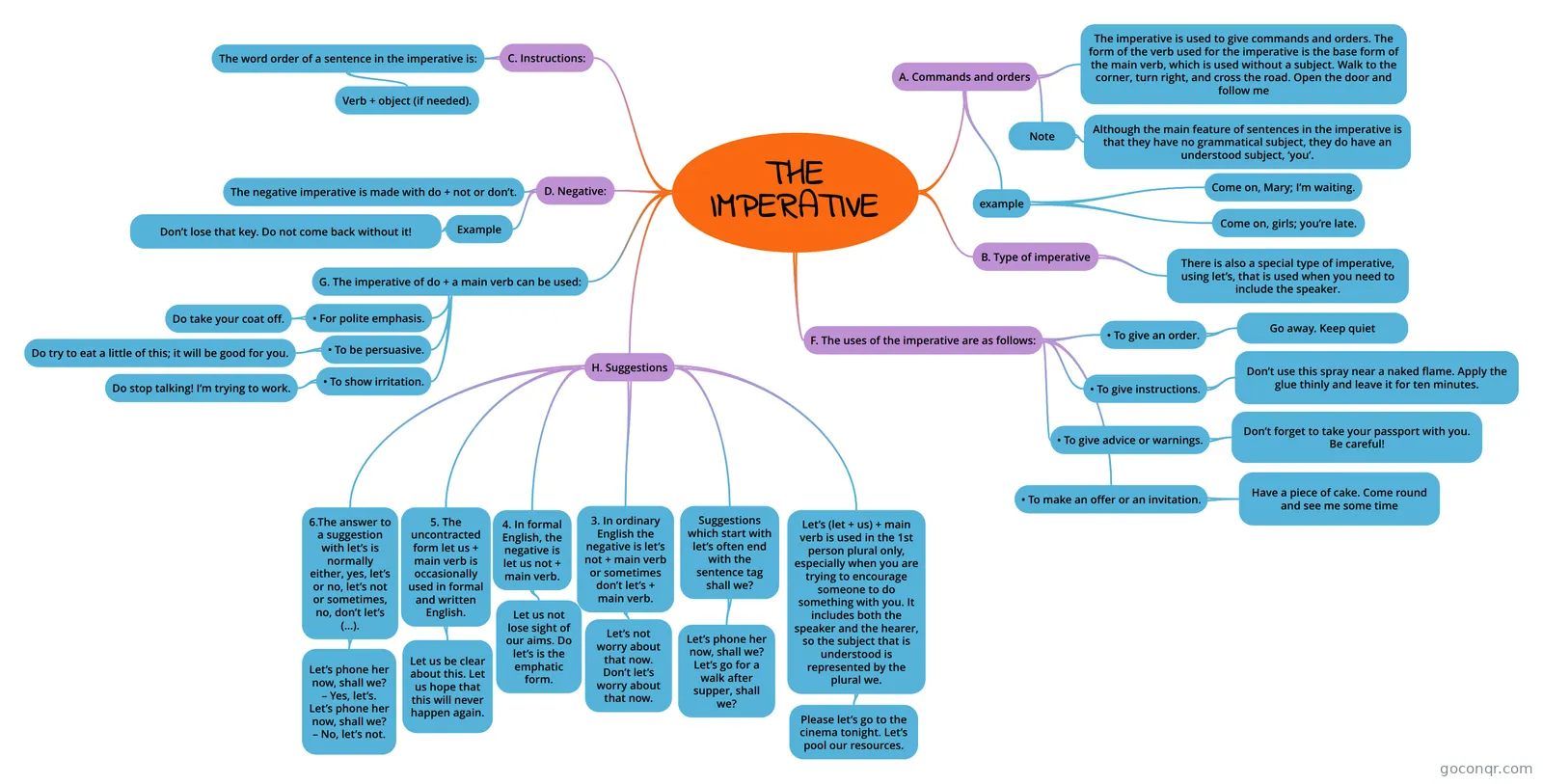
Mind map: the imperative
Contenido del mapa
THE IMPERATIVE
A. Commands and orders
- The imperative is used to give commands and orders. The form of the verb used for the imperative is the base form of the main verb, which is used without a subject. Walk to the corner, turn right, and cross the road. Open the door and follow me
- Note
- Although the main feature of sentences in the imperative is that they have no grammatical subject, they do have an understood subject, ‘you’.
- example
- Come on, Mary; I’m waiting.
- Come on, girls; you’re late.
B. Type of imperative
- There is also a special type of imperative, using let’s, that is used when you need to include the speaker.
C. Instructions:
- The word order of a sentence in the imperative is:
- Verb + object (if needed).
- The word order of a sentence in the imperative is:
D. Negative:
- The negative imperative is made with do + not or don’t.
- Example
- Don’t lose that key. Do not come back without it!
F. The uses of the imperative are as follows:
- • To give an order.
- Go away. Keep quiet
- • To give instructions.
- Don’t use this spray near a naked flame. Apply the glue thinly and leave it for ten minutes.
- • To give advice or warnings.
- Don’t forget to take your passport with you. Be careful!
- • To make an offer or an invitation.
- Have a piece of cake. Come round and see me some time
- • To give an order.
G. The imperative of do + a main verb can be used:
- • For polite emphasis.
- Do take your coat off.
- • To be persuasive.
- Do try to eat a little of this; it will be good for you.
- • To show irritation.
- Do stop talking! I’m trying to work.
- • For polite emphasis.
H. Suggestions
- Let’s (let + us) + main verb is used in the 1st person plural only, especially when you are trying to encourage someone to do something with you. It includes both the speaker and the hearer, so the subject that is understood is represented by the plural we.
- Please let’s go to the cinema tonight. Let’s pool our resources.
- Suggestions which start with let’s often end with the sentence tag shall we?
- Let’s phone her now, shall we? Let’s go for a walk after supper, shall we?
- 3. In ordinary English the negative is let’s not + main verb or sometimes don’t let’s + main verb.
- Let’s not worry about that now. Don’t let’s worry about that now.
- 4. In formal English, the negative is let us not + main verb.
- Let us not lose sight of our aims. Do let’s is the emphatic form.
- 5. The uncontracted form let us + main verb is occasionally used in formal and written English.
- Let us be clear about this. Let us hope that this will never happen again.
- 6.The answer to a suggestion with let’s is normally either, yes, let’s or no, let’s not or sometimes, no, don’t let’s (…).
- Let’s phone her now, shall we? – Yes, let’s. Let’s phone her now, shall we? – No, let’s not.
- Let’s (let + us) + main verb is used in the 1st person plural only, especially when you are trying to encourage someone to do something with you. It includes both the speaker and the hearer, so the subject that is understood is represented by the plural we.
Información
- Descripción
- Mapa Mental sobre THE IMPERATIVE, creado por claudia gonzalez quiroga el 03/10/2019.
- Creado por
- claudia gonzalez quiroga
- Visitas
- 4
- Valoración