
Mapa mental
EVOLUTION BY GENETIC DRIFT (important aspects)
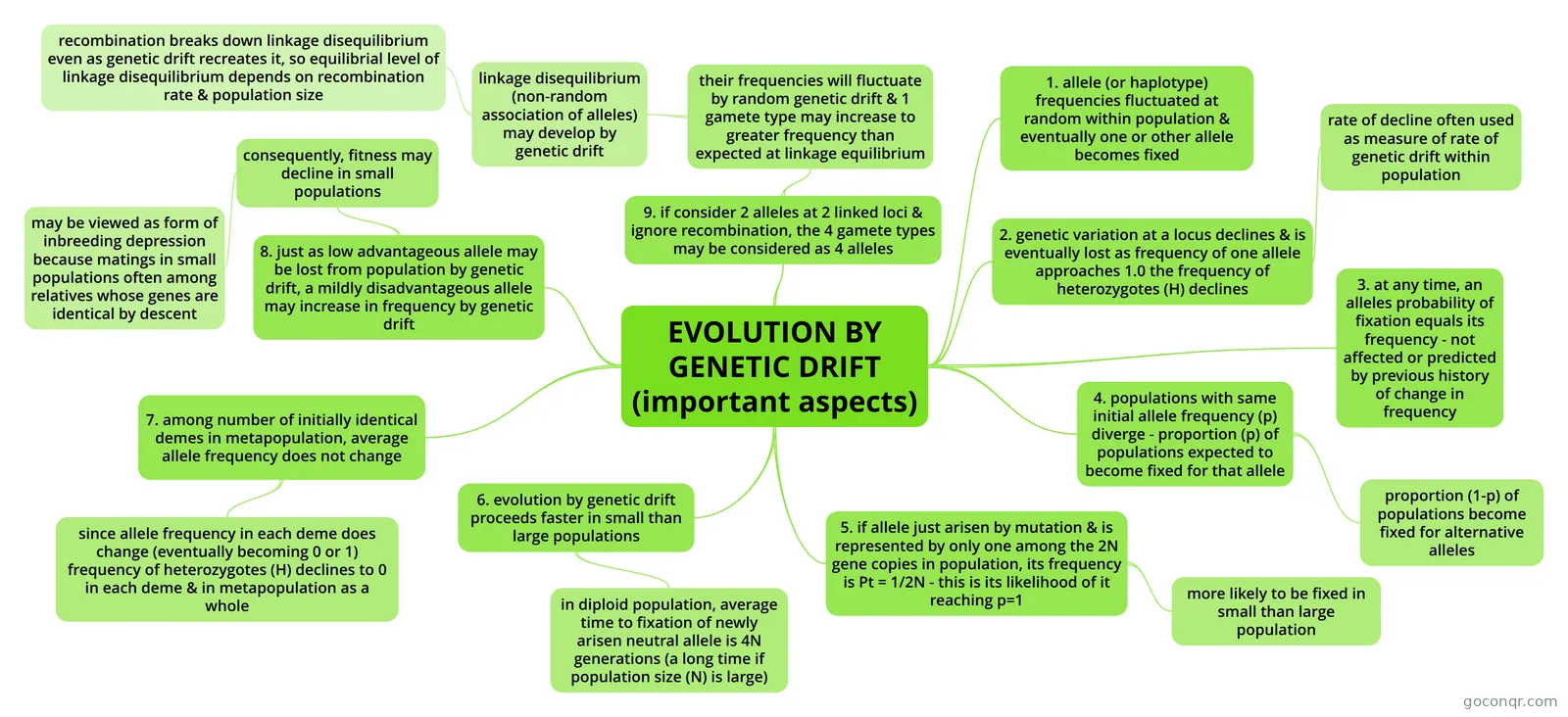
Mind map: Evolution by genetic drift important aspects
Contenido del mapa
EVOLUTION BY GENETIC DRIFT (important aspects)
1. allele (or haplotype) frequencies fluctuated at random within population & eventually one or other allele becomes fixed
2. genetic variation at a locus declines & is eventually lost as frequency of one allele approaches 1.0 the frequency of heterozygotes (H) declines
- rate of decline often used as measure of rate of genetic drift within population
3. at any time, an alleles probability of fixation equals its frequency - not affected or predicted by previous history of change in frequency
4. populations with same initial allele frequency (p) diverge - proportion (p) of populations expected to become fixed for that allele
- proportion (1-p) of populations become fixed for alternative alleles
5. if allele just arisen by mutation & is represented by only one among the 2N gene copies in population, its frequency is Pt = 1/2N - this is its likelihood of it reaching p=1
- more likely to be fixed in small than large population
6. evolution by genetic drift proceeds faster in small than large populations
- in diploid population, average time to fixation of newly arisen neutral allele is 4N generations (a long time if population size (N) is large)
7. among number of initially identical demes in metapopulation, average allele frequency does not change
- since allele frequency in each deme does change (eventually becoming 0 or 1) frequency of heterozygotes (H) declines to 0 in each deme & in metapopulation as a whole
8. just as low advantageous allele may be lost from population by genetic drift, a mildly disadvantageous allele may increase in frequency by genetic drift
- consequently, fitness may decline in small populations
- may be viewed as form of inbreeding depression because matings in small populations often among relatives whose genes are identical by descent
- consequently, fitness may decline in small populations
9. if consider 2 alleles at 2 linked loci & ignore recombination, the 4 gamete types may be considered as 4 alleles
- their frequencies will fluctuate by random genetic drift & 1 gamete type may increase to greater frequency than expected at linkage equilibrium
- linkage disequilibrium (non-random association of alleles) may develop by genetic drift
- recombination breaks down linkage disequilibrium even as genetic drift recreates it, so equilibrial level of linkage disequilibrium depends on recombination rate & population size
- linkage disequilibrium (non-random association of alleles) may develop by genetic drift
- their frequencies will fluctuate by random genetic drift & 1 gamete type may increase to greater frequency than expected at linkage equilibrium
Información
- Descripción
- Mapa Mental sobre EVOLUTION BY GENETIC DRIFT (important aspects), creado por tomking304 el 09/09/2013.
- Creado por
- tomking304
- Visitas
- 34
- Valoración