
Mapa mental
SPECIATION 3
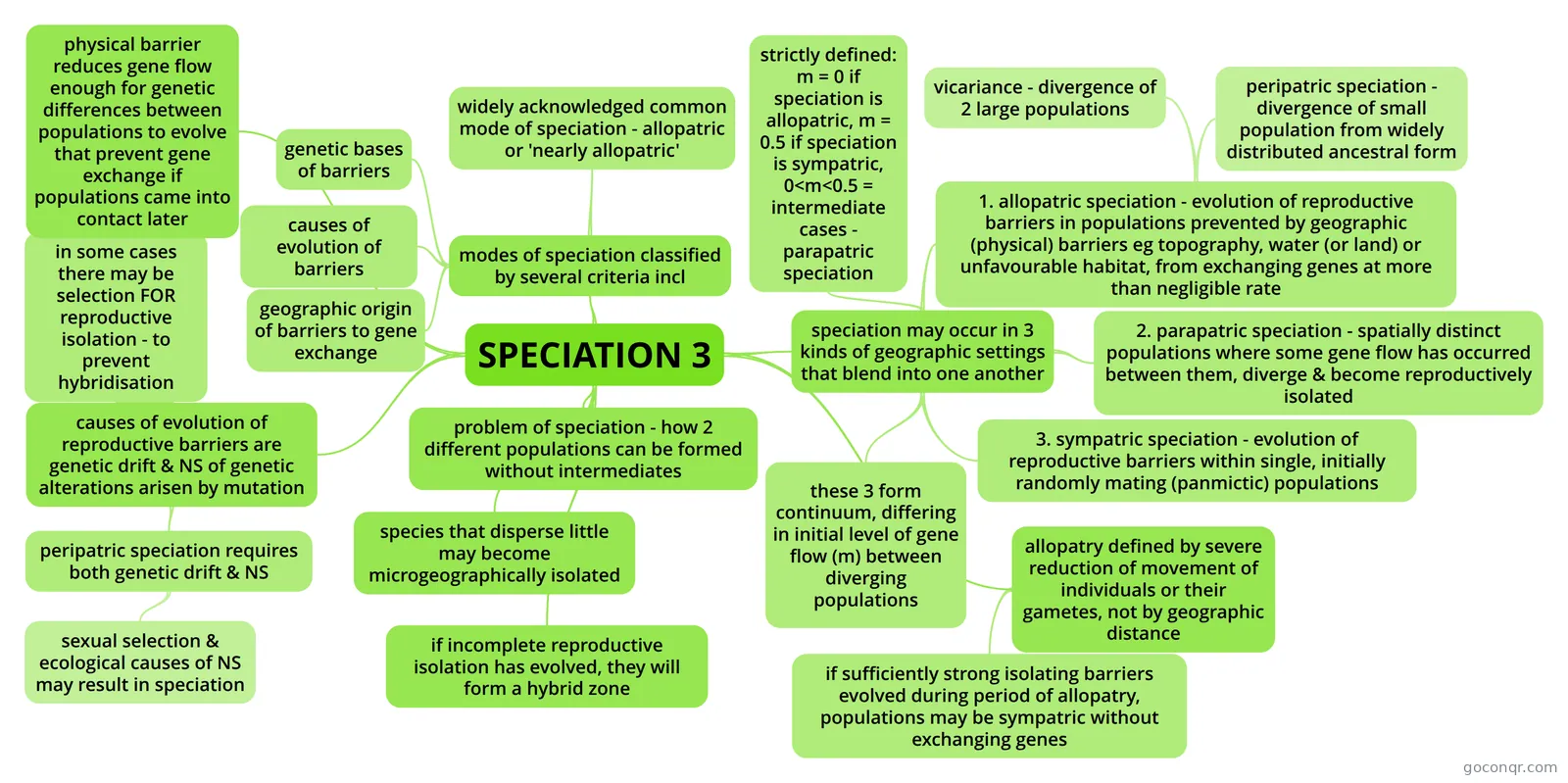
Mind map: Speciation
Contenido del mapa
SPECIATION 3
problem of speciation - how 2 different populations can be formed without intermediates
modes of speciation classified by several criteria incl
- geographic origin of barriers to gene exchange
- genetic bases of barriers
- causes of evolution of barriers
- widely acknowledged common mode of speciation - allopatric or 'nearly allopatric'
speciation may occur in 3 kinds of geographic settings that blend into one another
- 1. allopatric speciation - evolution of reproductive barriers in populations prevented by geographic (physical) barriers eg topography, water (or land) or unfavourable habitat, from exchanging genes at more than negligible rate
- vicariance - divergence of 2 large populations
- peripatric speciation - divergence of small population from widely distributed ancestral form
- 2. parapatric speciation - spatially distinct populations where some gene flow has occurred between them, diverge & become reproductively isolated
- 3. sympatric speciation - evolution of reproductive barriers within single, initially randomly mating (panmictic) populations
- these 3 form continuum, differing in initial level of gene flow (m) between diverging populations
- strictly defined: m = 0 if speciation is allopatric, m = 0.5 if speciation is sympatric, 0<m<0.5 = intermediate cases - parapatric speciation
- 1. allopatric speciation - evolution of reproductive barriers in populations prevented by geographic (physical) barriers eg topography, water (or land) or unfavourable habitat, from exchanging genes at more than negligible rate
causes of evolution of reproductive barriers are genetic drift & NS of genetic alterations arisen by mutation
- peripatric speciation requires both genetic drift & NS
- sexual selection & ecological causes of NS may result in speciation
- in some cases there may be selection FOR reproductive isolation - to prevent hybridisation
- peripatric speciation requires both genetic drift & NS
physical barrier reduces gene flow enough for genetic differences between populations to evolve that prevent gene exchange if populations came into contact later
allopatry defined by severe reduction of movement of individuals or their gametes, not by geographic distance
- if sufficiently strong isolating barriers evolved during period of allopatry, populations may be sympatric without exchanging genes
species that disperse little may become microgeographically isolated
if incomplete reproductive isolation has evolved, they will form a hybrid zone
Información
- Descripción
- Mapa Mental sobre SPECIATION 3, creado por tomking304 el 09/09/2013.
- Creado por
- tomking304
- Visitas
- 43
- Valoración