
Mapa mental
The Living World
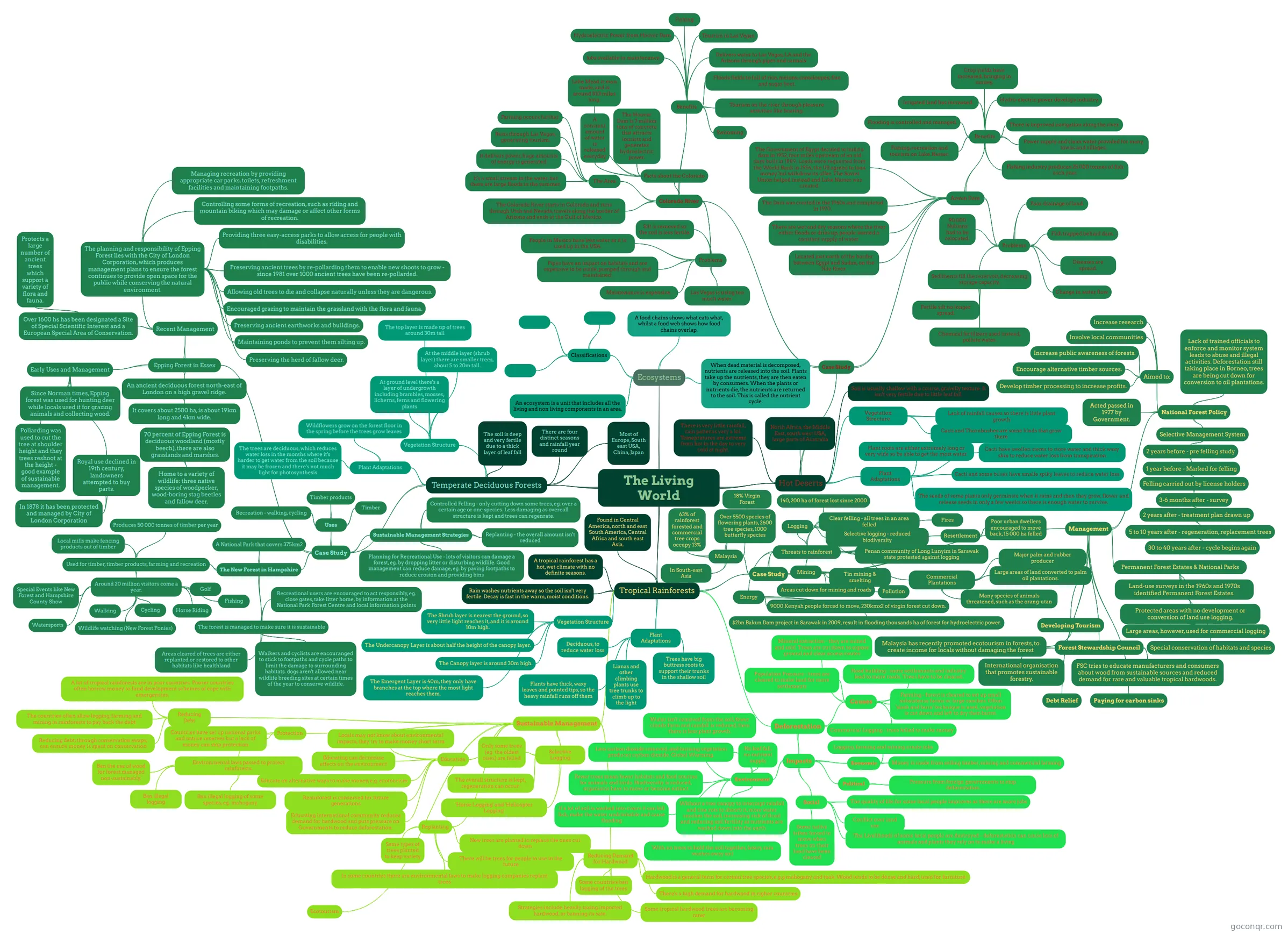
Mind map: The living world
Contenido del mapa
The Living World
Ecosystems
- An ecosystem is a unit that includes all the living and non living components in an area.
- Classifications
- A food chains shows what eats what, whilst a food web shows how food chains overlap.
- When dead material is decomposed, nutrients are released into the soil. Plants take up the nutrients, they are then eaten by consumers. When the plants or nutrients die, the nutrients are returned to the soil. This is called the nutrient cycle.
Tropical Rainforests
- Case Study
- Malaysia
- In South-east Asia
- 63% of rainforest forested and commercial tree crops occupy 13%
- 18% Virgin Forest
- Over 5500 species of flowering plants, 2600 tree species, 1000 butterfly species
- Threats to rainforest
- 140, 200 ha of forest lost since 2000
- Logging
- Clear felling - all trees in an area felled
- Selective logging - reduced biodiversity
- Penan community of Long Lunyim in Sarawak state protested against logging
- Energy
- $2bn Bakun Dam project in Sarawak in 2009, result in flooding thousands ha of forest for hydroelectric power.
- 9000 Kenyah people forced to move, 230kmx2 of virgin forest cut down.
- Mining
- Tin mining & smelting
- Areas cut down for mining and roads
- Pollution
- Resettlement
- Poor urban dwellers encouraged to move back, 15 000 ha felled
- Fires
- Commercial Plantations
- Major palm and rubber producer
- Large areas of land converted to palm oil plantations.
- Many species of animals threatened, such as the orang-utan
- Management
- National Forest Policy
- Acted passed in 1977 by Government.
- Aimed to:
- Develop timber processing to increase profits.
- Encourage alternative timber sources.
- Increase public awareness of forests.
- Involve local communities
- Increase research
- Selective Management System
- 2 years before - pre felling study
- 1 year before - Marked for felling
- Felling carried out by license holders
- 3-6 months after - survey
- 2 years after - treatment plan drawn up
- 5 to 10 years after - regeneration, replacement trees
- 30 to 40 years after - cycle begins again
- 5 to 10 years after - regeneration, replacement trees
- 2 years after - treatment plan drawn up
- 3-6 months after - survey
- Felling carried out by license holders
- 1 year before - Marked for felling
- 2 years before - pre felling study
- Lack of trained officials to enforce and monitor system leads to abuse and illegal activities. Deforestation still taking place in Borneo, trees are being cut down for conversion to oil plantations.
- Permanent Forest Estates & National Parks
- Land-use surveys in the 1960s and 1970s identified Permanent Forest Estates.
- Protected areas with no development or conversion of land use logging.
- Large areas, however, used for commercial logging
- Special conservation of habitats and species
- Forest Stewardship Council
- International organisation that promotes sustainable forestry.
- FSC tries to educate manufacturers and consumers about wood from sustainable sources and reduced demand for rare and valuable tropical hardwoods.
- Developing Tourism
- Malaysia has recently promoted ecotourism in forests, to create income for locals without damaging the forest
- Debt Relief
- Paying for carbon sinks
- National Forest Policy
- Malaysia
- Deforestation
- Causes
- Mineral extraction - they are mined and sold. Trees are cut down to expose ground and clear access routes
- Road building - more settlements and industry lead to more roads. Trees have to be cleared.
- Population Pressure - trees are cleared to make land for more settlements
- Commercial Logging - trees felled to make money
- Farming - forest is cleared to set up small subsistence farms or large ranches. Often 'slash and burn' technique is used, vegetation is cut down and left to dry then burnt.
- Impacts
- Environment
- Fewer trees mean fewer habitats and food sources for animals and birds. Biodiversity is reduced, organisms have to move or become extinct
- With no trees to hold the soil together, heavy rain washes away soil
- If a lot of soil is washed into rivers it can kill fish, make the water undrinkable and cause flooding
- Without a tree canopy to intercept rainfall and tree rots to absorb it, more water reaches the soil, increasing risk of flood and reducing soil fertility as nutrients are washed down into the earth
- No leaf fall, no nutrient supply
- Less carbon dioxide removed, and burning vegetation produces carbon dioxide. Global Warming.
- Water isn't removed from the soil, fewer clouds form and rainfall is reduced, then there is less plant growth.
- Political
- Pressure from foreign governments to stop deforestation
- Economic
- Logging, farming and mining create jobs
- Money is made from selling timber, mining and commercial farming
- Social
- The quality of life for some local people improves as there are more jobs
- The Livelihoods of some local people are destroyed - deforestation can cause loss of animals and plants they rely on to make a living
- Conflict over land use
- Some native tribes forced to move when trees on their land have been cleared
- Environment
- Causes
- Sustainable Management
- Reducing Debt
- A lot of tropical rainforests are in poor countries. Poorer countries often borrow money to fund development schemes of cope with emergencies.
- The countries often allow logging, farming and mining in rainforests to pay back the debt
- Reducing debt, through conservation swaps, can ensure money is spent on conservation
- Protection
- Environmental laws passed to protect rainforests.
- Ban the use of wood for forest managed non-sustainably.
- Ban illegal logging
- Ban illegal logging of some species, eg. mahogany
- Countries have set up national parks and nature reserves but a lack of money can stop protection
- Environmental laws passed to protect rainforests.
- Ecotourism
- Selective Logging
- Only some trees (eg. the oldest ones) are felled
- The overall structure is kept, regeneration can occur.
- 'Horse Logging' and 'Helicopter Logging'
- Reducing Demand for Hardwood
- Hardwood is a general term for certain tree species, e.g.g mahogany and teak. Wood tends to be dense and hard, used for furniture.
- There's a high demand for hardwood in righer countries
- Some tropical hardwood trees are becoming rarer
- Strategies include heavily taxing imported hardwood, or banning its sale.
- Some countries ban logging of the trees
- Education
- Locals may not know about environmental impacts, they try to make money short term
- Educating can decreease effects on the environment
- Educate on alternative ways to make money, e.g. ecotourism
- Reainforest is conserved for future generations
- Educating international community reduces demand for hardwood and puts pressure on Governments to reduce deforestation.
- Replanting
- New trees are planted to replace the ones cut down
- There will be trees for people to use in the future
- Same types of trees planted to keep variety
- In some countries there are environmental laws to make logging companies replant trees
- Reducing Debt
- Found in Central America, north and east South America, Central Africa and south east Asia.
- A tropical rainforest has a hot, wet climate with no definite seasons.
- Rain washes nutrients away so the soil isn't very fertile. Decay is fast in the warm, moist conditions.
- Vegetation Structure
- The Shrub layer is nearest the ground, so very little light reaches it, and it is around 10m high.
- The Undercanopy Layer is about half the height of the canopy layer.
- The Canopy layer is around 30m high.
- The Emergent Layer is 40m, they only have branches at the top where the most light reaches them.
- Plant Adaptations
- Deciduous, to reduce water loss
- Lianas and other climbing plants use tree trunks to climb up to the light
- Plants have thick, waxy leaves and pointed tips, so the heavy rainfall runs off them
- Trees have big buttress roots to support their trunks in the shallow soil
- Case Study
Hot Deserts
- Case Study
- Colorado River
- The Colorado River starts in Colorado and runs through Utah and Nevada, travels along the border of Arizona and ends at the Gulf of Mexico.
- The Area
- It's a small stream in the water, but there are large floods in the summer.
- It delivers power, huge amounts of energy is generated
- Farming occurs further
- Runs through Las Vegas, generating tourism.
- Facts about the Colorado
- Lake Mead is man made, and is around 810 miles long.
- A constant amount of water is released everyday
- The Hoover Dam is 7 million tons of concrete that attracts tourists and generates hydroelectric power.
- Benefits
- Hydroelectric Power from Hoover Dam
- Fishing
- Swimming
- Delivers water to Las Vegas, LA and the Arizona through pipes and cannals
- Floods fields to full of rice, melons, cantaloupes, flax and sugar beet.
- Tourism in Las Vegas
- Tourism on the river through pleasure activities like boating.
- Jobs available in maintenance.
- Problems
- Silt is removed so the soil is less fertile.
- Pipes have an impact on habitats and are expensive to be made, pumped through and maintained.
- Maintenance is expensive.
- People in Mexico have less water as it is used up in the USA.
- Las Vegas is using too much water.
- Aswan Dam
- Located just north of the border between Egypt and Sudan, on the Nile River.
- The Dam was created in the 1960s and completed in 1970.
- There are wet and dry seasons where the river either floods or dries up, people wanted a constant supply of water.
- The Government of Egypt decided to build a dam in 1952, four miles upstream of an old dam built in 1889. Loads were requested from the World Bank in 1954, the US agreed to loan money but withdrew its offer. The Soviet Union helped instead and Lake Nasser was created.
- Problems
- Sediments fill the reservoir, decreasing storage capacity.
- Fertile silt no longer spread.
- Chemical fertilizers used instead, pollute water.
- Change in water flow.
- Poor drainage of land.
- 90 000 Nubians had to be relocated.
- Diseases are spread.
- Fish trapped behind dam.
- Sediments fill the reservoir, decreasing storage capacity.
- Benefits
- Flooding is controlled and managed.
- Irrigated land has increased.
- Crop yields have increased, bringing in money.
- There is improved navigation along the river.
- Fishing industry produces 25 000 tonnes of fish each year.
- Fishing, recreation and tourism on Lake Nasser.
- Hydro-electric power develops industry.
- Power supply and clean water provided for many towns and villages.
- Colorado River
- North Africa, the Middle East, south west USA, large parts of Australia
- There is very little rainfall, rain patterns vary a lot. Temepratures are extreme from hot in the day to very cold at night.
- Soil is usually shallow with a course, gravelly texture. It isn't very fertile due to little leaf fall.
- Vegetation Structure
- Lack of rainfall causes so there is little plant growth
- Cacti and Thornbushes are some kinds that grow there
- Plant Adaptations
- Plant roots are either extremely long or very wide so be able to get the most water.
- Cacti have swollen stems to store water and thick waxy skin to reduce water loss from transpiration
- Cacti and some buses have smalle spiky leaves to reduce water loss.
- The seeds of some plants only germinste when it rains and then they grow, flower and release seeds in only a few weeks so there is enough water to survive.
- Case Study
Temperate Deciduous Forests
- Case Study
- Uses
- Timber
- Timber products
- Recreation - walking, cycling
- Sustainable Management Strategies
- Controlled Felling - only cutting down some trees, eg. over a certain age or one species. Less damaging as overeall structure is kept and trees can regenrate.
- Replanting - the overall amount isn't reduced
- Planning for Recreational Use - lots of visitors can damage a forest, eg. by dropping litter or disturbing wildlife. Good management can reduce damage, eg. by paving footpaths to reduce erosion and providing bins
- The New Forest in Hampshire
- A National Park that covers 375km2
- Used for timber, timber products, farming and recreation
- Produces 50 000 tonnes of timber per year
- Local mills make fencing products out of timber
- Around 20 million visitors come a year.
- Walking
- Cycling
- Wildlife watching (New Forest Ponies)
- Horse Riding
- Fishing
- Golf
- Watersports
- Special Events like New Forest and Hampshire County Show
- The forest is managed to make sure it is sustainable
- Areas cleared of trees are either replanted or restored to other habitats like healthland
- Walkers and cyclists are encouranged to stick to footpaths and cycle paths to limit the damage to surrounding habitats. dogs aren't allowed near wildlife breeding sites at certain times of the year to conserve wildlife.
- Recreational users are encouraged to act responsibly, eg. close gates, take litter home, by information at the National Park Forest Centre and local information points
- Epping Forest in Essex
- An ancient deciduous forest north-east of London on a high gravel ridge.
- It covers about 2500 ha, is about 19km long and 4km wide.
- 70 percent of Epping Forest is deciduous woodland (mostly beech), there are also grasslands and marshes.
- Home to a variety of wildlife: three native species of woodpecker, wood-boring stag beetles and fallow deer.
- 70 percent of Epping Forest is deciduous woodland (mostly beech), there are also grasslands and marshes.
- It covers about 2500 ha, is about 19km long and 4km wide.
- Early Uses and Management
- Since Norman times, Epping forest was used for hunting deer while locals used it for grazing animals and collecting wood.
- Pollarding was used to cut the tree at shoulder height and they trees reshoot at the height - good example of sustainable management.
- Royal use declined in 19th century, landowners attempted to buy parts.
- In 1878 it has been protected and managed by City of London Corporation
- Recent Management
- Over 1600 hs has been designated a Site of Special Scientific Interest and a European Special Area of Conservation.
- Protects a large number of ancient trees which support a variety of flora and fauna.
- The planning and responsibility of Epping Forest lies with the City of London Corporation, which produces management plans to ensure the forest continues to provide open space for the public while conserving the natural environment.
- Managing recreation by providing appropriate car parks, toilets, refreshment facilities and maintaining footpaths.
- Providing three easy-access parks to allow access for people with disabilities.
- Allowing old trees to die and collapse naturally unless they are dangerous.
- Preserving ancient trees by re-pollarding them to enable new shoots to grow - since 1981 over 1000 ancient trees have been re-pollarded.
- Controlling some forms of recreation, such as riding and mountain biking which may damage or affect other forms of recreation.
- Encouraged grazing to maintain the grassland with the flora and fauna.
- Preserving ancient earthworks and buildings.
- Maintaining ponds to prevent them silting up.
- Preserving the herd of fallow deer.
- Over 1600 hs has been designated a Site of Special Scientific Interest and a European Special Area of Conservation.
- An ancient deciduous forest north-east of London on a high gravel ridge.
- Uses
- Most of Europe, South east USA, China, Japan
- There are four distinct seasons and rainfall year round
- The soil is deep and very fertile due to a thick layer of leaf fall
- Vegetation Structure
- At the middle layer (shrub layer) there are smaller trees, about 5 to 20m tall.
- The top layer is made up of trees around 30m tall
- At ground level there's a layer of undergrowth including brambles, mosses, licherns, ferns and flowering plants
- Plant Adaptations
- Wildflowers grow on the forest floor in the spring before the trees grow leaves
- The trees are deciduous, which reduces water loss in the months where it's harder to get water from the soil because it may be frozen and there's not much light for photosynthesis
- Case Study
Información
- Descripción
- GCSE (Geography) Choice Subjects Mapa Mental sobre The Living World, creado por Zaynab Greengrass el 17/02/2015.
- Creado por
- Zaynab Greengrass
- Visitas
- 2
- Valoración