
Mapa mental
The Digestive System
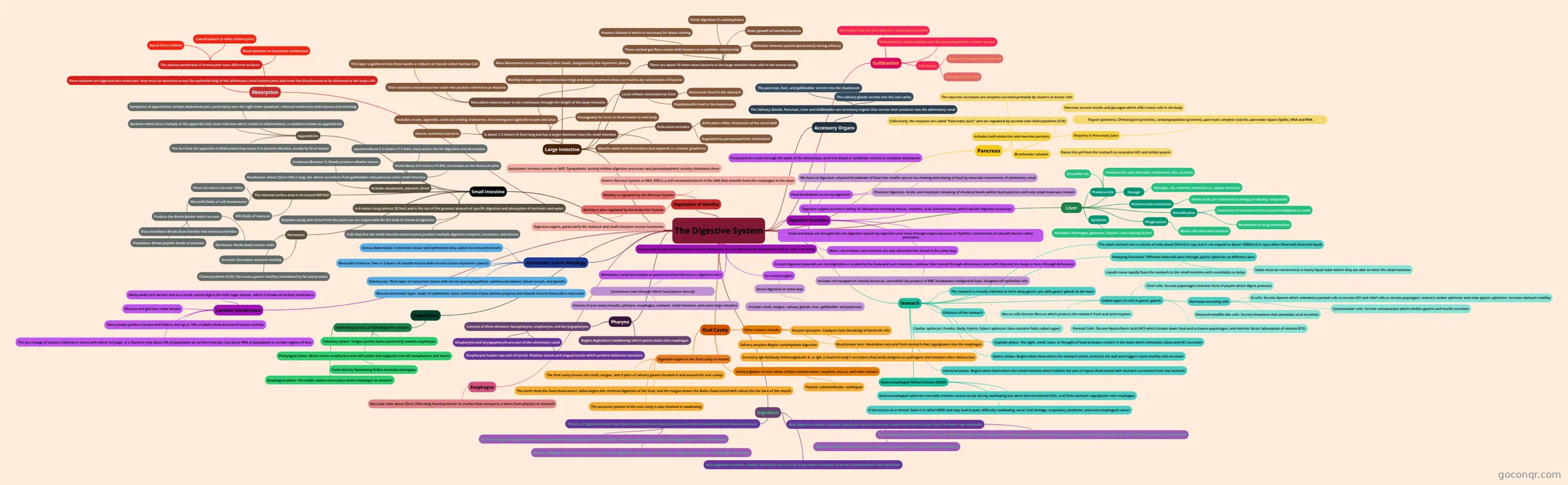
Mind map: The digestive system
Contenido del mapa
The Digestive System
Organs that break down food into nutrient molecules hat are delivered by the bloodstream to cells n the body
- Alimentary canal also known as gastrointestinal (GI) tract or digestive tract
- Continuous tube through which food passes directly
- Consist of oral cavity (mouth), pharynx, esophagus, stomach, small intestine, and some large intestine
- Continuous tube through which food passes directly
- Accessory organs
- Assist digestion in some way
- Includes teeth, tongue, salivary glands, liver, gallbladder and pancreas
- Assist digestion in some way
- Alimentary canal also known as gastrointestinal (GI) tract or digestive tract
Digestive functions
- Food and water are brought into the digestive system by ingestion and move through organs because of rhythmic contractions of smooth muscle called peristalsis
- Digestive organs secrete a variety of substances including mucus, enzymes, acid, and hormones, which aid the digestive processes
- Food breakdown occurs by digestion:
- Mechanical digestion- physical breakdown of food into smaller pieces via chewing and mixing of food by muscular movements of alimentary canal
- Chemical digestion- Acidic and enzymatic breaking of chemical bonds within food particles until only small molecules remain
- Food particles move through the walls of the alimentary canal into blood or lymphatic vessels to complete absorption
- Water, electrolytes, and vitamins are also absorbed into blood in the same way
- Certain ingested materials are not digestible or usable by the body and such materials continue their transit through alimentary canal until they exit the body as feces through defecation
- Includes microorganism (mostly bacteria), stereobilin (by-product of RBC breakdown) undigested food, sloughed-off epithelial cells
Regulation of Motility
- Motility is regulated by the Nervous System
- Autonomic nervous system or ANS- Sympathetic activity inhibits digestive processes and parasympathetic activity stimulates them
- Enteric Nervous System or ENS- ENS is a self-contained branch of the ANS that extends from the esophagus to the anus
- Molitity is also regulated by the Endocrine System
- Digestive organs, particularly the stomach and small intestine secrete hormones
- Motility is regulated by the Nervous System
Alimentary Canal Histology
- Mucosa-Innermost layer, made of epithelium, loose connective tissue (lamina propria) and smooth muscle (muscularis mucosae)
- Submucosa- Thick layer of connective tissue with nerves (parasympathetic submucosal plexus), blood vessels, and glands)
- Muscularis Externa- Two or 3 layers of smooth muscle with nervous tissue (myenteric plexus)
- Serosa (Adventitia)- Connective tissue and epithelium (also called visceral peritoneum)
Oral Cavity
- Digestion begins in the Oral cavity or mouth
- The Oral cavity houses the teeth, tongue, and 3 pairs of salivary glands (located in and around the oral cavity)
- The teeth chew the food (masication), saliva begins the chemical digestion of the food, and the tongue moves the Bolus (food mixed with saliva) the the back of the mouth
- The posterior portion of the oral cavity is also involved in swallowing
- Salivary glands secrete saliva, a fluid contains water, enzymes, mucus, and other solutes
- Parotid, submandibular, sublingual
- Other solutes include:
- Salivary amylase-Begins carbohydrate digestion
- Enzyme lysozyme- Catalyzes lysis (breaking) of bacterial cells
- Secretory IgA-Antibody immunoglobulin A, or IgA, is found in body's secretions that binds antigens on pathogens and mediates their destruction
- Bicarbonate Ions- Neutralizes any acid from stomach that regurgitates into the esophagus
- Digestion begins in the Oral cavity or mouth
Pharynx
- Begins deglutition (swallowing) which passes bolus into esophagus
- Consists of three divisions: Nasopharynx, oropharynx, and larryngopharynx
- Oropharynx and laryngopharynx are part of the alimentary canal
- Oropharynx houses two sets of tonsils -Palatine tonsils and Lingual tonsils which perform defensive functions
Esophagus
- Muscular tube about 25cm (10in) long found posterior to trachea that transports a bolus from pharynx to stomach
Deglutition
- Swallowing consists of following three phases:
- Voluntary phase- Tongue pushes bolus posteriorly toward oropharynx
- Pharyngeal phase- Bolus enters oropharynx and soft palate and epiglottis seal off nasopharynx and larynx
- Controlled by Swallowing Reflex (medulla oblongata
- Esophageal phase- Peristalltic waves move bolus down esophagus to stomach
- Swallowing consists of following three phases:
Stomach
- Divisions of the stomach
- Cardiac sphincter, Fundus, Body, Pyloris, Pyloric sphincter (also contains folds called rugae)
- The stomach is heavily indented to form deep gastric pits with gastric glands at the base
- 4 Main types of cells in gastric galnds
- Mucus cells-Secrete Muscus which protects the stomach from acid and enzymes
- Parietal Cells- Secrete Hydrochloric Acid (HCI) which breaks down food and activates pepsinogen, and intrinsic factor (absorption of vitamin B12)
- Chief cells- Secrete pepsinogen (inactive form of pepsin which digest proteins)
- Hormone-secreting cells
- Enterochromaffin-like cells- Secrete histamine that stimulates acid secretion
- G-cells- Secrete Gastrin which stimulates parietal cells to secrete HCI and chief cells to secrete pepsiogen; contract cardiac sphincter and relax pyloric sphincter; increase stomach motility
- Somatostatin cells- Secrete somatostatin which inhibits gastrin and insulin secretion
- Cephalic phase- The sight, smell, taste, or thought of food activates centers in the brain which stimulates saliva and HCI secretion
- Gastric phase- Begins when food enters the stomach which stretches the wall and triggers more motility and secretion
- Intestinal phase- Begins when food enters the small intestine which inhibits the exit of chyme (food mixed with stomach secretions) from the stomach
- Gastroesophageal Reflux Disease (GERD)
- Gastroesophageal sphincter normally remains closed except during swallowing but when this mechanism fails, acid from stomach regurgitates into esophagus
- If this occurs on a chronic basis it is called GERD and may lead to pain, difficulty swallowing, vocal cord damage, respiratory problems, and even esophageal cancer
- The adult stomach has a volume of only about 50ml (0.2 cup), but it can expand to about 1500ml (6.3 cups) when filled with food and liquid
- Emptying Functions- Different materials pass through pyloric sphincter at different rates
- Liquids move rapidly from the stomach to the small intestine with essentially no delay
- Solids must be converted to a nearly liquid state before they are able to enter the small intestine
- Divisions of the stomach
Small Intestine
- Is 6 meters long (almost 20 feet) and is the site of the greatest amount of specific digestion and absorption of nutrients and water
- Includes duodenum, jejunum, ileum
- Duodenum- About 25cm (10in.) long, site where secretions from gallbladder and pancreas enter small intestine
- Duodenal (Brunner's) Glands produce alkaline mucus
- Ileum-About 3.6 meters (10.8ft), terminates at the ileocecal valve
- Jejunum-About 2.5 meters (7.5 feet), most active site for digestion and absorption
- Duodenum- About 25cm (10in.) long, site where secretions from gallbladder and pancreas enter small intestine
- Cells that line the small intestine (enterocytes) produce multiple digestive enzymes, hormones, and mucus
- Enzymes along with those from the pancreas are responsible for the bulk of chemical digestion
- Includes duodenum, jejunum, ileum
- The internal surface area is increased 600 fold
- Plicae circulares (circular folds)
- Microvilli (folds of cell membranes)
- Produce the Brush Border which secrete:
- Disaccharidases-Break disaccharides into monosaccharides
- Peptidases- Break peptide bonds of proteins
- Nucleases- Break down nucleic acids
- Produce the Brush Border which secrete:
- Villi (folds of mucosa)
- Hormones:
- Secretin- Decreases stomach motility
- Cholecystokinin (CCK)- Decreases gastric motility (stimulated by fat and protein)
- Appendicitis
- The fact that the appendix is blind-ended may cause it to become blocked, usually by fecal matter
- Bacteria within feces multiply in the appendix and cause infection which results in inflammation, a condition known as appendicitis
- Symptoms of appendicitis include abdominal pain, particularly over the right lower quadrant, rebound tenderness with nausea and vomiting
- Is 6 meters long (almost 20 feet) and is the site of the greatest amount of specific digestion and absorption of nutrients and water
Large Intestine
- Is about 1.5 meters (5 feet) long but has a larger diameter than the small intestine
- Includes cecum, appendix, colon (ascending, transverse, descending and sigmoid) rectum and anus
- Absorbs water and electrolytes (but depends on osmotic gradients)
- Passageway for feces or fecal matter to exit body
- Houses numerous bacteria
- Muscularis externa layer is not continuous through the length of the large intestine
- This layer is gathered into three bands or ribbons of muscle called Taeniae Coli
- Their constant tension bunches colon into pockets referred to as Haustra
- Motility includes segmentation (claurning) and mass movement (mass peristalsis) by contractions of haustra
- Mass Movements occur commonly after meals, integrated by the myenteric plexus
- Local reflexes stimulated by food:
- Gastrocolic-Food in the stomach
- Duodenocolic-Food in the duodenum
- Defecation includes:
- Defecation reflex- Distension of the rectal wall
- Regulated by parasympathetic stimulation
- There are about 10 times more bacteria in the large intestine than cells in the human body
- These normal gut flora coexist with humans in a symbiotic relationship
- Produce Vitamin K which is necessary for blood clotting
- Finish digestion of carbohydrates
- Deter growth of harmful bacteria
- Stimulate immune system (particularly during infancy)
- These normal gut flora coexist with humans in a symbiotic relationship
- Is about 1.5 meters (5 feet) long but has a larger diameter than the small intestine
Accessory Organs
- The Salivary Glands, Pancreas, Liver and Gallbladder are accessory organs that secrete their products into the alimentary canal
- The salivary glands secrete into the oral cavity
- The pancreas, liver, and gallbladder secrete into the duodenum
- The Salivary Glands, Pancreas, Liver and Gallbladder are accessory organs that secrete their products into the alimentary canal
Pancreas
- Includes both endocrine and exocrine portions
- Pancreas secrete insulin and glucagon which affect most cells in the body
- The exocrine secretions are enzymes secreted primarily by clusters of acinar cells
- Collectively, the enzymes are called "Pancreatic Juice" and are regulated by secretin and cholecystokinin (CCK)
- Bicarbonate solution
- Raises the pH from the stomach to neutralize HCI and inhibit pepsin
- Enzymes in Pancreatic Juice
- Trypsin (proteins), Chmotrypsin (proteins), carboxypeptidase (proteins), pancreatic amylase (starch), pancreatic lipase (lipids), DNA and RNA
- Includes both endocrine and exocrine portions
Liver
- Produces bile
- Emulsifies fat
- Contains bile salts (bilirubin, cholesterol, fats, lecithin)
- Storage
- Glycogen, fat, vitamins, minerals (i.e. copper and iron)
- Nutrient interconversion
- Amino acids are converted to energy producing compounds
- Detoxification
- Conversion of ammonia (from protein breakdown to urea)
- Breakdown of drug metabolites
- Phagocytosis
- Blood cells and some bacteria
- Synthesis
- Albumins, fibrinogen, globulins, heparin, and clotting factors
- Produces bile
Gallbladder
- Stores bile from the liver (which is constantly secreted)
- Stimulated by cholecystokinin and the parasympathetic nervous system
- Gall stones:
- Made of precipitated cholesterol
- Can block cystic duct
Digestion
- Process of digestion breaks food down into smaller and smaller pieces until only individual nutrient molecules remain
- All nutrients go through the same mechanisms of mechanical digestion-mastication in mouth, churning in stomach, and segmentation in small intestine
- Chemical digestion varies for each nutrient because digestive enzymes are specific for a single type of bond in a single type of nutrient
- Most digestive enzymes catalyze hydrolysis reactions that use a water molecule to break a bond between two molecules
- This explains why so much water is secreted with fluids like gastric and pancreatic juices because water molecules are key components of reactions that chemically break down food molecules
- Digestive enzymes speed up these reactions by a process known as enzymatic hydrolysis
- Most digestive enzymes catalyze hydrolysis reactions by using a water molecule to break a bond between two molecules
- Process of digestion breaks food down into smaller and smaller pieces until only individual nutrient molecules remain
Absorption
- Once nutrients are digested into molecules. they must be absorbed across the epithelial linig of the alimentary canal (enterocytes) and enter the bloodstream to be delivered to the body cells
- The plasma membrane of enterocytes have different surfaces
- Apical (feces lumen)
- Lateral (attach to other enterocytes)
- Basal (attaches to basement membrane)
Lactose intolerance
- Many adults lack lactase and as a result cannot digest the milk sugar lactose, which is known as lactose intolerance
- Most people produce lactase and infants, but up to 75% of adults show decreased lactase activity
- The percentage of lactose intolerance varies with ethnic heritage- it is found in only about 5% of population of northern Europe, but about 90% of population in certain regions of Asia
- Glucose and glactose make lactase
Información
- Descripción
- Mapa Mental sobre The Digestive System, creado por K Fos el 25/02/2020.
- Creado por
- K Fos
- Visitas
- 0
- Valoración