
Mapa mental
Semicolon & Period
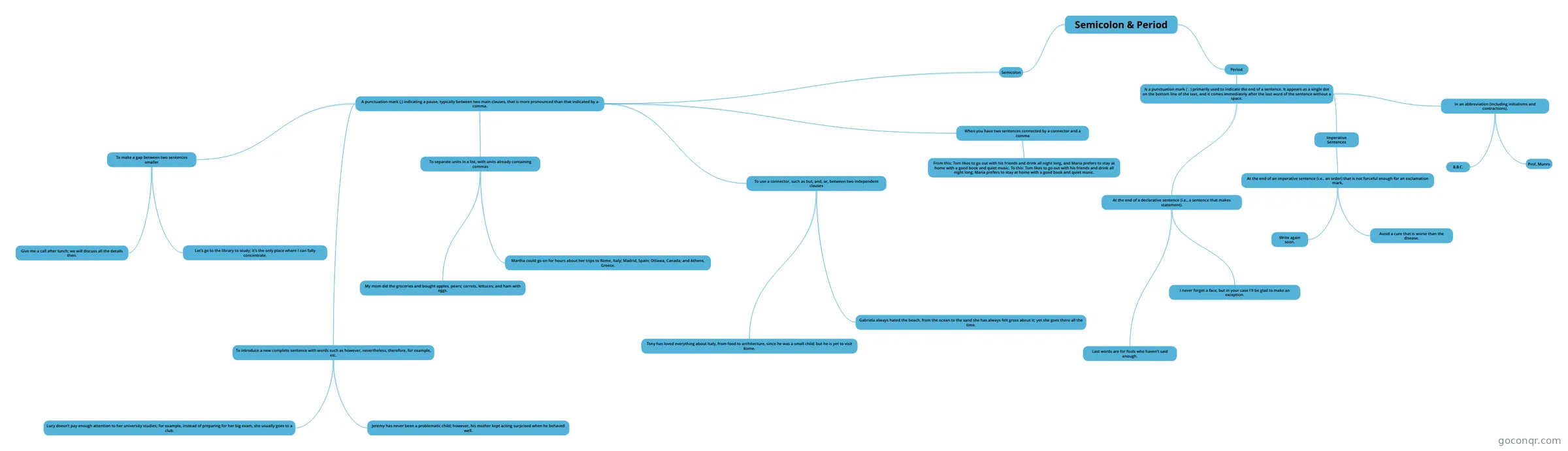
Mind map: Semicolon & Period
Contenido del mapa
Semicolon & Period
Semicolon
- A punctuation mark (;) indicating a pause, typically between two main clauses, that is more pronounced than that indicated by a comma.
- To make a gap between two sentences smaller
- Give me a call after lunch; we will discuss all the details then.
- Let’s go to the library to study; it’s the only place where I can fully concentrate.
- To introduce a new complete sentence with words such as however, nevertheless, therefore, for example, etc.
- Jeremy has never been a problematic child; however, his mother kept acting surprised when he behaved well.
- Lucy doesn’t pay enough attention to her university studies; for example, instead of preparing for her big exam, she usually goes to a club.
- To separate units in a list, with units already containing commas
- Martha could go on for hours about her trips to Rome, Italy; Madrid, Spain; Ottawa, Canada; and Athens, Greece.
- My mom did the groceries and bought apples, pears; carrots, lettuces; and ham with eggs.
- To use a connector, such as but, and, or, between two independent clauses
- Tony has loved everything about Italy, from food to architecture, since he was a small child; but he is yet to visit Rome.
- Gabriela always hated the beach, from the ocean to the sand she has always felt gross about it; yet she goes there all the time.
- When you have two sentences connected by a connector and a comma
- From this: Tom likes to go out with his friends and drink all night long, and Maria prefers to stay at home with a good book and quiet music. To this: Tom likes to go out with his friends and drink all night long; Maria prefers to stay at home with a good book and quiet music.
- To make a gap between two sentences smaller
- A punctuation mark (;) indicating a pause, typically between two main clauses, that is more pronounced than that indicated by a comma.
Period
- Is a punctuation mark ( . ) primarily used to indicate the end of a sentence. It appears as a single dot on the bottom line of the text, and it comes immediately after the last word of the sentence without a space.
- At the end of a declarative sentence (i.e., a sentence that makes statement).
- Last words are for fools who haven't said enough.
- I never forget a face, but in your case I'll be glad to make an exception.
- In an abbreviation (including initialisms and contractions).
- B.B.C.
- Prof. Munro
- Imperative Sentences
- At the end of an imperative sentence (i.e., an order) that is not forceful enough for an exclamation mark.
- Write again soon.
- Avoid a cure that is worse than the disease.
- At the end of an imperative sentence (i.e., an order) that is not forceful enough for an exclamation mark.
- At the end of a declarative sentence (i.e., a sentence that makes statement).
- Is a punctuation mark ( . ) primarily used to indicate the end of a sentence. It appears as a single dot on the bottom line of the text, and it comes immediately after the last word of the sentence without a space.
Información
- Descripción
- Mapa Mental sobre Semicolon & Period, creado por MATEUS PALMA DANIELA el 27/03/2020.
- Creado por
- MATEUS PALMA DANIELA
- Visitas
- 0
- Valoración