
Mapa mental
Nativism
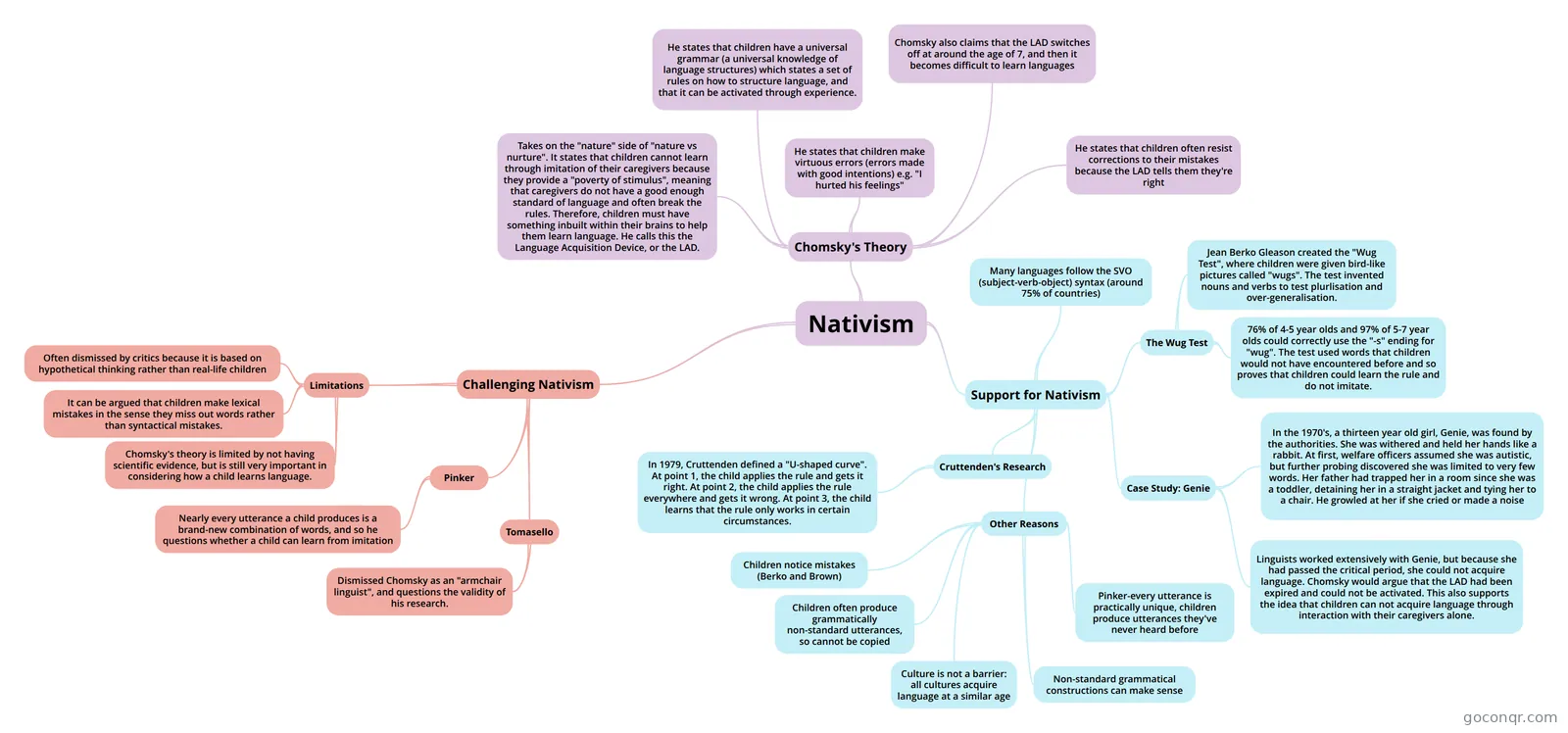
Mind map: Nativism
Contenido del mapa
Nativism
Chomsky's Theory
- Takes on the "nature" side of "nature vs nurture". It states that children cannot learn through imitation of their caregivers because they provide a "poverty of stimulus", meaning that caregivers do not have a good enough standard of language and often break the rules. Therefore, children must have something inbuilt within their brains to help them learn language. He calls this the Language Acquisition Device, or the LAD.
- He states that children have a universal grammar (a universal knowledge of language structures) which states a set of rules on how to structure language, and that it can be activated through experience.
- He states that children make virtuous errors (errors made with good intentions) e.g. "I hurted his feelings"
- He states that children often resist corrections to their mistakes because the LAD tells them they're right
- Chomsky also claims that the LAD switches off at around the age of 7, and then it becomes difficult to learn languages
Support for Nativism
- Many languages follow the SVO (subject-verb-object) syntax (around 75% of countries)
- The Wug Test
- Jean Berko Gleason created the "Wug Test", where children were given bird-like pictures called "wugs". The test invented nouns and verbs to test plurlisation and over-generalisation.
- 76% of 4-5 year olds and 97% of 5-7 year olds could correctly use the "-s" ending for "wug". The test used words that children would not have encountered before and so proves that children could learn the rule and do not imitate.
- Case Study: Genie
- In the 1970's, a thirteen year old girl, Genie, was found by the authorities. She was withered and held her hands like a rabbit. At first, welfare officers assumed she was autistic, but further probing discovered she was limited to very few words. Her father had trapped her in a room since she was a toddler, detaining her in a straight jacket and tying her to a chair. He growled at her if she cried or made a noise
- Linguists worked extensively with Genie, but because she had passed the critical period, she could not acquire language. Chomsky would argue that the LAD had been expired and could not be activated. This also supports the idea that children can not acquire language through interaction with their caregivers alone.
- Other Reasons
- Non-standard grammatical constructions can make sense
- Pinker-every utterance is practically unique, children produce utterances they've never heard before
- Children often produce grammatically non-standard utterances, so cannot be copied
- Culture is not a barrier: all cultures acquire language at a similar age
- Children notice mistakes (Berko and Brown)
- Cruttenden's Research
- In 1979, Cruttenden defined a "U-shaped curve". At point 1, the child applies the rule and gets it right. At point 2, the child applies the rule everywhere and gets it wrong. At point 3, the child learns that the rule only works in certain circumstances.
Challenging Nativism
- Tomasello
- Dismissed Chomsky as an "armchair linguist", and questions the validity of his research.
- Pinker
- Nearly every utterance a child produces is a brand-new combination of words, and so he questions whether a child can learn from imitation
- Limitations
- Chomsky's theory is limited by not having scientific evidence, but is still very important in considering how a child learns language.
- It can be argued that children make lexical mistakes in the sense they miss out words rather than syntactical mistakes.
- Often dismissed by critics because it is based on hypothetical thinking rather than real-life children
- Tomasello
Información
- Descripción
- Mapa Mental sobre Nativism, creado por Amy Greaves el 10/04/2020.
- Creado por
- Amy Greaves
- Visitas
- 0
- Valoración