
Mapa mental
OPERATIONS
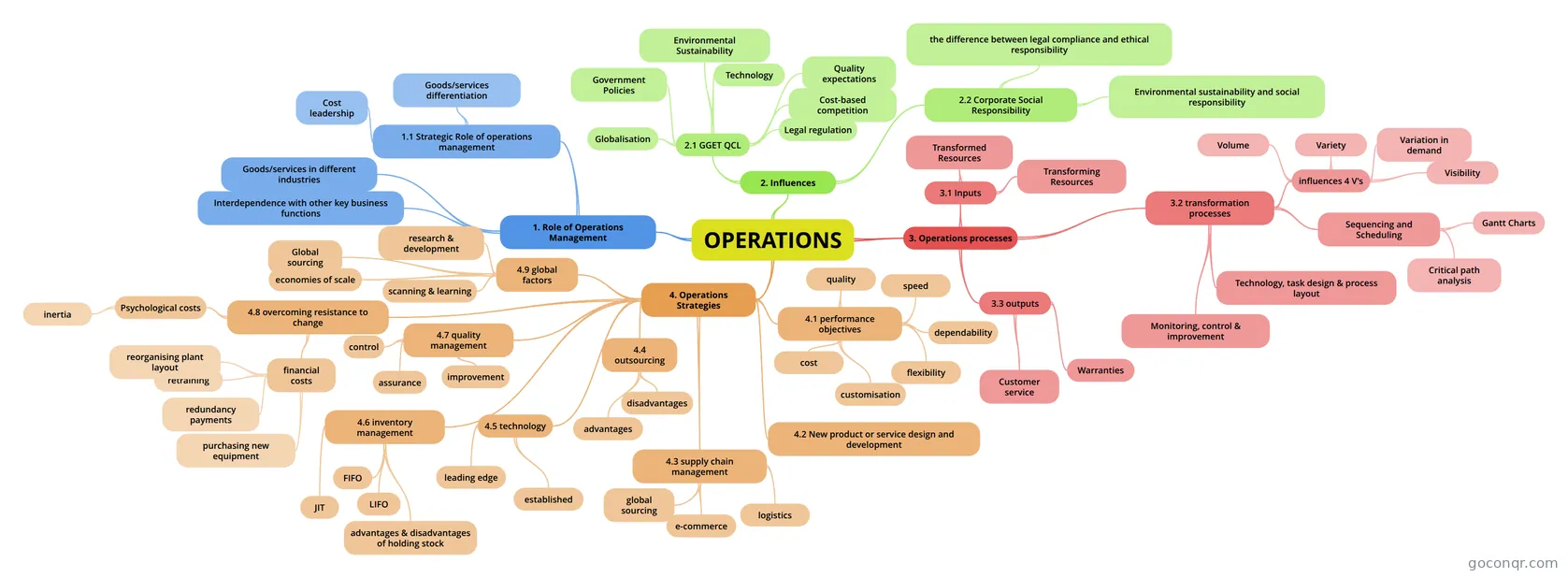
Mind map: Operations management
Contenido del mapa
OPERATIONS
- (RIPS) Operations = Processes INPUTS (resources) Transformed into OUTPUTS (goods & services)
1. Role of Operations Management
- 1.1 Strategic Role of operations management
- Strategic role: make sure that the processes help achieve the business's goals
- Cost leadership
- aim to be most price-competitive Strategies: Economies of Scales Control costs (production & other) technology
- Goods/services differentiation
- distinguishing products in some way from its competitiors focused on: Goods: features, design, quality and add ons/ additional benefits Services: time, level of expertise, qualifications/ experience and quality of materials/ technology
- Goods/services in different industries
- Goods: Standardised - mass produced Customised - varies to customer wants/needsIntermediate good - has been created to become an input to create soemthing else perishable/non-perishable Services: customised - specialised e.g. legal/ medical Self service - e.g. checkout at coles/woolworths
- Interdependence with other key business functions
- each business function depends on one another and must interact in order to achieve business goals - mutual dependence
- 1.1 Strategic Role of operations management
2. Influences
- 2.1 GGET QCL
- Government Policies
- affect management decisions source of change: can become laws and regulations
- Globalisation
- Removal of barriers of trade between nations characterised by:- increasing integration with national economies - high degree transfer of capital:labour, intellectual capital & ideas, financial recourses & technology- global web: integration of a range of suppliers creates a network
- Affects: - consumers seek global brands - large/ TNC business's - organisational design & supply chain
- Environmental Sustainability
- business operations shaped around practices that consume resources today without compromising access to those resources for future generations
- - intergenerational equity - sustainable use of renewable resources - reduction use non-renewable resources - rise climate change awareness: need integrate long-term sustainable approaches - environmental sustainable practices reduce carbon footprint
- Technology
- design, construction & application of innovative devices, methods & machinery upon operations processes
- Used in: Administration: organisation, planning and decision making Processing: (all aspects) manufacturing, logistics, distribution
- Quality expectations
- Standard of excellence customers believe is suited for product goods: - quality of design - fit for purpose - durability Services: - professionalism of the service provider - reliability of service provider - level of customisation
- Cost-based competition
- derived from determining break-even point and applying strategies to create cost advantages over competitors
- reducing fixed and variable costs to maximise profits without decreasing quality
- Legal regulation
- compliance costs: expenses with meeting requirements legal regulation avoid compliance costs via outsourcing
- WORK HEALTH AND SAFETY (WHS): use of machinery and interacting with business environment, safe and healthy working conditions, appropriate safety training, protective equipment
- FAIR WORK AND ANTI-DISTRIMINATION LAWS: employees treated with diginity and respect
- Government Policies
- 2.2 Corporate Social Responsibility
- open and accountable business actions based on respect for people, community/ society and broader environment
- - involves more than complying with laws and regulations - tripple bottom line: placing value on financial returns, social responsibility and environmental sustainability - lean production: minimising waste in operations and becoming more efficient by lowering costs, reducing errors and defects and minimising underuse of labour
- the difference between legal compliance and ethical responsibility
- Legal compliance: business abiding by law Ethical responsibility: encompasses broader integration of social, community and environmental concerns
- Environmental sustainability and social responsibility
- Environmental sustainability: economic, social and environmental performance of a business social responsibility: business's management of social, environmental, political and human consequences of its actions
- 2.1 GGET QCL
3. Operations processes
- 3.1 Inputs
- Transformed Resources
- transformed resources: Materials, information and customers
- Transforming Resources
- Transforming resources: human resources and facilities
- Transformed Resources
- 3.2 transformation processes
- influences 4 V's
- Volume
- Variety
- Variation in demand
- Visibility
- (customer contact)
- Sequencing and Scheduling
- sequencing: order in which activities occur Scheduling: length of time activities take within operations process
- Gantt Charts
- a bar chart that shows both the sheduled and completed work over a period of time
- Critical path analysis
- scheduling method shows what tasks need to be done, how long they will take and what order is necessary to complete the tasks
- Technology, task design & process layout
- technology: application of science/ knowledge enables people to do new things/ perform established tasks in new and better ways administrative technology: Email, Skype, phone calls Manufacturing technology: robotics, computer-aided design (CAD), computer-aided manufacturing (CAM)
- task design: classifying job activities so employees can successfully perform and complete tasks - involves job analysis and can be done after a skills audit has been conducted - plant (office/factory) layout: planning arrangement of workplace to streamline transformation processes
- Process layout: Machines and equipment grouped together by function they perform e.g hospitals - dedicated to different types of medical care (maternity wards) Product layout: machines and equipment relates to sequence of tasks performed in manufacturing product e.g. assembly line fixed position layout: employees and equipment come to product e.g. car repair business office layout: workstations e.g. service based sectors
- Monitoring, control & improvement
- Monitoring: measuring actual performance against planned performance key performance indicators (KPI): predetermined variables measured so appropriate control to operations processes can be made e.g. lead times, inventory, turnover rates, cost analysis
- control: corrective action taken if there is a discrepancy with performance and goals - can be done by setting reasonable performance targets - regular performance review: indicates intervention/ corrective action may need to be taken
- improvement: systematic reduction of inefficiencies and wastage, poor work process and elimination of any bottlenecks Bottleneck: transformation process which slows overall processing speed or creates an impediment causeing backlog of incompletely processed products
- influences 4 V's
- 3.3 outputs
- the end result of business efforts - good or service provided or delivered to customers
- Customer service
- how well business meets and exceeds expectations of customers in all aspects of its operations
- needs review is customer expresses dissatisfaction: - defective - not meeting quality expectations - lead times too long - warranty claim
- Warranties
- promise by business will correct any defects in goods/ service they produce/ deliver
- - effectiveness operations seen by number of warranty claims - can improve transformation process: identifying fault in manufacturing and rectifying it
- 3.1 Inputs
4. Operations Strategies
- 4.1 performance objectives
- Come Do Speed Quickly Cause Fun
- quality
- Design: how well a good is made of service is delivered Conformance: How well Good/ Service meets prescribed design with certain specification Service: how reliable, suitable and timely service delivery is
- speed
- time it takes for production and operations processes to respond to changs in market demand
- dependability
- how consistent and reliable business's goods/ services are
- flexibility
- how quickly operations processes can adjust to changes in market
- customisation
- creation individualised goods/services to meet specific needs of customers
- cost
- minimisation expenses so operations processes can be conducted cheap as possible
- 4.2 New product or service design and development
- - market research -product concept - specification developement - product design - prototype development - prototype testing inc. market testing - product refinement - production processes refined - production product launch - distribution
- Product: develop either: - consumer preferences - changes and innovations in technology important factors: -quality - supply chain management - capacity management - cost
- service: intangible: consumed as produced explicit: application of time, expertise, skill effort Implicit: feeling of being looked after
- 4.3 supply chain management
- management and flow supplies throughout all input, transformations processes and outputs
- factors influencing choice of suppliers: - consumer demand - quality inputs required - flexibility and timeliness supply - cost
- logistics
- physical distributions and transportation of products storage: secure location hold stock until required Warehousing: warehouse for storage, protection and later distribution of stock Distribution centres: not intended for long-term storage materials handling and packaging
- e-commerce
- buying and selling goods and services via internet e-procurement: use online systems manage supply, allow suppliers direct access to business's level supplies B2B: business source products from suppliers online B2C: customers direct access to products
- global sourcing
- purchasing supplies/ services without being constrained by location
- buying from wherever suppliers are best meet sourcing requirements allows: - cost and expertise advantages - access new technologies and resources challenges: - increased cost logistics, storage and distribution - managing different regulatory conditions between nations
- 4.4 outsourcing
- advantages
- - provides capacity to focus on core competencies thus improving performance - efficiency and cost savings - access to new skills/ resources
- disadvantages
- - huge start-up costs - communication and language barriers - loss of control of standards and information security - resistance to change form employees afraid of losing jobs
- advantages
- 4.5 technology
- leading edge
- most advanced/ innovative any point in time can help to: - create more products quickly and higher standards - reduce waste - operate more effectively
- established
- widely accepted and used can help to: establish basic standards for productivity and speed
- leading edge
- 4.6 inventory management
- advantages & disadvantages of holding stock
- advantages: - ability respond quickly changes in demand - prevent consumer seeking to buy alternative business - reduces lead times between order and delivery - increasing customer satisfaction, hence likelihood of a second purchase - stocks are an asset and of value to business - reflect well on balance sheet - older stock can be sold at reduced prices and encourage cash flow
- disadvantages: - costs of storage, spoilage, insurance, theft and handling - tying up of money could be applied elsewhere - cost of obsolescence if stock remains unsold
- LIFO
- (last-in-first-out) assumes last goods purchased are first sold
- FIFO
- (first-in-first-out) assumes first goods purchased are the first sold
- JIT
- (just-in-time) ensures exact amount of material inputs arrive only as they are needed in the operations process
- advantages & disadvantages of holding stock
- 4.7 quality management
- control
- - inspections at various points in production process to check for problems and defects - testing to access quality of prducts/ processes against standards
- assurance
- - system to ensure set standards are achieved to production - applicaiton of international quality standards (e.g. ISO 9000 series
- improvement
- - continuous improvement - Kaizen: continuous improvement in all business areas - total quality management: commitment and responsibility of every employee of business
- control
- 4.8 overcoming resistance to change
- Managing change effectively: - successful managers must anticipate and adjust to changing circumstances rather than being passive - must be proactive not reactive - changes must occur at steady pace to be integrated into business - create a culture of change - using change agents: somebody who initiates/ facilitates the change process - setting achievable goals SMART Specific Measurable Achievable Realistic Timely
- financial costs
- purchasing new equipment
- - improves operations - recuperate costs though value adding in transformation process
- redundancy payments
- loss of work arising from job skills no longer required
- retraining
- - reorganisation of business's internal hierarchy or new technology - change in job roles - acquire different work skills
- reorganising plant layout
- - long-term greater efficiencies
- purchasing new equipment
- Psychological costs
- inertia
- Psychological resistance to change: feel: - job prospect threatened - loss career opportunities - find new technology/ equipment intimidating
- inertia
- 4.9 global factors
- Global sourcing
- - purchasing supplies/ services without being constrained by location Benefits: - purchase supplies/ services without constrained by location - cost advantages Challenges: - increased cost logistics, storage and distribution - managing different regulatory conditions between nations - financial (exchange rate fluctuations) Contractual (language and cultural differences)
- economies of scale
- business selling to global market - achieved as scale of production increases - decrease in cost per unit - increasing profits
- scanning & learning
- help managers adopt best/ suitable practise to business operations
- research & development
- - influence level innovation, quality and competitive advantage - govt. encourages through taxation incentives and grants - assist businessinvest and allocate resources into R&D - Ascertaining what consumers want and assisting to create products that meet their needs
- Global sourcing
- 4.1 performance objectives
Información
- Descripción
- HSC Business Studies Mapa Mental sobre OPERATIONS, creado por peifferc28 el 25/09/2013.
- Creado por
- peifferc28
- Visitas
- 79
- Etiquetas
- Valoración