
Mapa mental
CONNECTED SPEECH ELEMENTS
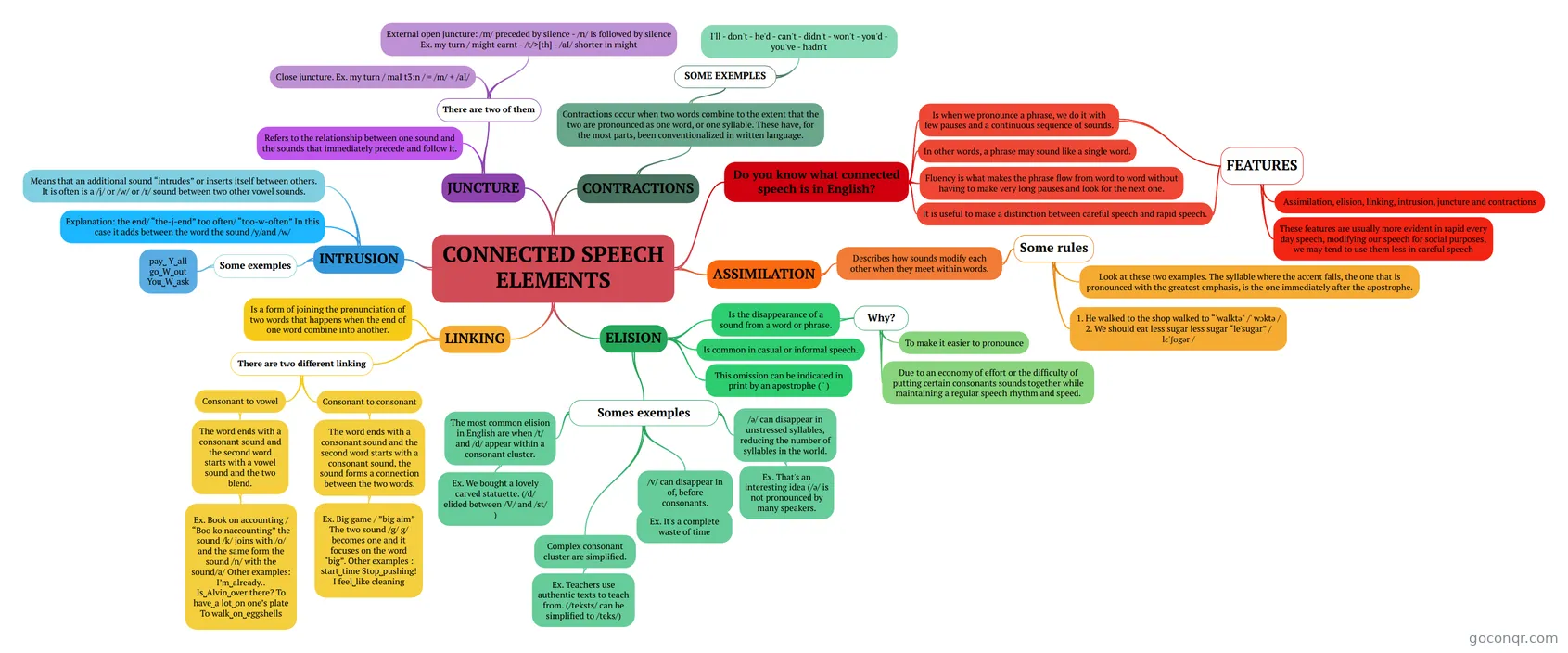
Mind map: Connected speech elements in English
Contenido del mapa
CONNECTED SPEECH ELEMENTS
Do you know what connected speech is in English?
- Is when we pronounce a phrase, we do it with few pauses and a continuous sequence of sounds.
- In other words, a phrase may sound like a single word.
- Fluency is what makes the phrase flow from word to word without having to make very long pauses and look for the next one.
- It is useful to make a distinction between careful speech and rapid speech.
- FEATURES
- Assimilation, elision, linking, intrusion, juncture and contractions
- These features are usually more evident in rapid every day speech, modifying our speech for social purposes, we may tend to use them less in careful speech
- FEATURES
- Is when we pronounce a phrase, we do it with few pauses and a continuous sequence of sounds.
ASSIMILATION
- Describes how sounds modify each other when they meet within words.
- Some rules
- Look at these two examples. The syllable where the accent falls, the one that is pronounced with the greatest emphasis, is the one immediately after the apostrophe.
- 1. He walked to the shop walked to “'walktə" /' wɔktə / 2. We should eat less sugar less sugar “le'sugar” / lɛ'ʃʊgər /
- Some rules
- Describes how sounds modify each other when they meet within words.
ELISION
- Is the disappearance of a sound from a word or phrase.
- Why?
- To make it easier to pronounce
- Due to an economy of effort or the difficulty of putting certain consonants sounds together while maintaining a regular speech rhythm and speed.
- Why?
- Is common in casual or informal speech.
- This omission can be indicated in print by an apostrophe ( ' )
- Somes exemples
- The most common elision in English are when /t/ and /d/ appear within a consonant cluster.
- Ex. We bought a lovely carved statuette. (/d/ elided between /V/ and /st/ )
- Complex consonant cluster are simplified.
- Ex. Teachers use authentic texts to teach from. (/teksts/ can be simplified to /teks/)
- /v/ can disappear in of, before consonants.
- Ex. It's a complete waste of time
- /ə/ can disappear in unstressed syllables, reducing the number of syllables in the world.
- Ex. That's an interesting idea (/ə/ is not pronounced by many speakers.
- The most common elision in English are when /t/ and /d/ appear within a consonant cluster.
- Is the disappearance of a sound from a word or phrase.
LINKING
- Is a form of joining the pronunciation of two words that happens when the end of one word combine into another.
- There are two different linking
- Consonant to vowel
- The word ends with a consonant sound and the second word starts with a vowel sound and the two blend.
- Ex. Book on accounting / “Boo ko naccounting” the sound /k/ joins with /o/ and the same form the sound /n/ with the sound/a/ Other examples: I’m⎵already.. Is⎵Alvin⎵over there? To have⎵a lot⎵on one’s plate To walk⎵on⎵eggshells
- The word ends with a consonant sound and the second word starts with a vowel sound and the two blend.
- Consonant to consonant
- The word ends with a consonant sound and the second word starts with a consonant sound, the sound forms a connection between the two words.
- Ex. Big game / ”big aim” The two sound /g/ g/ becomes one and it focuses on the word “big”. Other examples : start⎵time Stop⎵pushing! I feel⎵like cleaning
- The word ends with a consonant sound and the second word starts with a consonant sound, the sound forms a connection between the two words.
- Consonant to vowel
INTRUSION
- Means that an additional sound “intrudes” or inserts itself between others. It is often is a /j/ or /w/ or /r/ sound between two other vowel sounds.
- Explanation: the end/ “the-j-end” too often/ “too-w-often” In this case it adds between the word the sound /y/and /w/
- Some exemples
- pay⎵ Y⎵all go⎵W⎵out You⎵W⎵ask
JUNCTURE
- Refers to the relationship between one sound and the sounds that immediately precede and follow it.
- There are two of them
- Close juncture. Ex. my turn / maI t3:n / = /m/ + /aI/
- External open juncture: /m/ preceded by silence - /n/ is followed by silence Ex. my turn / might earnt - /t/>[th] - /aI/ shorter in might
CONTRACTIONS
- Contractions occur when two words combine to the extent that the two are pronounced as one word, or one syllable. These have, for the most parts, been conventionalized in written language.
- SOME EXEMPLES
- I'll - don't - he'd - can't - didn't - won't - you'd - you've - hadn't
- SOME EXEMPLES
- Contractions occur when two words combine to the extent that the two are pronounced as one word, or one syllable. These have, for the most parts, been conventionalized in written language.
Información
- Descripción
- Mapa Mental sobre CONNECTED SPEECH ELEMENTS, creado por Natalia Cantor el 22/08/2020.
- Creado por
- Natalia Cantor
- Visitas
- 0
- Valoración