
Mapa mental
Markets and Competitions
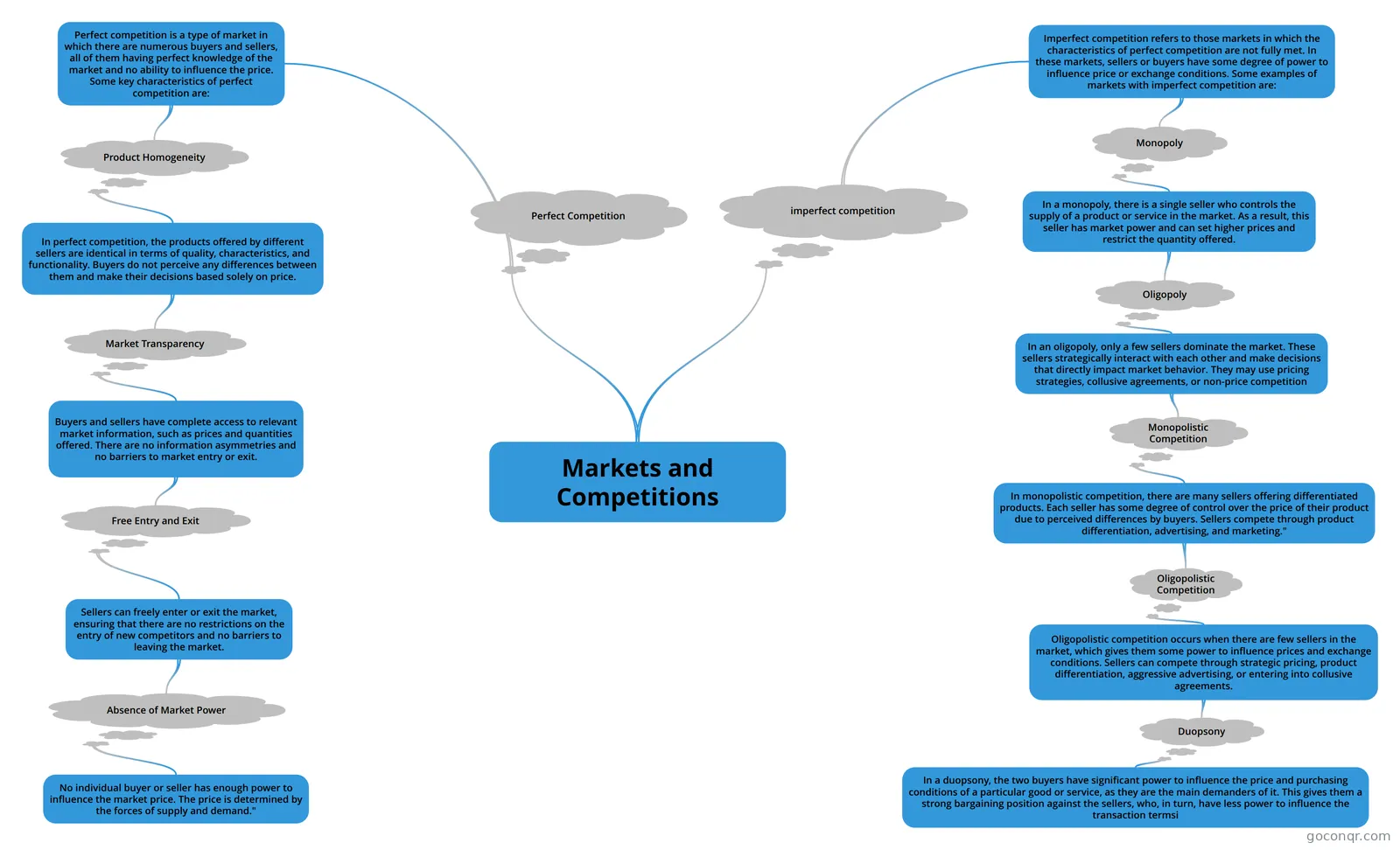
Mind map: markets and competitions
Contenido del mapa
Markets and Competitions
Perfect Competition
- Perfect competition is a type of market in which there are numerous buyers and sellers, all of them having perfect knowledge of the market and no ability to influence the price. Some key characteristics of perfect competition are:
- Product Homogeneity
- In perfect competition, the products offered by different sellers are identical in terms of quality, characteristics, and functionality. Buyers do not perceive any differences between them and make their decisions based solely on price.
- Market Transparency
- Buyers and sellers have complete access to relevant market information, such as prices and quantities offered. There are no information asymmetries and no barriers to market entry or exit.
- Free Entry and Exit
- Sellers can freely enter or exit the market, ensuring that there are no restrictions on the entry of new competitors and no barriers to leaving the market.
- Absence of Market Power
- No individual buyer or seller has enough power to influence the market price. The price is determined by the forces of supply and demand."
- Absence of Market Power
- Sellers can freely enter or exit the market, ensuring that there are no restrictions on the entry of new competitors and no barriers to leaving the market.
- Free Entry and Exit
- Buyers and sellers have complete access to relevant market information, such as prices and quantities offered. There are no information asymmetries and no barriers to market entry or exit.
- Market Transparency
- In perfect competition, the products offered by different sellers are identical in terms of quality, characteristics, and functionality. Buyers do not perceive any differences between them and make their decisions based solely on price.
- Product Homogeneity
- Perfect competition is a type of market in which there are numerous buyers and sellers, all of them having perfect knowledge of the market and no ability to influence the price. Some key characteristics of perfect competition are:
imperfect competition
- Imperfect competition refers to those markets in which the characteristics of perfect competition are not fully met. In these markets, sellers or buyers have some degree of power to influence price or exchange conditions. Some examples of markets with imperfect competition are:
- Monopoly
- In a monopoly, there is a single seller who controls the supply of a product or service in the market. As a result, this seller has market power and can set higher prices and restrict the quantity offered.
- Oligopoly
- In an oligopoly, only a few sellers dominate the market. These sellers strategically interact with each other and make decisions that directly impact market behavior. They may use pricing strategies, collusive agreements, or non-price competition
- Monopolistic Competition
- In monopolistic competition, there are many sellers offering differentiated products. Each seller has some degree of control over the price of their product due to perceived differences by buyers. Sellers compete through product differentiation, advertising, and marketing."
- Oligopolistic Competition
- Oligopolistic competition occurs when there are few sellers in the market, which gives them some power to influence prices and exchange conditions. Sellers can compete through strategic pricing, product differentiation, aggressive advertising, or entering into collusive agreements.
- Duopsony
- In a duopsony, the two buyers have significant power to influence the price and purchasing conditions of a particular good or service, as they are the main demanders of it. This gives them a strong bargaining position against the sellers, who, in turn, have less power to influence the transaction termsi
- Duopsony
- Oligopolistic competition occurs when there are few sellers in the market, which gives them some power to influence prices and exchange conditions. Sellers can compete through strategic pricing, product differentiation, aggressive advertising, or entering into collusive agreements.
- Oligopolistic Competition
- In monopolistic competition, there are many sellers offering differentiated products. Each seller has some degree of control over the price of their product due to perceived differences by buyers. Sellers compete through product differentiation, advertising, and marketing."
- Monopolistic Competition
- In an oligopoly, only a few sellers dominate the market. These sellers strategically interact with each other and make decisions that directly impact market behavior. They may use pricing strategies, collusive agreements, or non-price competition
- Oligopoly
- In a monopoly, there is a single seller who controls the supply of a product or service in the market. As a result, this seller has market power and can set higher prices and restrict the quantity offered.
- Monopoly
- Imperfect competition refers to those markets in which the characteristics of perfect competition are not fully met. In these markets, sellers or buyers have some degree of power to influence price or exchange conditions. Some examples of markets with imperfect competition are:
Información
- Descripción
- MARKETS AND COMPETITIONS
- Creado por
- yudy barajas
- Visitas
- 6
- Valoración
Más sobre Imperfect competition