
Mapa mental
Defamation
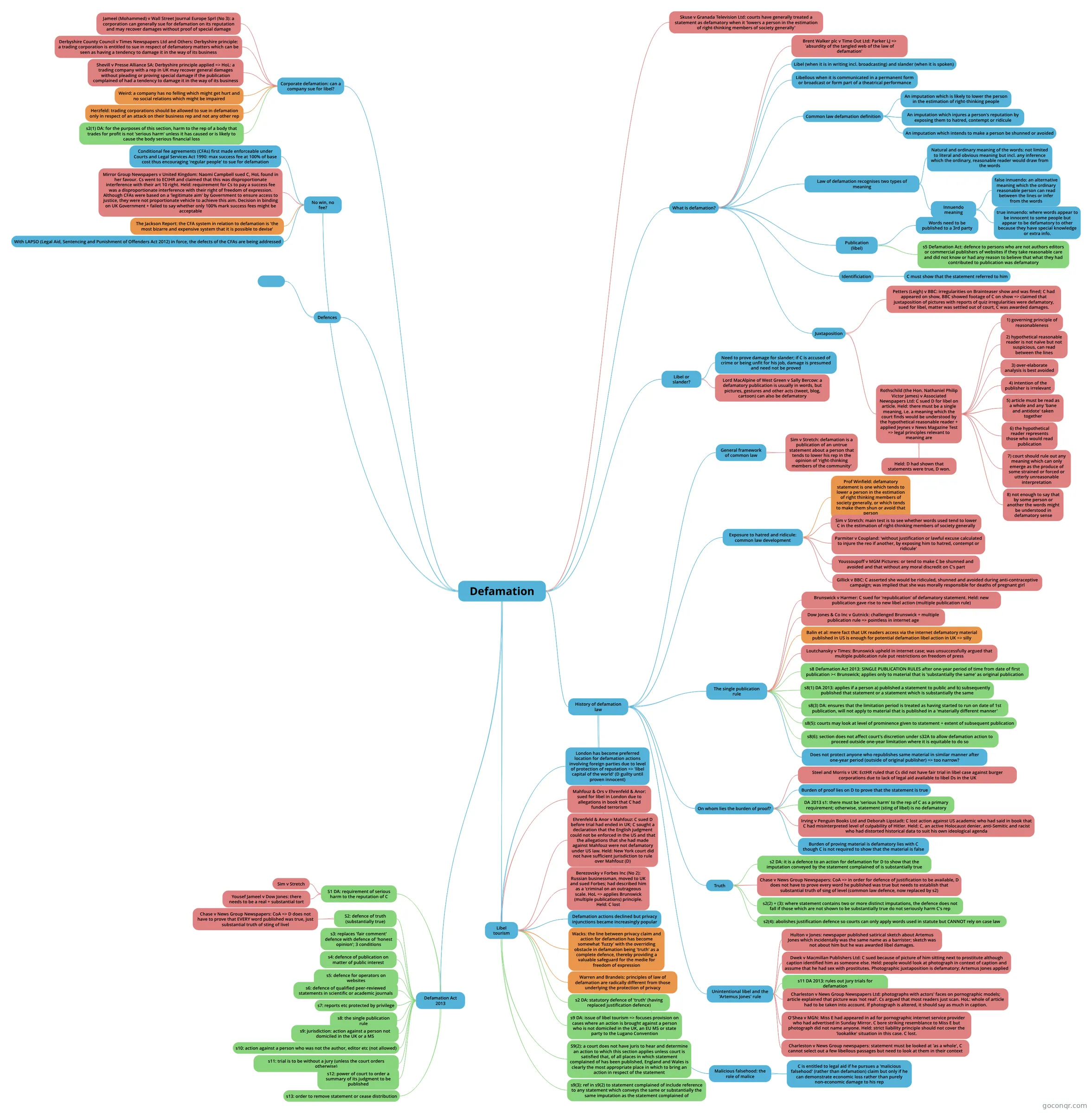
Mind map: Defamation Law and Defences
Contenido del mapa
Defamation
Skuse v Granada Television Ltd: courts have generally treated a statement as defamatory when it 'lowers a person in the estimation of right-thinking members of society generally'
What is defamation?
- Brent Walker plc v Time Out Ltd: Parker LJ => 'absurdity of the tangled web of the law of defamation'
- Libel (when it is in writing incl. broadcasting) and slander (when it is spoken)
- Libellous when it is communicated in a permanent form or broadcast or form part of a theatrical performance
- Common law defamation definition
- An imputation which is likely to lower the person in the estimation of right-thinking people
- An imputation which injures a person's reputation by exposing them to hatred, contempt or ridicule
- An imputation which intends to make a person be shunned or avoided
- Law of defamation recognises two types of meaning
- Natural and ordinary meaning of the words: not limited to literal and obvious meaning but incl. any inference which the ordinary, reasonable reader would draw from the words
- Innuendo meaning
- false innuendo: an alternative meaning which the ordinary reasonable person can read between the lines or infer from the words
- true innuendo: where words appear to be innocent to some people but appear to be defamatory to other because they have special knowledge or extra info.
- Publication (libel)
- Words need to be published to a 3rd party
- s5 Defamation Act: defence to persons who are not authors editors or commercial publishers of websites if they take reasonable care and did not know or had any reason to believe that what they had contributed to publication was defamatory
- Identificiation
- C must show that the statement referred to him
- Juxtaposition
- Petters (Leigh) v BBC: irregularities on Brainteaser show and was fined; C had appeared on show, BBC showed footage of C on show => claimed that juxtaposition of pictures with reports of quiz irregularities were defamatory, sued for libel, matter was settled out of court, C was awarded damages.
- Rothschild (the Hon. Nathaniel Philip Victor James) v Associated Newspapers Ltd: C sued D for libel on article. Held: there must be a single meaning, i.e. a meaning which the court finds would be understood by the hypothetical reasonable reader + applied Jeynes v News Magazine Test => legal principles relevant to meaning are
- 1) governing principle of reasonableness
- 2) hypothetical reasonable reader is not naïve but not suspicious, can read between the lines
- 3) over-elaborate analysis is best avoided
- 4) intention of the publisher is irrelevant
- 5) article must be read as a whole and any 'bane and antidote' taken together
- 6) the hypothetical reader represents those who would read publication
- 7) court should rule out any meaning which can only emerge as the produce of some strained or forced or utterly unreasonable interpretation
- 8) not enough to say that by some person or another the words might be understood in defamatory sense
- Held: D had shown that statements were true, D won.
Libel or slander?
- Need to prove damage for slander; if C is accused of crime or being unfit for his job, damage is presumed and need not be proved
- Lord MacAlpine of West Green v Sally Bercow: a defamatory publication is usually in words, but pictures, gestures and other acts (tweet, blog, cartoon) can also be defamatory
History of defamation law
- General framework of common law
- Sim v Stretch: defamation is a publication of an untrue statement about a person that tends to lower his rep in the opinion of 'right-thinking members of the community'
- Exposure to hatred and ridicule: common law development
- Prof Winfield: defamatory statement is one which tends to lower a person in the estimation of right thinking members of society generally, or which tends to make them shun or avoid that person
- Sim v Stretch: main test is to see whether words used tend to lower C in the estimation of right-thinking members of society generally
- Parmiter v Coupland: 'without justification or lawful excuse calculated to injure the reo if another, by exposing him to hatred, contempt or ridicule'
- Youssoupoff v MGM Pictures: or tend to make C be shunned and avoided and that without any moral discredit on C's part
- Gillick v BBC: C asserted she would be ridiculed, shunned and avoided during anti-contraceptive campaign; was implied that she was morally responsible for deaths of pregnant girl
- The single publication rule
- Brunswick v Harmer: C sued for 'republication' of defamatory statement. Held: new publication gave rise to new libel action (multiple publication rule)
- Dow Jones & Co Inc v Gutnick: challenged Brunswick + multiple publication rule => pointless in internet age
- Balin et al: mere fact that UK readers access via the internet defamatory material published in US is enough for potential defamation libel action in UK => silly
- Loutchansky v Times: Brunswick upheld in internet case; was unsuccessfully argued that multiple publication rule put restrictions on freedom of press
- s8 Defamation Act 2013: SINGLE PUBLICATION RULES after one-year period of time from date of first publication >< Brunswick; applies only to material that is 'substantially the same' as original publication
- s8(1) DA 2013: applies if a person a) published a statement to public and b) subsequently published that statement or a statement which is substantially the same
- s8(3) DA: ensures that the limitation period is treated as having started to run on date of 1st publication, will not apply to material that is published in a 'materially different manner'
- s8(5): courts may look at level of prominence given to statement + extent of subsequent publication
- s8(6): section does not affect court's discretion under s32A to allow defamation action to proceed outside one-year limitation where it is equitable to do so
- Does not protect anyone who republishes same material in similar manner after one-year period (outside of original publisher) => too narrow?
- On whom lies the burden of proof?
- Steel and Morris v UK: EctHR ruled that Cs did not have fair trial in libel case against burger corporations due to lack of legal aid available to libel Ds in the UK
- Burden of proof lies on D to prove that the statement is true
- DA 2013 s1: there must be 'serious harm' to the rep of C as a primary requirement; otherwise, statement (sting of libel) is no defamatory
- Irving v Penguin Books Ltd and Deborah Lipstadt: C lost action against US academic who had said in book that C had misinterpreted level of culpability of Hitler. Held: C, an active Holocaust denier, anti-Semitic and racist who had distorted historical data to suit his own ideological agenda
- Burden of proving material is defamatory lies with C though C is not required to show that the material is false
- Truth
- s2 DA: it is a defence to an action for defamation for D to show that the imputation conveyed by the statement complained of is substantially true
- Chase v News Group Newspapers: CoA => in order for defence of justification to be available, D does not have to prove every word he published was true but needs to establish that substantial truth of sing of level (common law defence, now replaced by s2)
- s2(2) + (3): where statement contains two or more distinct imputations, the defence does not fall if those which are not shown to be substantially true do not seriously harm C's rep
- s2(4): abolishes justification defence so courts can only apply words used in statute but CANNOT rely on case law
- Unintentional libel and the 'Artemus Jones' rule
- Hulton v Jones: newspaper published satirical sketch about Artemus Jones which incidentally was the same name as a barrister; sketch was not about him but he was awarded libel damages.
- Dwek v Macmillan Publishers Ltd: C sued because of picture of him sitting next to prostitute although caption identified him as someone else. Held: people would look at photograph in context of caption and assume that he had sex with prostitutes. Photographic juxtaposition is defamatory; Artemus Jones applied
- s11 DA 2013: rules out jury trials for defamation
- Charleston v News Group Newspapers Ltd: photographs with actors' faces on pornographic models; article explained that picture was 'not real'. Cs argued that most readers just scan. HoL: whole of article had to be taken into account. If photograph is altered, it should say as much in caption.
- O'Shea v MGN: Miss E had appeared in ad for pornographic internet service provider who had advertised in Sunday Mirror. C bore striking resemblance to Miss E but photograph did not name anyone. Held: strict liability principle should not cover the 'lookalike' situation in this case. C lost.
- Charleston v News Group newspapers: statement must be looked at 'as a whole', C cannot select out a few libellous passages but need to look at them in their context
- Malicious falsehood: the role of malice
- C is entitled to legal aid if he pursues a 'malicious falsehood' (rather than defamation) claim but only if he can demonstrate economic loss rather than purely non-economic damage to his rep
- General framework of common law
Libel tourism
- London has become preferred location for defamation actions involving foreign parties due to level of protection of reputation => 'libel capital of the world' (D guilty until proven innocent)
- Berezovsky v Forbes Inc (No 2): Russian businessman, moved to UK and sued Forbes; had described him as a 'criminal on an outrageous scale. HoL => applies Brunswick (multiple publications) principle. Held: C lost
- Defamation actions declined but privacy injunctions became increasingly popular
- Wacks: the line between privacy claim and action for defamation has become somewhat 'fuzzy' with the overriding obstacle in defamation being 'truth' as a complete defence, thereby providing a valuable safeguard for the medie for freedom of expression
- Warren and Brandeis: principles of law of defamation are radically different from those underlying the protection of privacy
- s2 DA: statutory defence of 'truth' (having replaced justification defence)
- s9 DA: issue of libel tourism => focuses provision on cases where an action is brought against a person who is not domiciled in the UK, an EU MS or state party to the Lugano Convention
- S9(2): a court does not have juris to hear and determine an action to which this section applies unless court is satisfied that, of all places in which statement complained of has been published, England and Wales is clearly the most appropriate place in which to bring an action in respect of the statement
- s9(3): ref in s9(2) to statement complained of include reference to any statement which conveys the same or substantially the same imputation as the statement complained of
- Mahfouz & Ors v Ehrenfeld & Anor: sued for libel in London due to allegations in book that C had funded terrorism
- Ehrenfeld & Anor v Mahfouz: C sued D before trial had ended in UK; C sought a declaration that the English judgment could not be enforced in the US and that the allegations that she had made against Mahfouz were not defamatory under US law. Held: New York court did not have sufficient jurisdiction to rule over Mahfouz (D)
Defamation Act 2013
- S1 DA: requirement of serious harm to the reputation of C
- Sim v Stretch
- Yousef Jameel v Dow Jones: there needs to be a real + substantial tort
- S2: defence of truth (substantially true)
- Chase v News Group Newspapers: CoA => D does not have to prove that EVERY word published was true, just substantial truth of sting of livel
- s3: replaces 'fair comment' defence with defence of 'honest opinion'; 3 conditions
- s4: defence of publication on matter of public interest
- s5: defence for operators on websites
- s6: defence of qualified peer-reviewed statements in scientific or academic journals
- s7: reports etc protected by privilege
- s8: the single publication rule
- s9: jurisdiction: action against a person not domiciled in the UK or a MS
- s10: action against a person who was not the author, editor etc (not allowed)
- s11: trial is to be without a jury (unless the court orders otherwise)
- s12: power of court to order a summary of its judgment to be published
- s13: order to remove statement or cease distribution
- S1 DA: requirement of serious harm to the reputation of C
Corporate defamation: can a company sue for libel?
- Jameel (Mohammed) v Wall Street Journal Europe Sprl (No 3): a corporation can generally sue for defamation on its reputation and may recover damages without proof of special damage
- Derbyshire County Council v Times Newspapers Ltd and Others: Derbyshire principle: a trading corporation is entitled to sue in respect of defamatory matters which can be seen as having a tendency to damage it in the way of its business
- Shevill v Presse Alliance SA: Derbyshire principle applied => HoL: a trading company with a rep in UK may recover general damages without pleading or proving special damage if the publication complained of had a tendency to damage it in the way of its business
- Weird: a company has no felling which might get hurt and no social relations which might be impaired
- Herzfeld: trading corporations should be allowed to sue in defamation only in respect of an attack on their business rep and not any other rep
- s2(1) DA: for the purposes of this section, harm to the rep of a body that trades for profit is not 'serious harm' unless it has caused or is likely to cause the body serious financial loss
No win, no fee?
- Conditional fee agreements (CFAs) first made enforceable under Courts and Legal Services Act 1990: max success fee at 100% of base cost thus encouraging 'regular people' to sue for defamation
- Mirror Group Newspapers v United Kingdom: Naomi Campbell sued C, HoL found in her favour. Cs went to ECtHR and claimed that this was disproportionate interference with their art 10 right. Held: requirement for Cs to pay a success fee was a disproportionate interference with their right of freedom of expression. Although CFAs were based on a 'legitimate aim' by Government to ensure access to justice, they were not proportionate vehicle to achieve this aim. Decision in binding on UK Government + failed to say whether only 100% mark success fees might be acceptable
- The Jackson Report: the CFA system in relation to defamation is 'the most bizarre and expensive system that it is possible to devise'
- With LAPSO (Legal Aid, Sentencing and Punishment of Offenders Act 2012) in force, the defects of the CFAs are being addressed
Defences
Información
- Descripción
- Undergraduate Media law Mapa Mental sobre Defamation, creado por e.schou el 05/05/2015.
- Creado por
- e.schou
- Visitas
- 1
- Valoración