
Mapa mental
grammar level 5
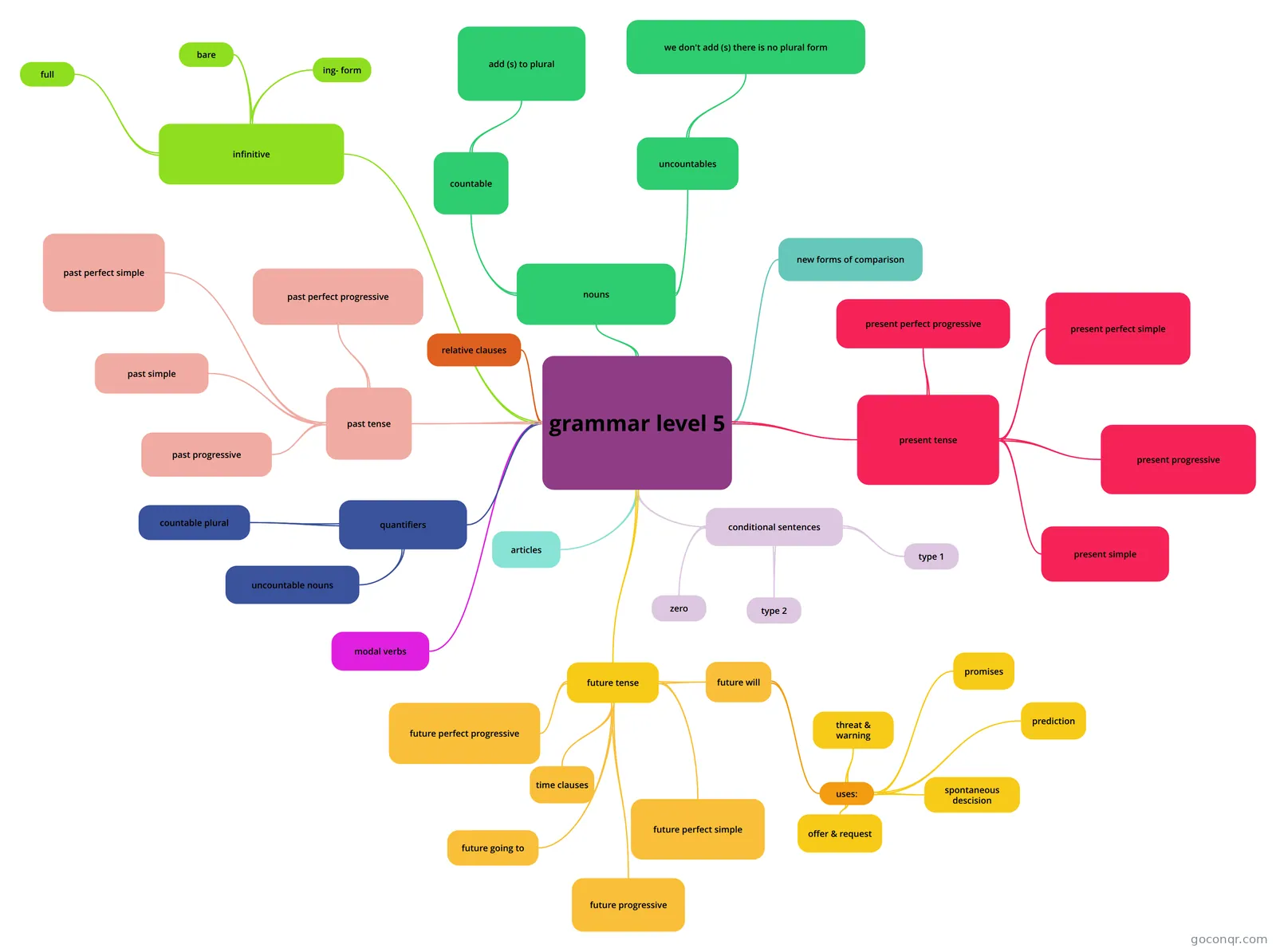
Mind map: grammar level 5
Contenido del mapa
grammar level 5
future tense
- future will
- form : sub + will + base form of verb i will go to London.
- uses:
- prediction
- i think it will rain.
- spontaneous descision
- We don't have much sugar , I will bring some.
- promises
- I promise you , I will call you when I reach home.
- offer & request
- Will you bring me some coffee.
- threat & warning
- I won't give you sweet.
- prediction
- future going to
- form: sub+ be + going to + base verb they are going to travel.she is going to visit me.I am going to study English.
- time expressions: tomorrow tonight next this month....
- future progressive
- form : sub + will
- form : sub + will be + ving at 9 oclock tomorrow , he will be flying to London
- future perfect simple
- form: sub + will have + p.p. I will have gone before they visit him. they will have eaten by the time you arrive
- time expressions: by the time / by then / before
- future perfect progressive
- form: sub + will have been + ving It focuses on the duration of the action.
- time expressions: by / by the time / by then / before By midnight , we will have been flying for 7 hours.
- time clauses
- as soon as / when / after / before until / by the time / as /while When I arrive , I will give you a call. Notice: time clause NEVER comes in future but it is in the present tense the second part could be in the future
- future will
past tense
- past simple
- form: sub+ past tense i went to the mall yesterday. time expression: ago / yesterday / last / in 1897....
- past progressive
- form: sub + (was / were ) + ving they were playing tennis.
- time clauses: when / as / while / as soon as I was watching TV ,when the phone rang. As /While they were playing tennis , Ali fell down. As soon as he arrived , he cooked dinner.
- past perfect simple
- form: sub + had + p.p they had gone to the mall before she left.
- past perfect progressive
- notice: always progressive focuses on the duration of the action
- form: sub+ had been + ving i had been cleaning the room for five hours
- time expressions: for / since / how long / by the time
- past simple
present tense
- present simple
- form: sub+ v(s) they go to school every day he often plays tennis time expression: always / often / every
- present progressive
- be careful: stative verbs always in present simple they don't come in the progressive tense.
- form : sub + be + ving time expressions: now / this month..... these days.... next / tonight / tomorrow
- present perfect simple
- form : sub+ has / have + p.p they have gone to the mall she has written the report
- time expressions: already / just / before / after
- present perfect progressive
- the main difference between the present perfect and the present perfect progressive is that the progressive focuses on the duration of the action while present perfect focuses on the result of the action
- time expressions: for / since / how long / all for example:we have been working all day.we have worked before we leave.
- present simple
nouns
- countable
- add (s) to plural
- uncountables
- we don't add (s) there is no plural form
- countable
quantifiers
- countable plural
- many: there are many students a few: I need a few pens for the students few: there are few cars in the park some: there are some new cups any : there aren't any one. alot of / plenty of / lots of there are a lot of books on the desk.
- uncountable nouns
- a little there is a little water some there is some juice in the cup. any i dont have any milk little : i have little rice much: there are much cream on the cake.
- countable plural
conditional sentences
- type 1
- if you study hard you will pass the exam. part 1 ( present simple) part2 (future)
- type 2
- if she were you , she wouldn't come here. part1 ( past) part 2 (would)
- zero
- if water reaches 100 degrees , it boils. part 1 ( present simple) part 2( present simple)
- type 1
articles
- the (unique things ) a ( to mention sth for the first time an ( before vowels)
new forms of comparison
- comparative + and + comparative: it is getting more and more higher. the +comparative , the + comparative: the more you study the better you will do in the test.
infinitive
- full
- to + v too / enough to express purpose after certain verbs after certain adj after question words
- bare
- base form of verb: after modals after (let / make) after ( would rather / had better
- ing- form
- (v+ing) as subject after certain verbs after certain expressions
- full
modal verbs
- could must have to had better with their negative forms
relative clauses
- who (pple) which ( things / ideas / animals) where (places) when (time)