
Mapa mental
Modals verbs
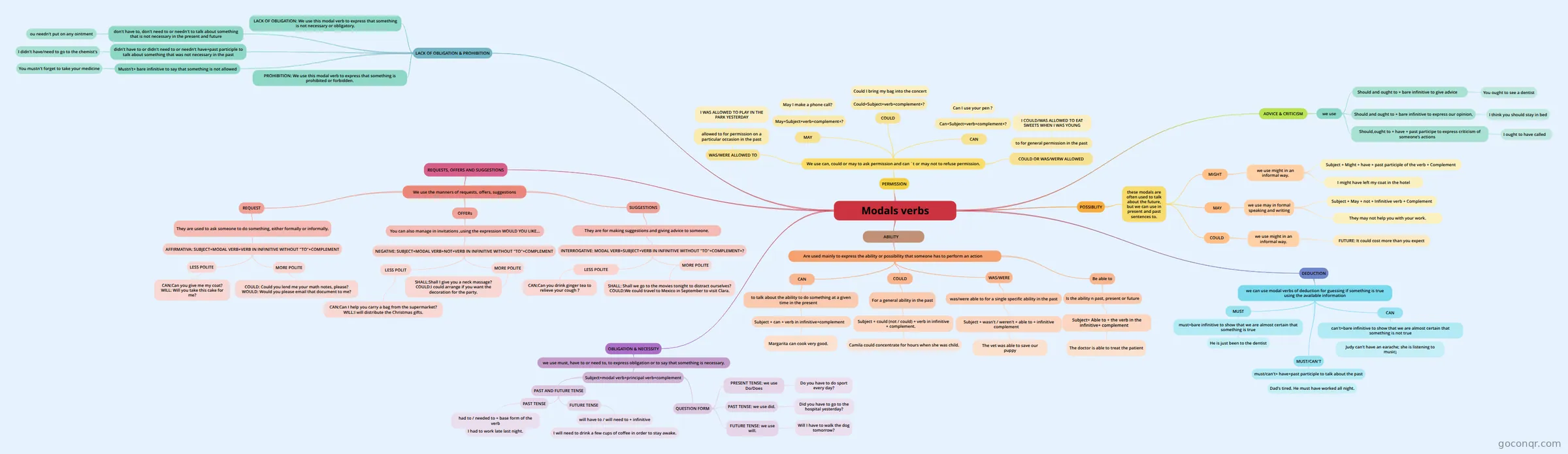
Mind map: Modal verbs
Contenido del mapa
Modals verbs
ABILITY
- Are used mainly to express the ability or possibility that someone has to perform an action
- CAN
- to talk about the ability to do something at a given time in the present
- Subject + can + verb in infinitive+complement
- Margarita can cook very good.
- Subject + can + verb in infinitive+complement
- to talk about the ability to do something at a given time in the present
- COULD
- For a general ability in the past
- Subject + could (not / could) + verb in infinitive + complement.
- Camila could concentrate for hours when she was child.
- Subject + could (not / could) + verb in infinitive + complement.
- For a general ability in the past
- WAS/WERE
- was/were able to for a single specific ability in the past
- Subject + wasn't / weren't + able to + infinitive complement
- The vet was able to save our puppy
- Subject + wasn't / weren't + able to + infinitive complement
- was/were able to for a single specific ability in the past
- Be able to
- Is the ability n past, present or future
- Subject+ Able to + the verb in the infinitive+ complement
- The doctor is able to treat the patient
- Subject+ Able to + the verb in the infinitive+ complement
- Is the ability n past, present or future
- CAN
- Are used mainly to express the ability or possibility that someone has to perform an action
REQUESTS, OFFERS AND SUGGESTIONS
- We use the manners of requests, offers, suggestions
- REQUEST
- They are used to ask someone to do something, either formally or informally.
- AFFIRMATIVA: SUBJECT+MODAL VERB+VERB IN INFINITIVE WITHOUT "TO"+COMPLEMENT
- LESS POLITE
- CAN:Can you give me my coat? WILL: Will you take this cake for me?
- MORE POLITE
- COULD: Could you lend me your math notes, please? WOULD: Would you please email that document to me?
- LESS POLITE
- AFFIRMATIVA: SUBJECT+MODAL VERB+VERB IN INFINITIVE WITHOUT "TO"+COMPLEMENT
- They are used to ask someone to do something, either formally or informally.
- OFFERs
- You can also manage in invitations ,using the expression WOULD YOU LIKE...
- NEGATIVE: SUBJECT+MODAL VERB+NOT+VERB IN INFINITIVE WITHOUT "TO"+COMPLEMENT
- LESS POLIT
- CAN:Can I help you carry a bag from the supermarket? WILL:I will distribute the Christmas gifts.
- MORE POLITE
- SHALL:Shall I give you a neck massage? COULD:I could arrange if you want the decoration for the party.
- LESS POLIT
- NEGATIVE: SUBJECT+MODAL VERB+NOT+VERB IN INFINITIVE WITHOUT "TO"+COMPLEMENT
- You can also manage in invitations ,using the expression WOULD YOU LIKE...
- SUGGESTIONS
- They are for making suggestions and giving advice to someone.
- INTERROGATIVE: MODAL VERB+SUBJECT+VERB IN INFINITIVE WITHOUT "TO"+COMPLEMENT+?
- LESS POLITE
- CAN:Can you drink ginger tea to relieve your cough ?
- MORE POLITE
- SHALL: Shall we go to the movies tonight to distract ourselves? COULD:We could travel to Mexico in September to visit Clara.
- LESS POLITE
- INTERROGATIVE: MODAL VERB+SUBJECT+VERB IN INFINITIVE WITHOUT "TO"+COMPLEMENT+?
- They are for making suggestions and giving advice to someone.
- REQUEST
- We use the manners of requests, offers, suggestions
PERMISSION
- We use can, could or may to ask permission and can ´t or may not to refuse permission.
- MAY
- May+Subject+verb+complement+?
- May I make a phone call?
- May+Subject+verb+complement+?
- COULD
- Could+Subject+verb+complement+?
- Could I bring my bag into the concert
- Could+Subject+verb+complement+?
- CAN
- Can+Subject+verb+complement+?
- Can I use your pen ?
- Can+Subject+verb+complement+?
- WAS/WERE ALLOWED TO
- allowed to for permission on a particular occasion in the past
- I WAS ALLOWED TO PLAY IN THE PARK YESTERDAY
- allowed to for permission on a particular occasion in the past
- COULD OR WAS/WERW ALLOWED
- to for general permission in the past
- I COULD/WAS ALLOWED TO EAT SWEETS WHEN I WAS YOUNG
- to for general permission in the past
- MAY
- We use can, could or may to ask permission and can ´t or may not to refuse permission.
POSSIBLITY
- these modals are often used to talk about the future, but we can use in present and past sentences to.
- MIGHT
- we use might in an informal way.
- Subject + Might + have + past participle of the verb + Complement
- I might have left my coat in the hotel
- we use might in an informal way.
- MAY
- we use may in formal speaking and writing
- Subject + May + not + Infinitive verb + Complement
- They may not help you with your work.
- we use may in formal speaking and writing
- COULD
- we use might in an informal way.
- FUTURE: It could cost more than you expect
- we use might in an informal way.
- MIGHT
- these modals are often used to talk about the future, but we can use in present and past sentences to.
OBLIGATION & NECESSITY
- we use must, have to or need to, to express obligation or to say that something is necessary.
- Subject+modal verb+principal verb+complement
- PAST AND FUTURE TENSE
- PAST TENSE
- had to / needed to + base form of the verb
- I had to work late last night.
- had to / needed to + base form of the verb
- FUTURE TENSE
- will have to / will need to + infinitive
- I will need to drink a few cups of coffee in order to stay awake.
- will have to / will need to + infinitive
- PAST TENSE
- QUESTION FORM
- PRESENT TENSE: we use Do/Does
- Do you have to do sport every day?
- PAST TENSE: we use did.
- Did you have to go to the hospital yesterday?
- FUTURE TENSE: we use will.
- Will I have to walk the dog tomorrow?
- PRESENT TENSE: we use Do/Does
- PAST AND FUTURE TENSE
- Subject+modal verb+principal verb+complement
- we use must, have to or need to, to express obligation or to say that something is necessary.
ADVICE & CRITICISM
- we use
- Should and ought to + bare infinitive to give advice
- You ought to see a dentist
- Should and ought to + bare infinitive to express our opinion,
- I think you should stay in bed
- Should,ought to + have + past participe to express criticism of someone’s actions
- I ought to have called
- Should and ought to + bare infinitive to give advice
- we use
DEDUCTION
- we can use modal verbs of deduction for guessing if something is true using the available information
- MUST
- must+bare infinitive to show that we are almost certain that something is true
- He is just been to the dentist
- must+bare infinitive to show that we are almost certain that something is true
- CAN
- can't+bare infinitive to show that we are almost certain that something is not true
- Judy can't have an earache; she is listening to music¡
- can't+bare infinitive to show that we are almost certain that something is not true
- MUST/CAN'T
- must/can't+ have+past participle to talk about the past
- Dad's tired. He must have worked all night.
- must/can't+ have+past participle to talk about the past
- MUST
- we can use modal verbs of deduction for guessing if something is true using the available information
LACK OF OBLIGATION & PROHIBITION
- LACK OF OBLIGATION: We use this modal verb to express that something is not necessary or obligatory.
- PROHIBITION: We use this modal verb to express that something is prohibited or forbidden.
- don't have to, don't need to or needn't to talk about something that is not necessary in the present and future
- ou needn't put on any ointment
- didn't have to or didn't need to or needn't have+past participle to talk about something that was not necessary in the past
- I didn't have/need to go to the chemist's
- Mustn't+ bare infinitive to say that something is not allowed
- You mustn't forget to take your medicine
Información
- Descripción
- Mapa Mental sobre Modals verbs, creado por Camila Manzano el 06/11/2020.
- Creado por
- Camila Manzano
- Visitas
- 1
- Valoración