
Mapa mental
Lady Macbeth
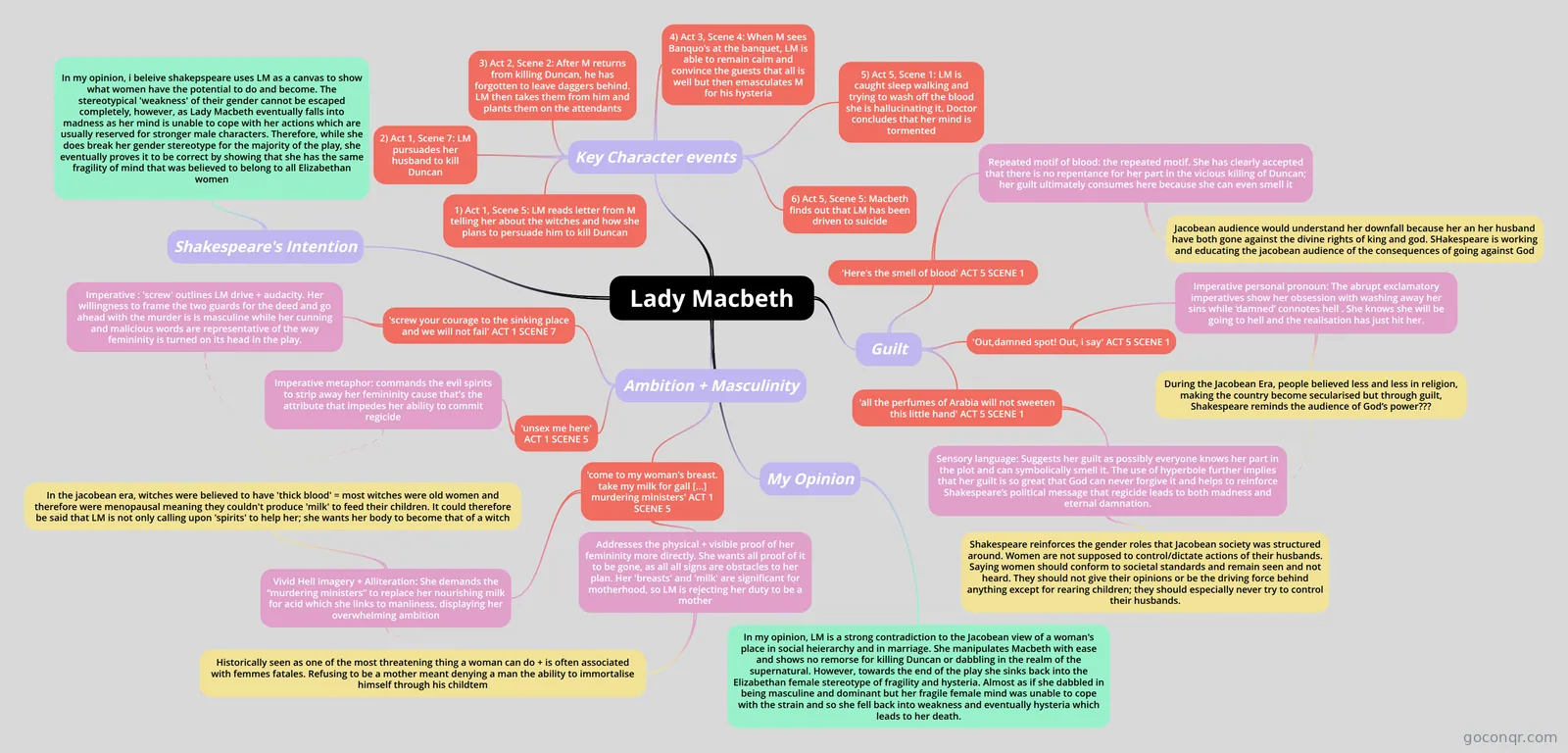
Mind map: Lady Macbeth
Contenido del mapa
Lady Macbeth
Guilt
- 'Here's the smell of blood' ACT 5 SCENE 1
- Repeated motif of blood: the repeated motif. She has clearly accepted that there is no repentance for her part in the vicious killing of Duncan; her guilt ultimately consumes here because she can even smell it
- Jacobean audience would understand her downfall because her an her husband have both gone against the divine rights of king and god. SHakespeare is working and educating the jacobean audience of the consequences of going against God
- Repeated motif of blood: the repeated motif. She has clearly accepted that there is no repentance for her part in the vicious killing of Duncan; her guilt ultimately consumes here because she can even smell it
- 'Out,damned spot! Out, i say' ACT 5 SCENE 1
- Imperative personal pronoun: The abrupt exclamatory imperatives show her obsession with washing away her sins while ‘damned’ connotes hell . She knows she will be going to hell and the realisation has just hit her.
- During the Jacobean Era, people believed less and less in religion, making the country become secularised but through guilt, Shakespeare reminds the audience of God’s power???
- Imperative personal pronoun: The abrupt exclamatory imperatives show her obsession with washing away her sins while ‘damned’ connotes hell . She knows she will be going to hell and the realisation has just hit her.
- 'all the perfumes of Arabia will not sweeten this little hand' ACT 5 SCENE 1
- Sensory language: Suggests her guilt as possibly everyone knows her part in the plot and can symbolically smell it. The use of hyperbole further implies that her guilt is so great that God can never forgive it and helps to reinforce Shakespeare’s political message that regicide leads to both madness and eternal damnation.
- Shakespeare reinforces the gender roles that Jacobean society was structured around. Women are not supposed to control/dictate actions of their husbands. Saying women should conform to societal standards and remain seen and not heard. They should not give their opinions or be the driving force behind anything except for rearing children; they should especially never try to control their husbands.
- Sensory language: Suggests her guilt as possibly everyone knows her part in the plot and can symbolically smell it. The use of hyperbole further implies that her guilt is so great that God can never forgive it and helps to reinforce Shakespeare’s political message that regicide leads to both madness and eternal damnation.
- 'Here's the smell of blood' ACT 5 SCENE 1
Ambition + Masculinity
- 'screw your courage to the sinking place and we will not fail' ACT 1 SCENE 7
- Imperative : 'screw' outlines LM drive + audacity. Her willingness to frame the two guards for the deed and go ahead with the murder is is masculine while her cunning and malicious words are representative of the way femininity is turned on its head in the play.
- 'come to my woman's breast. take my milk for gall [...] murdering ministers' ACT 1 SCENE 5
- Addresses the physical + visible proof of her femininity more directly. She wants all proof of it to be gone, as all all signs are obstacles to her plan. Her 'breasts' and 'milk' are significant for motherhood, so LM is rejecting her duty to be a mother
- Historically seen as one of the most threatening thing a woman can do + is often associated with femmes fatales. Refusing to be a mother meant denying a man the ability to immortalise himself through his childtem
- Vivid Hell imagery + Alliteration: She demands the “murdering ministers” to replace her nourishing milk for acid which she links to manliness, displaying her overwhelming ambition
- In the jacobean era, witches were believed to have 'thick blood' = most witches were old women and therefore were menopausal meaning they couldn't produce 'milk' to feed their children. It could therefore be said that LM is not only calling upon 'spirits' to help her; she wants her body to become that of a witch
- Addresses the physical + visible proof of her femininity more directly. She wants all proof of it to be gone, as all all signs are obstacles to her plan. Her 'breasts' and 'milk' are significant for motherhood, so LM is rejecting her duty to be a mother
- 'unsex me here' ACT 1 SCENE 5
- Imperative metaphor: commands the evil spirits to strip away her femininity cause that's the attribute that impedes her ability to commit regicide
- 'screw your courage to the sinking place and we will not fail' ACT 1 SCENE 7
Key Character events
- 1) Act 1, Scene 5: LM reads letter from M telling her about the witches and how she plans to persuade him to kill Duncan
- 2) Act 1, Scene 7: LM pursuades her husband to kill Duncan
- 3) Act 2, Scene 2: After M returns from killing Duncan, he has forgotten to leave daggers behind. LM then takes them from him and plants them on the attendants
- 4) Act 3, Scene 4: When M sees Banquo's at the banquet, LM is able to remain calm and convince the guests that all is well but then emasculates M for his hysteria
- 5) Act 5, Scene 1: LM is caught sleep walking and trying to wash off the blood she is hallucinating it. Doctor concludes that her mind is tormented
- 6) Act 5, Scene 5: Macbeth finds out that LM has been driven to suicide
Shakespeare's Intention
- In my opinion, i beleive shakepspeare uses LM as a canvas to show what women have the potential to do and become. The stereotypical 'weakness' of their gender cannot be escaped completely, however, as Lady Macbeth eventually falls into madness as her mind is unable to cope with her actions which are usually reserved for stronger male characters. Therefore, while she does break her gender stereotype for the majority of the play, she eventually proves it to be correct by showing that she has the same fragility of mind that was believed to belong to all Elizabethan women
My Opinion
- In my opinion, LM is a strong contradiction to the Jacobean view of a woman's place in social heierarchy and in marriage. She manipulates Macbeth with ease and shows no remorse for killing Duncan or dabbling in the realm of the supernatural. However, towards the end of the play she sinks back into the Elizabethan female stereotype of fragility and hysteria. Almost as if she dabbled in being masculine and dominant but her fragile female mind was unable to cope with the strain and so she fell back into weakness and eventually hysteria which leads to her death.
Información
- Descripción
- Mapa Mental sobre Lady Macbeth, creado por Hadia Habibi el 14/11/2020.
- Creado por
- Hadia Habibi
- Visitas
- 0
- Valoración