
Mapa mental
Democratic Peace Theory
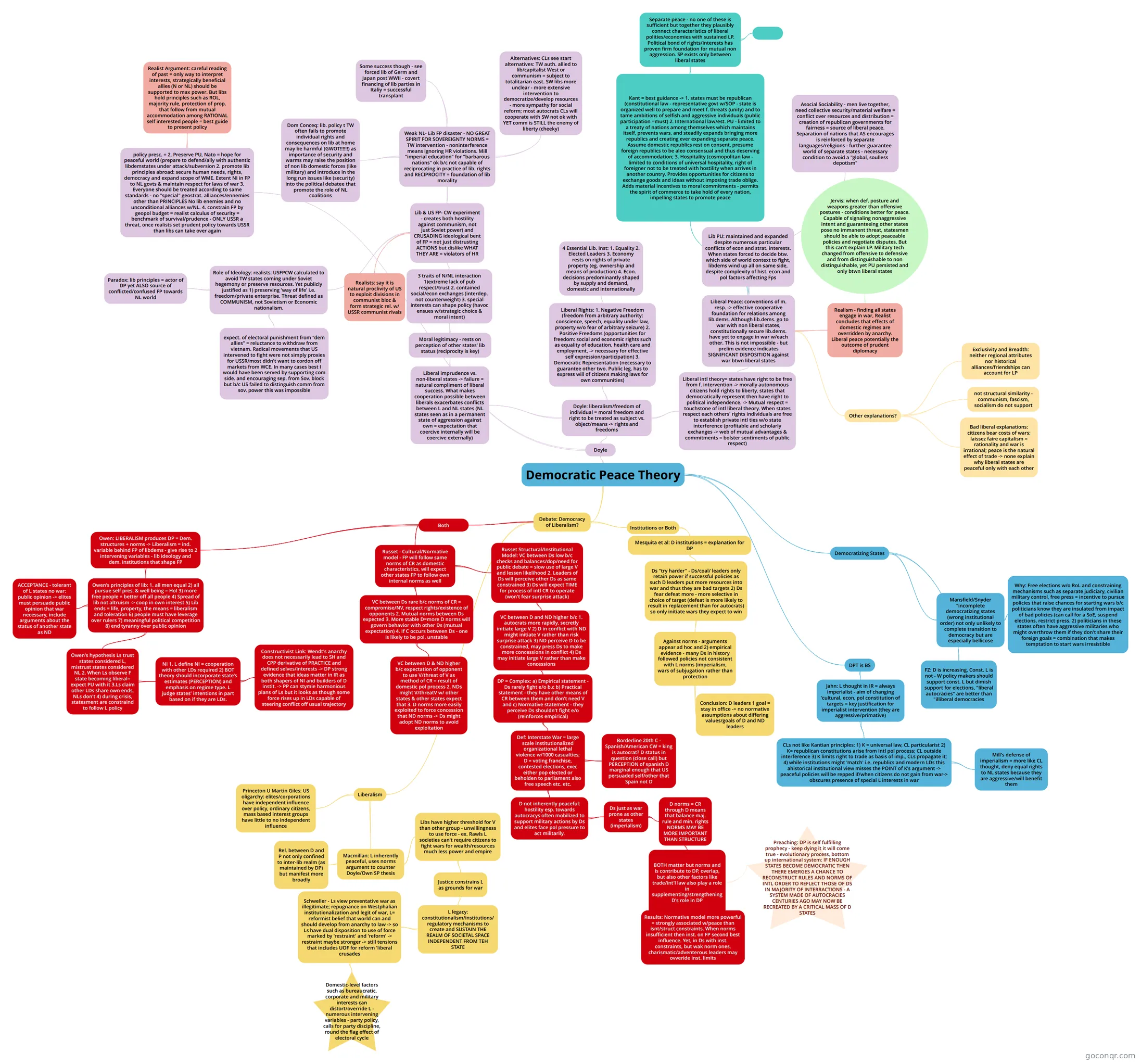
Mind map: Democratic peace theory
Contenido del mapa
Democratic Peace Theory
Doyle
- Doyle: liberalism/freedom of individual = moral freedom and right to be treated as subject vs. object/means -> rights and freedoms
- Liberal Rights: 1. Negative Freedom (freedom from arbitrary authority: conscience, speech, equality under law, property w/o fear of arbitrary seizure) 2. Positive Freedoms (opportunities for freedom: social and economic rights such as equality of education, health care and employment, -> necessary for effective self expression/participation) 3. Democratic Representation (necessary to guarantee other two. Public leg. has to express will of citizens making laws for own communities)
- 4 Essential Lib. Inst: 1. Equality 2. Elected Leaders 3. Economy rests on rights of private property (eg. ownership and means of production) 4. Econ. decisions predominantly shaped by supply and demand, domestic and internationally
- Liberal intl theory= states have right to be free from f. intervention -> morally autonomous citizens hold rights to liberty, states that democratically represent then have right to political independence. -> Mutual respect = touchstone of intl liberal theory. When states respect each others' rights individuals are free to establish private intl ties w/o state interference (profitable and scholarly exchanges -> web of mutual advantages & commitments = bolster sentiments of public respect)
- Liberal Peace: conventions of m. resp. -> effective cooperative foundation for relations among lib.dems. Although lib.dems. go to war with non liberal states, constitutionally secure lib.dems. have yet to engage in war w/each other. This is not impossible - but prelim evidence indicates SIGNIFICANT DISPOSITION against war btwn liberal states
- Lib PU: maintained and expanded despite numerous particular conflicts of econ and strat. interests. When states forced to decide btw. which side of world context to fight, libdems wind up all on same side, despite complexity of hist. econ and pol factors affecting Fps
- Realism - finding all states engage in war, Realist concludes that effects of domestic regimes are overridden by anarchy. Liberal peace potentially the outcome of prudent diplomacy
- Jervis: when def. posture and weapons greater than offensive postures - conditions better for peace. Capable of signaling nonaggressive intent and guaranteeing other states pose no immanent threat, statesmen should be able to adopt peaceable policies and negotiate disputes. But this can't explain LP. Military tech changed from offensive to defensive and from distinguishable to non distinguishable, yet PU persisted and only btwn liberal states
- Other explanations?
- not structural similarity - communism, fascism, socialism do not support
- Exclusivity and Breadth: neither regional attributes nor historical alliances/friendships can account for LP
- Bad liberal explanations: citizens bear costs of wars; laissez faire capitalism = rationality and war is irrational; peace is the natural effect of trade -> none explain why liberal states are peaceful only with each other
- Kant = best guidance -> 1. states must be republican (constitutional law - representative govt w/SOP - state is organized well to prepare and meet f. threats (unity) and to tame ambitions of selfish and aggressive individuals (public participation =must) 2. International law/est. PU - limited to a treaty of nations among themselves which maintains itself, prevents wars, and steadily expands bringing more republics and creating ever expanding separate peace. Assume domestic republics rest on consent, presume foreign republics to be aleo consensual and thus deserving of accommodation; 3. Hospitality (cosmopolitan law - limited to conditions of universal hospitality, right of foreigner not to be treated with hostility when arrives in another country. Provides opportunities for citizens to exchange goods and ideas without imposing trade oblige. Adds material incentives to moral commitments - permits the spirit of commerce to take hold of every nation, impelling states to promote peace
- Separate peace - no one of these is sufficient but together they plausibly connect characteristics of liberal polities/economies with sustained LP. Political bond of rights/interests has proven firm foundation for mutual non aggression. SP exists only between liberal states
- Separate peace - no one of these is sufficient but together they plausibly connect characteristics of liberal polities/economies with sustained LP. Political bond of rights/interests has proven firm foundation for mutual non aggression. SP exists only between liberal states
- Asocial Sociability - men live together, need collective security/material welfare = conflict over resources and distribution = creation of republican governments for fairness = source of liberal peace. Separation of nations that AS encourages is reinforced by separate languages/religions - further guarantee world of separate states - necessary condition to avoid a "global, soulless depotism"
- Liberal Peace: conventions of m. resp. -> effective cooperative foundation for relations among lib.dems. Although lib.dems. go to war with non liberal states, constitutionally secure lib.dems. have yet to engage in war w/each other. This is not impossible - but prelim evidence indicates SIGNIFICANT DISPOSITION against war btwn liberal states
- Liberal imprudence vs. non-liberal states -> failure = natural compliment of liberal success. What makes cooperation possible between liberals exacerbates conflicts between L and NL states (NL states seen as in a permanent state of aggression against own = expectation that coercive internally will be coercive externally)
- Moral legitimacy - rests on perception of other states' lib status (reciprocity is key)
- 3 traits of N/NL interaction 1)extreme lack of pub respect/trust 2. contained social/econ exchanges (interdep. not counterweight) 3. special interests can shape policy (havoc ensues w/strategic choice & moral intent)
- Lib & US FP- CW experiment - creates both hostility against communism, not just Soviet power) and CRUSADING ideological bent of FP = not just distrusting ACTIONS but dislike WHAT THEY ARE = violators of HR
- Realists: say it is natural proclivity of US to exploit divisions in communist bloc & form strategic rel. w/ USSR communist rivals
- Weak NL- Lib FP disaster - NO GREAT SPIRIT FOR SOVEREIGNTY NORMS = TW intervention - noninterference means ignoring HR violations. Mill "imperial education" for "barbarous nations" ok b/c not capable of reciprocating in practice of lib. rights and RECIPROCITY = foundation of lib morality
- Some success though - see forced lib of Germ and Japan post WWII - covert financing of lib parties in Italiy = successful transplant
- Alternatives: CLs see start alternatives: TW auth. allied to lib/capitalist West or communism = subject to totalitarian east. SW libs more unclear - more extensive intervention to democratize/develop resources - more sympathy for social reform; most autocrats CLs will cooperate with SW not ok with YET comm is STILL the enemy of liberty (cheeky)
- Dom Conceq: lib. policy t TW often fails to promote individual rights and consequences on lib at home may be harmful (GWOT!!!!!!) as importance of security and warms may raise the position of non lib domestic forces (like military) and introduce in the long run issues like (security) into the political debatee that promote the role of NL coalitions
- Role of Ideology: realists: USFPCW calculated to avoid TW states coming under Soviet hegemony or preserve resources. Yet publicly justified as 1) preserving 'way of life' i.e. freedom/private enterprise. Threat defined as COMMUNISM, not Sovietism or Economic nationalism.
- expect. of electoral punishment from "dem allies" = reluctance to withdraw from vietnam. Radical movements that US intervened to fight were not simply proxies for USSR/most didn't want to cordon off markets from WCE. In many cases best I would have been served by supporting com side. and encouraging sep. from Sov. block but b/c US failed to distinguish comm from sov. power this was impossible
- Paradox: lib principles = actor of DP yet ALSO source of conflicted/confused FP towards NL world
- Lib & US FP- CW experiment - creates both hostility against communism, not just Soviet power) and CRUSADING ideological bent of FP = not just distrusting ACTIONS but dislike WHAT THEY ARE = violators of HR
- 3 traits of N/NL interaction 1)extreme lack of pub respect/trust 2. contained social/econ exchanges (interdep. not counterweight) 3. special interests can shape policy (havoc ensues w/strategic choice & moral intent)
- Moral legitimacy - rests on perception of other states' lib status (reciprocity is key)
- Liberal Rights: 1. Negative Freedom (freedom from arbitrary authority: conscience, speech, equality under law, property w/o fear of arbitrary seizure) 2. Positive Freedoms (opportunities for freedom: social and economic rights such as equality of education, health care and employment, -> necessary for effective self expression/participation) 3. Democratic Representation (necessary to guarantee other two. Public leg. has to express will of citizens making laws for own communities)
- policy presc. = 2. Preserve PU, Nato = hope for peaceful world (prepare to defend/ally with authentic libdemstates under attack/subversion 2. promote lib principles abroad: secure human needs, rights, democracy and expand scope of WME. Extent NI in FP to NL govts & maintain respect for laws of war 3. Everyone should be treated according to same standards - no "special" geostrat. alliances/ennemies other than PRINCIPLES No lib enemies and no unconditional alliances w/NL. 4. constrain FP by geopol budget = realist calculus of security = benchmark of survival/prudence - ONLY USSR a threat, once realists set prudent policy towards USSR than libs can take over again
- Realist Argument: careful reading of past = only way to interpret interests, strategically beneficial allies (N or NL) should be supported to max power. But libs hold principles such as ROL, majority rule, protection of prop. that follow from mutual accommodation among RATIONAL self interested people = best guide to present policy
- Doyle: liberalism/freedom of individual = moral freedom and right to be treated as subject vs. object/means -> rights and freedoms
Debate: Democracy of Liberalism?
- Both
- Owen: LIBERALISM produces DP = Dem. structures + norms -> Liberalism = ind. variable behind FP of libdems - give rise to 2 intervening variables - lib ideology and dem. institutions that shape FP
- Owen's principles of lib: 1. all men equal 2) all pursue self pres. & well being = HoI 3) more free people = better off all people 4) Spread of lib not altruism -> coop in own interest 5) Lib ends = life, property, the means = liberalism and toleration 6) people must have leverage over rulers 7) meaningful political competition 8) end tyranny over public opinion
- ACCEPTANCE - tolerant of L states no war: public opinion -> elites must persuade public opinion that war necessary, include arguments about the status of another state as ND
- Owen's hypothesis Ls trust states considered L, mistrust states considered NL 2. When Ls observe F state becoming liberal= expect PU with it 3.Ls claim other LDs share own ends, NLs don't 4) during crisis, statesment are constraind to follow L policy
- NI 1. L define NI = cooperation with other LDs required 2) BOT theory should incorporate state's estimates (PERCEPTION) and emphasis on regime type. L judge states' intentions in part based on if they are LDs.
- Constructivist Link: Wendt's anarchy does not necessarily lead to SH and CPP derivative of PRACTICE and defined selves/interests -> DP strong evidence that ideas matter in IR as both shapers of NI and builders of D instit. -> PP can stymie harmonious plans of Ls but it looks as though some force rises up in LDs capable of steering conflict off usual trajectory
- NI 1. L define NI = cooperation with other LDs required 2) BOT theory should incorporate state's estimates (PERCEPTION) and emphasis on regime type. L judge states' intentions in part based on if they are LDs.
- Owen's principles of lib: 1. all men equal 2) all pursue self pres. & well being = HoI 3) more free people = better off all people 4) Spread of lib not altruism -> coop in own interest 5) Lib ends = life, property, the means = liberalism and toleration 6) people must have leverage over rulers 7) meaningful political competition 8) end tyranny over public opinion
- Russet - Cultural/Normative model - FP will follow same norms of CR as domestic characteristics, will expect other states FP to follow own internal norms as well
- VC between Ds rare b/c norms of CR = compromise/NV, respect rights/existence of opponents 2. Mutual norms between Ds expected 3. More stable D=more D norms will govern behavior with other Ds (mutual expectation) 4. If C occurs between Ds - one is likely to be pol. unstable
- VC between D & ND higher b/c expectation of opponent to use V/threat of V as method of CR = result of domestic pol process 2. NDs might V/threatV w/ other states & other states expect that 3. D norms more easily exploited to force concession that ND norms -> Ds might adopt ND norms to avoid exploitation
- Russet Structural/Institutional Model: VC between Ds low b/c checks and balances/dop/need for public debate = slow use of large V and lessen likelihood 2. Leaders of Ds will perceive other Ds as same constrained 3) Ds will expect TIME for process of intl CR to operate (won't fear surprise attack)
- VC between D and ND higher b/c 1. autocrats more rapidly, secretly initiate large V 2) D in conflict with ND might initiate V rather than risk surprise attack 3) ND perceive D to be constrained, may press Ds to make more concessions in conflict 4) Ds may initiate large V rather than make concessions
- DP = Complex: a) Empirical statement - Ds rarely fight e/o b.c b) Practical statement - they have other means of CR between them and don't need V and c) Normative statement - they perceive Ds shouldn't fight e/o (reinforces empirical)
- Def: Interstate War = large scale institutionalized organizational lethal violence w/1000 casualties; D = voting franchise, contested elections, exec either pop elected or beholden to parliament also free speech etc. etc.
- Borderline 20th C - Spanish/American CW = king is autocrat? D status in question (close call) but PERCEPTION of spanish D marginal enough that US persuaded self/other that Spain not D
- D not inherently peaceful: hostility esp. towards autocracys often mobilized to support military actions by Ds and elites face pol pressure to act militarily.
- Ds just as war prone as other states (imperialism)
- D norms = CR through D means that balance maj. rule and min. rights NORMS MAY BE MORE IMPORTANT THAN STRUCTURE
- BOTH matter but norms and Is contribute to DP, overlap, but also other factors like trade/int'l law also play a role in supplementing/strengthening D's role in DP
- Results: Normative model more powerful = strongly associated w/peace than isnt/struct constraints. When norms insufficient then inst. on FP second best influence. Yet, in Ds with inst. constraints, but wak norm ones, charismatic/adventerous leaders may ovveride inst. limits
- Preaching: DP is self fulfilling prophecy - keep dying it it will come true - evolutionary process, bottom up international system: IF ENOUGH STATES BECOME DEMOCRATIC THEN THERE EMERGES A CHANCE TO RECONSTRUCT RULES AND NORMS OF INTL ORDER TO REFLECT THOSE OF DS IN MAJORITY OF INTERRACTIONS - A SYSTEM MADE OF AUTOCRACIES CENTURIES AGO MAY NOW BE RECREATED BY A CRITICAL MASS OF D STATES
- BOTH matter but norms and Is contribute to DP, overlap, but also other factors like trade/int'l law also play a role in supplementing/strengthening D's role in DP
- D norms = CR through D means that balance maj. rule and min. rights NORMS MAY BE MORE IMPORTANT THAN STRUCTURE
- Ds just as war prone as other states (imperialism)
- Def: Interstate War = large scale institutionalized organizational lethal violence w/1000 casualties; D = voting franchise, contested elections, exec either pop elected or beholden to parliament also free speech etc. etc.
- DP = Complex: a) Empirical statement - Ds rarely fight e/o b.c b) Practical statement - they have other means of CR between them and don't need V and c) Normative statement - they perceive Ds shouldn't fight e/o (reinforces empirical)
- VC between D and ND higher b/c 1. autocrats more rapidly, secretly initiate large V 2) D in conflict with ND might initiate V rather than risk surprise attack 3) ND perceive D to be constrained, may press Ds to make more concessions in conflict 4) Ds may initiate large V rather than make concessions
- VC between Ds rare b/c norms of CR = compromise/NV, respect rights/existence of opponents 2. Mutual norms between Ds expected 3. More stable D=more D norms will govern behavior with other Ds (mutual expectation) 4. If C occurs between Ds - one is likely to be pol. unstable
- Owen: LIBERALISM produces DP = Dem. structures + norms -> Liberalism = ind. variable behind FP of libdems - give rise to 2 intervening variables - lib ideology and dem. institutions that shape FP
- Institutions or Both
- Mesquita et al: D institutions = explanation for DP
- Ds "try harder" - Ds/coal/ leaders only retain power if successful policies as such D leaders put more resources into war and thus they are bad targets 2) Ds fear defeat more - more selective in choice of target (defeat is more likely to result in replacement than for autocrats) so only initiate wars they expect to win
- Against norms - arguments appear ad hoc and 2) empirical evidence - many Ds in history followed policies not consistent with L norms (imperialism, wars of subjugation rather than protection
- Conclusion: D leaders 1 goal = stay in office -> no normative assumptions about differing values/goals of D and ND leaders
- Against norms - arguments appear ad hoc and 2) empirical evidence - many Ds in history followed policies not consistent with L norms (imperialism, wars of subjugation rather than protection
- Ds "try harder" - Ds/coal/ leaders only retain power if successful policies as such D leaders put more resources into war and thus they are bad targets 2) Ds fear defeat more - more selective in choice of target (defeat is more likely to result in replacement than for autocrats) so only initiate wars they expect to win
- Mesquita et al: D institutions = explanation for DP
- Liberalism
- Macmillan: L inherently peaceful, uses norms argument to counter Doyle/Own SP thesis
- Rel. between D and P not only confined to inter-lib realm (as maintained by DP) but manifest more broadly
- Libs have higher threshold for V than other group - unwillingness to use force - ex. Rawls L societies can't require citizens to fight wars for wealth/resources much less power and empire
- Justice constrains L as grounds for war
- L legacy: constitutionalism/institutions/ regulatory mechanisms to create and SUSTAIN THE REALM OF SOCIETAL SPACE INDEPENDENT FROM TEH STATE
- Schweller - Ls view preventative war as illegitimate; repugnance on Westphalian institutionalization and legit of war, L= reformist belief that world can and should develop from anarchy to law -> so Ls have dual disposition to use of force marked by 'restraint' and 'reform' -> restraint maybe stronger -> still tensions that includes UOF for reform 'liberal crusades
- Domestic-level factors such as bureaucratic, corporate and military interests can distort/override L - numerous intervening variables - party policy, calls for party discipline, round the flag effect of electoral cycle
- Schweller - Ls view preventative war as illegitimate; repugnance on Westphalian institutionalization and legit of war, L= reformist belief that world can and should develop from anarchy to law -> so Ls have dual disposition to use of force marked by 'restraint' and 'reform' -> restraint maybe stronger -> still tensions that includes UOF for reform 'liberal crusades
- L legacy: constitutionalism/institutions/ regulatory mechanisms to create and SUSTAIN THE REALM OF SOCIETAL SPACE INDEPENDENT FROM TEH STATE
- Justice constrains L as grounds for war
- Princeton U Martin Giles: US oligarchy: elites/corporations have independent influence over policy, ordinary citizens, mass based interest groups have little to no independent influence
- Macmillan: L inherently peaceful, uses norms argument to counter Doyle/Own SP thesis
- Both
DPT is BS
- Jahn: L thought in IR = always imperialist - aim of changing 'cultural, econ, pol constitution of targets = key justification for imperialist intervention (they are aggressive/primative)
- CLs not like Kantian principles: 1) K = universal law, CL particularist 2) K= republican constitutions arise from Intl pol process; CL outside interference 3) K limits right to trade as basis of imp., CLs propagate it; 4) while institutions might 'match' i.e. republics and modern LDs this ahistorical institutional view misses the POINT of K's argument -> peaceful policies will be repped if/when citizens do not gain from war-> obscures presence of special L interests in war
- Mill's defense of imperialism = more like CL thought, deny equal rights to NL states because they are aggressive/will benefit them
- CLs not like Kantian principles: 1) K = universal law, CL particularist 2) K= republican constitutions arise from Intl pol process; CL outside interference 3) K limits right to trade as basis of imp., CLs propagate it; 4) while institutions might 'match' i.e. republics and modern LDs this ahistorical institutional view misses the POINT of K's argument -> peaceful policies will be repped if/when citizens do not gain from war-> obscures presence of special L interests in war
- Jahn: L thought in IR = always imperialist - aim of changing 'cultural, econ, pol constitution of targets = key justification for imperialist intervention (they are aggressive/primative)
Democratizing States
- Mansfield/Snyder "incomplete democratizing states (wrong institutional order) not only unlikely to complete transition to democracy but are especially bellicose
- Why: Free elections w/o RoL and constraining mechanisms such as separate judiciary, civilian military control, free press = incentive to pursue policies that raise chances for starting wars b/c politicians know they are insulated from impact of bad policies (can call for a SoE, suspend elections, restrict press. 2) politicians in these states often have aggressive militaries who might overthrow them if they don't share their foreign goals = combination that makes temptation to start wars irresistible
- FZ: D is increasing, Const. L is not - W policy makers should support const. L but dimish support for elections, "liberal autocracies" are better than "illiberal democracies
- Mansfield/Snyder "incomplete democratizing states (wrong institutional order) not only unlikely to complete transition to democracy but are especially bellicose
Información
- Descripción
- Mapa Mental sobre Democratic Peace Theory, creado por Rachel Gabriel el 26/05/2015.
- Creado por
- Rachel Gabriel
- Visitas
- 1
- Valoración