
Mapa mental
Language & Power
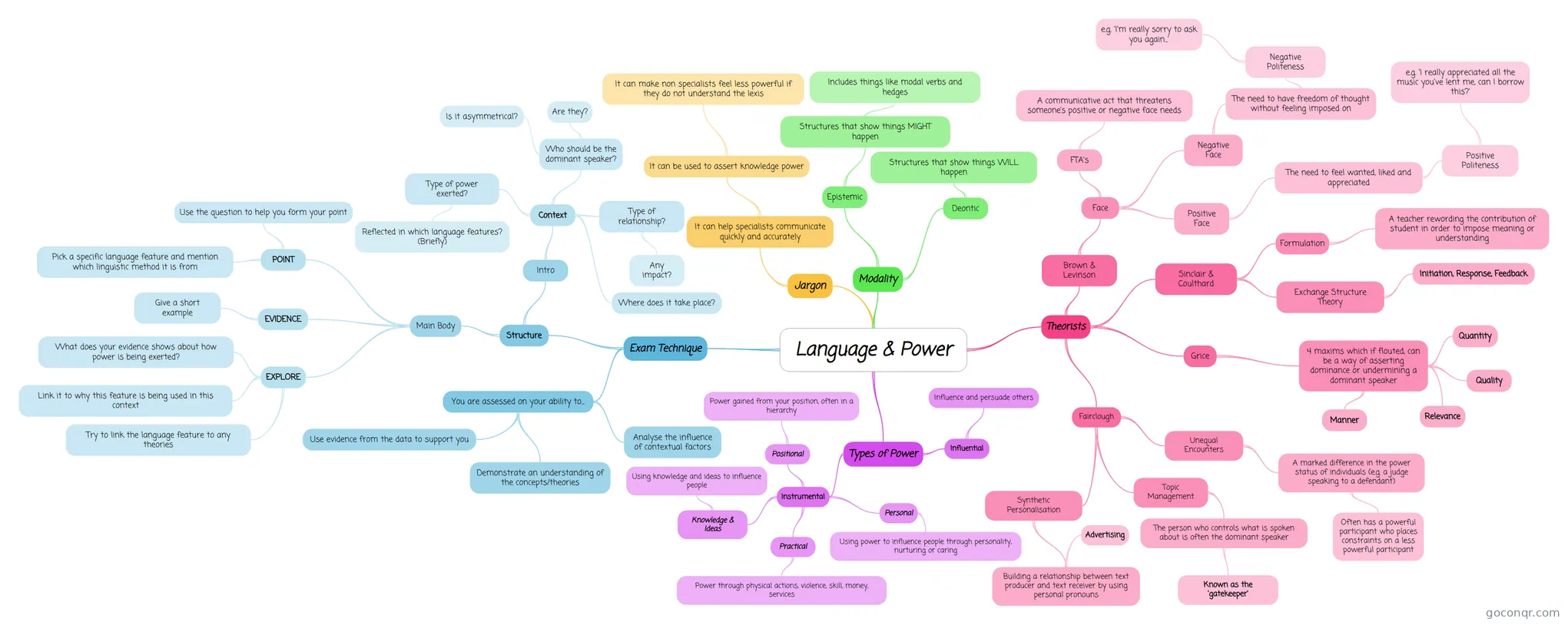
Mind map: Language & Power
Contenido del mapa
Language & Power
Types of Power
- Instrumental
- Personal
- Using power to influence people through personality, nurturing or caring
- Positional
- Power gained from your position, often in a hierarchy
- Knowledge & Ideas
- Using knowledge and ideas to influence people
- Practical
- Power through physical actions, violence, skill, money, services
- Personal
- Influential
- Influence and persuade others
- Instrumental
Theorists
- Fairclough
- Unequal Encounters
- A marked difference in the power status of individuals (e.g. a judge speaking to a defendant)
- Often has a powerful participant who places constraints on a less powerful participant
- A marked difference in the power status of individuals (e.g. a judge speaking to a defendant)
- Synthetic Personalisation
- Building a relationship between text producer and text receiver by using personal pronouns
- Advertising
- Building a relationship between text producer and text receiver by using personal pronouns
- Topic Management
- The person who controls what is spoken about is often the dominant speaker
- Known as the 'gatekeeper'
- The person who controls what is spoken about is often the dominant speaker
- Unequal Encounters
- Grice
- 4 maxims which if flouted, can be a way of asserting dominance or undermining a dominant speaker
- Manner
- Quality
- Quantity
- Relevance
- 4 maxims which if flouted, can be a way of asserting dominance or undermining a dominant speaker
- Sinclair & Coulthard
- Exchange Structure Theory
- Initiation, Response, Feedback
- Formulation
- A teacher rewording the contribution of student in order to impose meaning or understanding
- Exchange Structure Theory
- Brown & Levinson
- Face
- Positive Face
- The need to feel wanted, liked and appreciated
- Positive Politeness
- e.g. 'I really appreciated all the music you've lent me, can I borrow this?'
- Positive Politeness
- The need to feel wanted, liked and appreciated
- Negative Face
- The need to have freedom of thought without feeling imposed on
- Negative Politeness
- e.g. 'I'm really sorry to ask you again...'
- Negative Politeness
- The need to have freedom of thought without feeling imposed on
- FTA's
- A communicative act that threatens someone’s positive or negative face needs
- Positive Face
- Face
- Fairclough
Modality
- Deontic
- Structures that show things WILL happen
- Epistemic
- Structures that show things MIGHT happen
- Includes things like modal verbs and hedges
- Structures that show things MIGHT happen
- Deontic
Jargon
- It can help specialists communicate quickly and accurately
- It can be used to assert knowledge power
- It can make non specialists feel less powerful if they do not understand the lexis
- It can be used to assert knowledge power
- It can help specialists communicate quickly and accurately
Exam Technique
- You are assessed on your ability to...
- Demonstrate an understanding of the concepts/theories
- Analyse the influence of contextual factors
- Use evidence from the data to support you
- Structure
- Intro
- Context
- Where does it take place?
- Type of relationship?
- Any impact?
- Who should be the dominant speaker?
- Are they?
- Is it asymmetrical?
- Type of power exerted?
- Reflected in which language features? (Briefly)
- Context
- Main Body
- POINT
- Use the question to help you form your point
- Pick a specific language feature and mention which linguistic method it is from
- EVIDENCE
- Give a short example
- EXPLORE
- What does your evidence shows about how power is being exerted?
- Link it to why this feature is being used in this context
- Try to link the language feature to any theories
- POINT
- Intro
- You are assessed on your ability to...
Información
- Descripción
- A mind-map with everything you will need to revise for Language & Power at AS Level.
- Creado por
- anna.swainson
- Visitas
- 41
- Etiquetas
- Valoración