
Mapa mental
Segmentals & Suprasegmentals
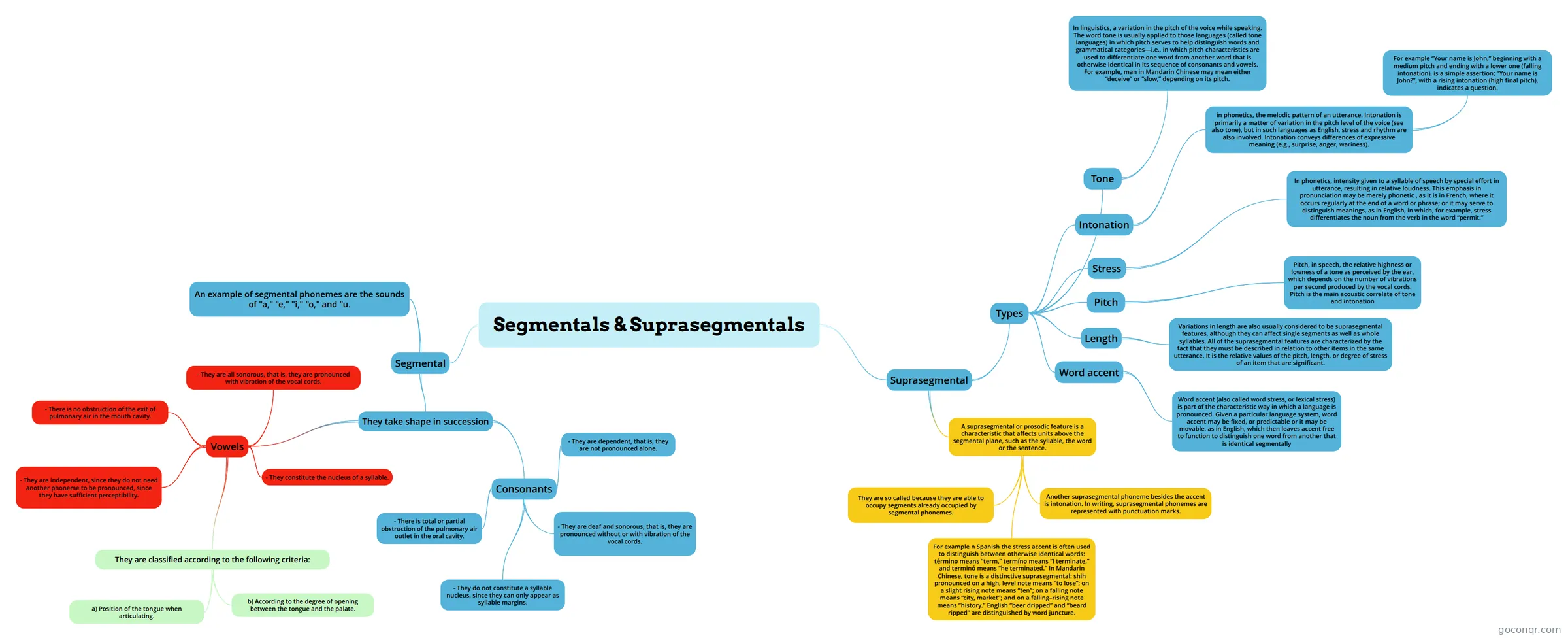
Mind map: Segmentals and suprasegmentals
Contenido del mapa
Segmentals & Suprasegmentals
Segmental
- They take shape in succession
- Vowels
- - They are independent, since they do not need another phoneme to be pronounced, since they have sufficient perceptibility.
- - There is no obstruction of the exit of pulmonary air in the mouth cavity.
- - They are all sonorous, that is, they are pronounced with vibration of the vocal cords.
- - They constitute the nucleus of a syllable.
- They are classified according to the following criteria:
- a) Position of the tongue when articulating.
- b) According to the degree of opening between the tongue and the palate.
- Consonants
- - They are dependent, that is, they are not pronounced alone.
- - There is total or partial obstruction of the pulmonary air outlet in the oral cavity.
- - They are deaf and sonorous, that is, they are pronounced without or with vibration of the vocal cords.
- - They do not constitute a syllable nucleus, since they can only appear as syllable margins.
- Vowels
- An example of segmental phonemes are the sounds of "a," "e," "i," "o," and "u.
- They take shape in succession
Suprasegmental
- A suprasegmental or prosodic feature is a characteristic that affects units above the segmental plane, such as the syllable, the word or the sentence.
- They are so called because they are able to occupy segments already occupied by segmental phonemes.
- Another suprasegmental phoneme besides the accent is intonation. In writing, suprasegmental phonemes are represented with punctuation marks.
- For example n Spanish the stress accent is often used to distinguish between otherwise identical words: término means “term,” termíno means “I terminate,” and terminó means “he terminated.” In Mandarin Chinese, tone is a distinctive suprasegmental: shih pronounced on a high, level note means “to lose”; on a slight rising note means “ten”; on a falling note means “city, market”; and on a falling–rising note means “history.” English “beer dripped” and “beard ripped” are distinguished by word juncture.
- Types
- Length
- Variations in length are also usually considered to be suprasegmental features, although they can affect single segments as well as whole syllables. All of the suprasegmental features are characterized by the fact that they must be described in relation to other items in the same utterance. It is the relative values of the pitch, length, or degree of stress of an item that are significant.
- Stress
- In phonetics, intensity given to a syllable of speech by special effort in utterance, resulting in relative loudness. This emphasis in pronunciation may be merely phonetic , as it is in French, where it occurs regularly at the end of a word or phrase; or it may serve to distinguish meanings, as in English, in which, for example, stress differentiates the noun from the verb in the word “permit.”
- Word accent
- Word accent (also called word stress, or lexical stress) is part of the characteristic way in which a language is pronounced. Given a particular language system, word accent may be fixed, or predictable or it may be movable, as in English, which then leaves accent free to function to distinguish one word from another that is identical segmentally
- Intonation
- in phonetics, the melodic pattern of an utterance. Intonation is primarily a matter of variation in the pitch level of the voice (see also tone), but in such languages as English, stress and rhythm are also involved. Intonation conveys differences of expressive meaning (e.g., surprise, anger, wariness).
- For example “Your name is John,” beginning with a medium pitch and ending with a lower one (falling intonation), is a simple assertion; “Your name is John?”, with a rising intonation (high final pitch), indicates a question.
- in phonetics, the melodic pattern of an utterance. Intonation is primarily a matter of variation in the pitch level of the voice (see also tone), but in such languages as English, stress and rhythm are also involved. Intonation conveys differences of expressive meaning (e.g., surprise, anger, wariness).
- Pitch
- Pitch, in speech, the relative highness or lowness of a tone as perceived by the ear, which depends on the number of vibrations per second produced by the vocal cords. Pitch is the main acoustic correlate of tone and intonation
- Tone
- In linguistics, a variation in the pitch of the voice while speaking. The word tone is usually applied to those languages (called tone languages) in which pitch serves to help distinguish words and grammatical categories—i.e., in which pitch characteristics are used to differentiate one word from another word that is otherwise identical in its sequence of consonants and vowels. For example, man in Mandarin Chinese may mean either “deceive” or “slow,” depending on its pitch.
- Length
- A suprasegmental or prosodic feature is a characteristic that affects units above the segmental plane, such as the syllable, the word or the sentence.
Información
- Descripción
- Mapa Mental sobre Segmentals & Suprasegmentals, creado por XlXN TB el 11/06/2021.
- Creado por
- XlXN TB
- Visitas
- 1
- Valoración