
Mapa mental
UNIT 2 TOPICS
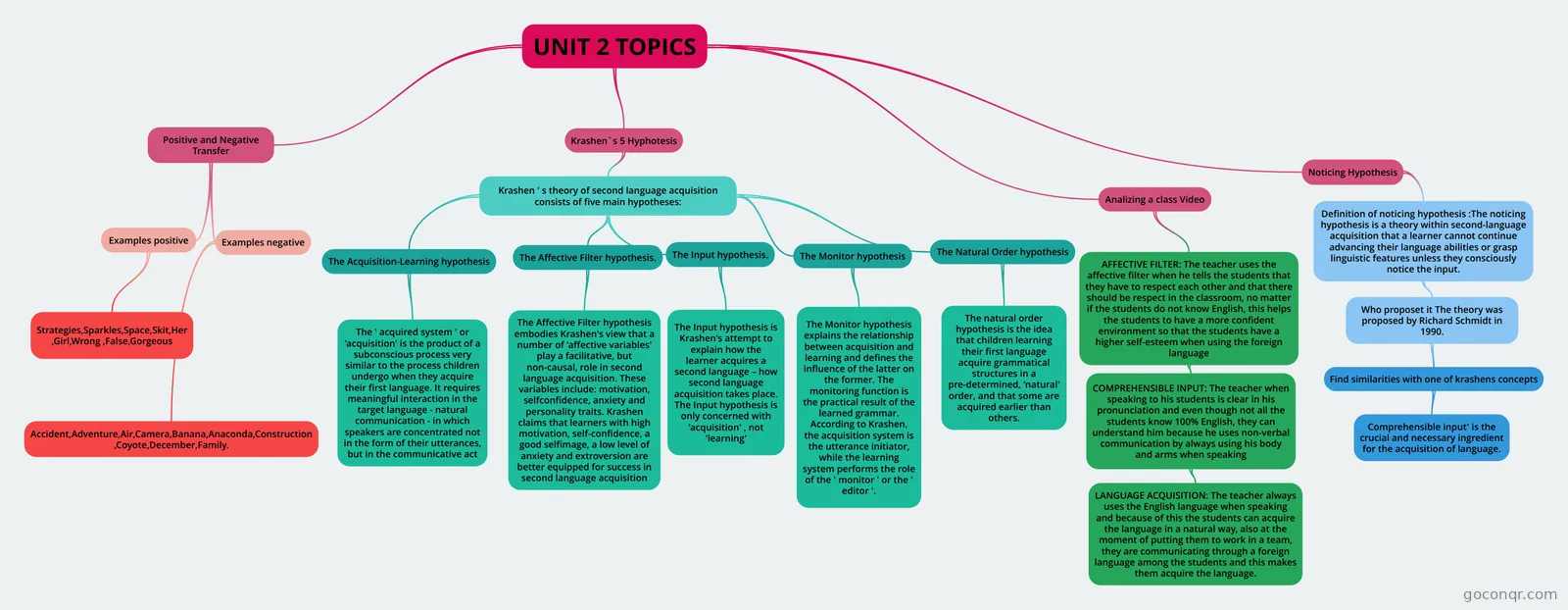
Mind map: Krashen's Hypotheses and Language Transfer
Contenido del mapa
UNIT 2 TOPICS
Positive and Negative Transfer
- Examples positive
- Strategies,Sparkles,Space,Skit,Her ,Girl,Wrong ,False,Gorgeous
- Examples negative
- Accident,Adventure,Air,Camera,Banana,Anaconda,Construction ,Coyote,December,Family.
- Examples positive
Krashen`s 5 Hyphotesis
- Krashen ' s theory of second language acquisition consists of five main hypotheses:
- The Acquisition-Learning hypothesis
- The ' acquired system ' or 'acquisition' is the product of a subconscious process very similar to the process children undergo when they acquire their first language. It requires meaningful interaction in the target language - natural communication - in which speakers are concentrated not in the form of their utterances, but in the communicative act
- The Affective Filter hypothesis.
- The Affective Filter hypothesis embodies Krashen's view that a number of 'affective variables' play a facilitative, but non-causal, role in second language acquisition. These variables include: motivation, selfconfidence, anxiety and personality traits. Krashen claims that learners with high motivation, self-confidence, a good selfimage, a low level of anxiety and extroversion are better equipped for success in second language acquisition
- The Input hypothesis.
- The Input hypothesis is Krashen's attempt to explain how the learner acquires a second language – how second language acquisition takes place. The Input hypothesis is only concerned with 'acquisition' , not 'learning'
- The Monitor hypothesis
- The Monitor hypothesis explains the relationship between acquisition and learning and defines the influence of the latter on the former. The monitoring function is the practical result of the learned grammar. According to Krashen, the acquisition system is the utterance initiator, while the learning system performs the role of the ' monitor ' or the ' editor '.
- The Natural Order hypothesis
- The natural order hypothesis is the idea that children learning their first language acquire grammatical structures in a pre-determined, 'natural' order, and that some are acquired earlier than others.
- The Acquisition-Learning hypothesis
- Krashen ' s theory of second language acquisition consists of five main hypotheses:
Noticing Hypothesis
- Definition of noticing hypothesis :The noticing hypothesis is a theory within second-language acquisition that a learner cannot continue advancing their language abilities or grasp linguistic features unless they consciously notice the input.
- Who proposet it The theory was proposed by Richard Schmidt in 1990.
- Find similarities with one of krashens concepts
- Comprehensible input' is the crucial and necessary ingredient for the acquisition of language.
- Find similarities with one of krashens concepts
- Who proposet it The theory was proposed by Richard Schmidt in 1990.
- Definition of noticing hypothesis :The noticing hypothesis is a theory within second-language acquisition that a learner cannot continue advancing their language abilities or grasp linguistic features unless they consciously notice the input.
Analizing a class Video
- AFFECTIVE FILTER: The teacher uses the affective filter when he tells the students that they have to respect each other and that there should be respect in the classroom, no matter if the students do not know English, this helps the students to have a more confident environment so that the students have a higher self-esteem when using the foreign language
- COMPREHENSIBLE INPUT: The teacher when speaking to his students is clear in his pronunciation and even though not all the students know 100% English, they can understand him because he uses non-verbal communication by always using his body and arms when speaking
- LANGUAGE ACQUISITION: The teacher always uses the English language when speaking and because of this the students can acquire the language in a natural way, also at the moment of putting them to work in a team, they are communicating through a foreign language among the students and this makes them acquire the language.
- COMPREHENSIBLE INPUT: The teacher when speaking to his students is clear in his pronunciation and even though not all the students know 100% English, they can understand him because he uses non-verbal communication by always using his body and arms when speaking
- AFFECTIVE FILTER: The teacher uses the affective filter when he tells the students that they have to respect each other and that there should be respect in the classroom, no matter if the students do not know English, this helps the students to have a more confident environment so that the students have a higher self-esteem when using the foreign language
Información
- Descripción
- Mapa Mental sobre UNIT 2 TOPICS, creado por CLARISSA VALENZUELA TIRADO el 04/11/2021.
- Creado por
- CLARISSA VALENZUELA TIRADO
- Visitas
- 0
- Valoración
Más sobre Krashen's Theory of Second Language Acquisition