
Mapa mental
population genetics and speciation
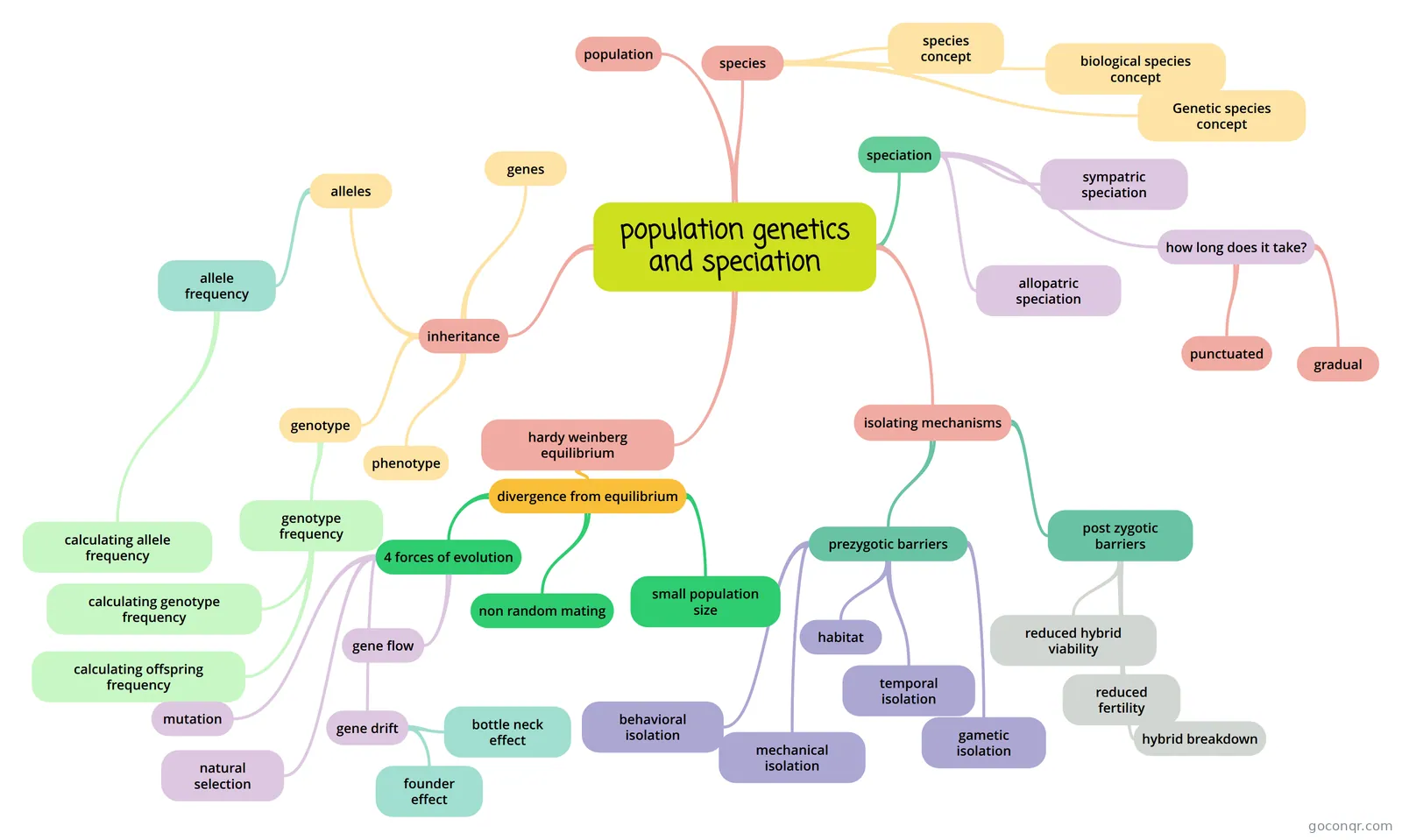
Mind map: population genetics and speciation
Contenido del mapa
population genetics and speciation
population
- - sub group within a species -populations are semi-isolated groups of the same species. -gene flow (genetic info moving) - migration (individual moving herd)
species
- - one kinf of thing
- species concept
- set of rules to determine same species
- Genetic species concept
- some percent genetic similarity
- biological species concept
- 2 individuals are of the same species if they will mate and produce a viable fertile pffspring
inheritance
- genes
- location or sections of DNA molecules that code for protein
- alleles
- versions of a gene A(dominant) and a(recessive)
- allele frequency
- # of alleles /# of alleles in sample
- calculating allele frequency
- p= P +H/2 q = Q + H/2
- genotype
- two alleles in one individual genome AA- homozygote Aa- heterozygote aa- homozygote
- genotype frequency
- calculating genotype frequency
- fre (AA)= #AA/n(total n ) = P freq )Aa)=#Aa/n= H freq (aa) = #aa/n = Q
- calculating offspring frequency
- P' = p^2 H' = 2pq Q' = q^2
- calculating genotype frequency
- phenotype
- what individuals look like
- genes
hardy weinberg equilibrium
- divergence from equilibrium
- 4 forces of evolution
- changing allele frequency from one generation to the next
- natural selection
- positive a favorable thing
- mutation
- change in DNA it can be positive and negative. creates diversity
- gene flow
- migration: movement of individuals from one population to another it can be positive and negative
- gene drift
- change in allele frequency by chance in mainly small populations almost always a negative thing
- bottle neck effect
- result of catastrophe
- founder effect
- new location and founders of new population
- small population size
- non random mating
- 4 forces of evolution
- divergence from equilibrium
isolating mechanisms
- what keeps species separate from one another
- prezygotic barriers
- prevent egg and sperm from fusing
- habitat
- species use different habitats
- temporal isolation
- species use different times (they dont interact, one comes out at night and the other during the day)
- behavioral isolation
- songs and dances to attract mates (learning behavior from parents) -chemical cues (correct smell)
- mechanical isolation
- mating is attempted but the sexual parts do not fit together
- gametic isolation
- sperm does not match to the egg membrane receptor
- post zygotic barriers
- hybrid offspring
- reduced hybrid viability
- low survival
- reduced fertility
- low or no successful reproduction
- hybrid breakdown
- children or offspring of hybrid have low fitness
speciation
- -formation of new species - mutations occur over time, natural selection acts, and evolution happens. - become different enough that isolation mechanism exists
- allopatric speciation
- geographic separation; different countries
- sympatric speciation
- separation between groups within population
- how long does it take?
- punctuated
- gradual
Información
- Descripción
- Mapa Mental sobre population genetics and speciation, creado por Manelly Gastelum el 15/09/2015.
- Creado por
- Manelly Gastelum
- Visitas
- 1
- Valoración