
Mapa mental
THE PLASTICS
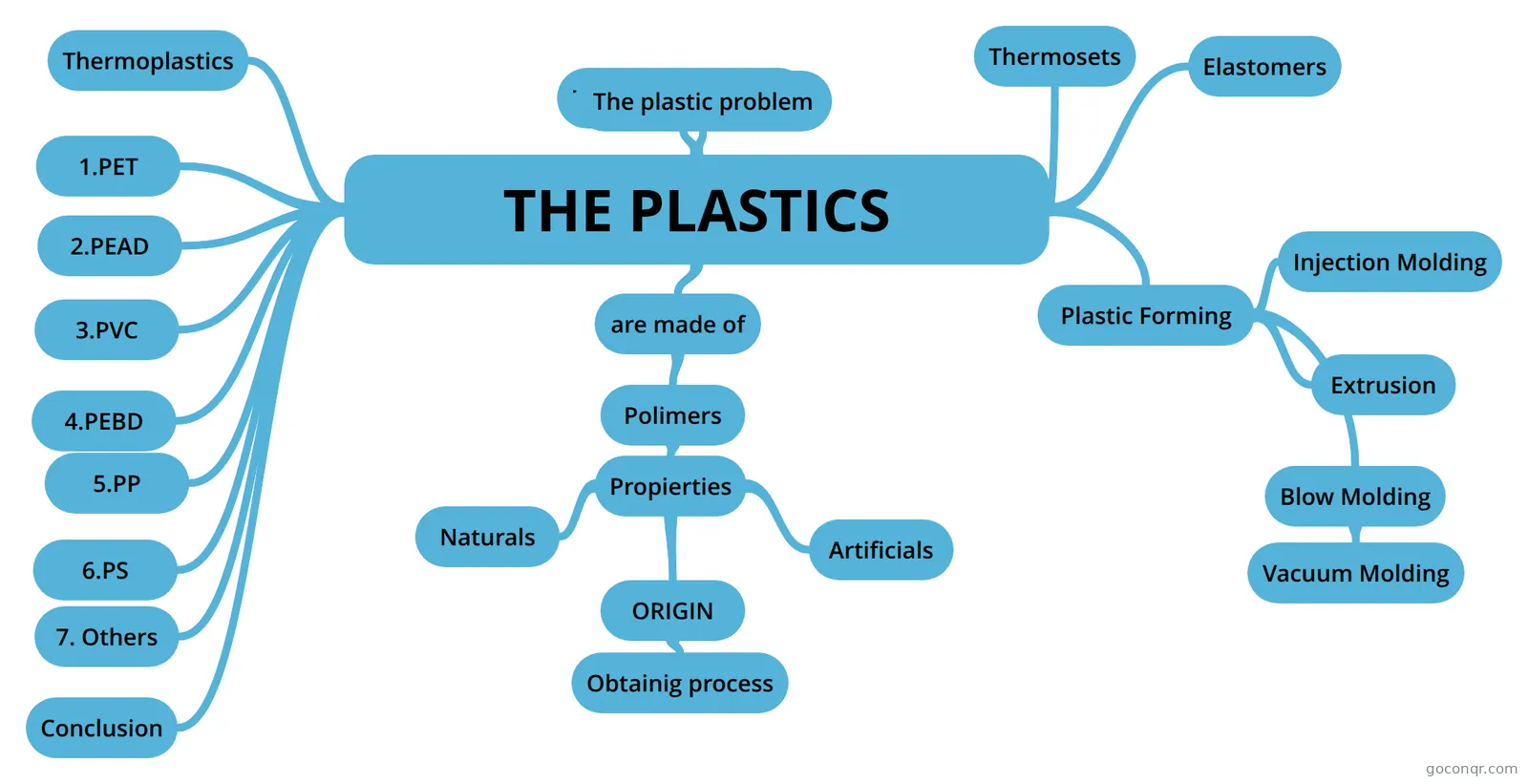
Mind map: Plastics
Contenido del mapa
THE PLASTICS
- Thera are three tipe of plasticsThermoplastics,Thermoseths and Elastomers
1.PET
- Polyethylene Lightweight, strong and moreused in foodBottles of water, soft drinks etc.SAFE: It’s recommended to use it only once for hygiene.
2.PEAD
- High density polyethylene More rigid and resistant to cold and heat Oil carafes, bottles, detergent, pipes, etc.SAFE: One of the most stable and inert. It’s used in long-term food storage
3.PVC
- Polyvinyl chloride Very resistant, flexible or rigid and the most versatile Pipelines,cables,toys, etc. UNSURE.It’s the most dangerous plastic in all its stages.
4.PEBD
- Low density polyethylene Strong, flexible and transparent Grocery bags, packaging films SAFE.It’s one of the safest plastics.
5.PP
- Polypropylene High melting point for liquid containmentYogurts, bottle caps SAFE.Safe and recyclable reuse.
6.PS
- Polystyrene Acoustic insulator Disposable plates and glasses, egg cups, etc. UNSURE.Easily deteriorated and polluting.
7. Others
- According to type UNSURE.Avoid for consumption.They release bisphenol A (BPA)
are made of
- Polimers
- are made up of macromolecules that are obtained by repeating a simple molecule called a monomer. The union of these simple molecules is carried out by the polymerization reaction.
- Propierties
- Good thermal insulators Good electrical insulators Very cheap Easy to model Light Waterproof
- Naturals
- They are obtained from natural substances. Examples: Latex, cellulose, casein
- Artificials
- They are obtained from petroleum hydrocarbons. They are the majority of those we know today
- ORIGIN
- 1st The oil is extracted from the wells (pozos) 2nd In the refineries we obtain the desired hydrocarbon 3rd It is stirred in a reactor together with the additives. 4th The polymer is obtained in granules
- Obtainig process
- During the production process some ADDITIVES (chemical substances) are incorporated, such as, for example, plasticizers, to increase the flexibility and resistance of the polymer, or pigments, to give the plastics a certain color.
- Polimers
Thermoplastics
- A completely linear internal structure. They melt easily. They are ideal for recycling. They are very cheap They are easy to model. They have the disadvantage that with high temperatures they deform.
Conclusion
- In conclusion, we can reuse plastic containers of types 1, 2, 4 and 5, as long as we maintain correct hygiene standards and not putting food in containers that were not originally designed for food use.If in addition to the symbol, we find an "R", it means that the product is made with recycled material.
Thermosets
- Their chains are entangled and held together with strong bonds (three-dimensional network structure). Heating them can give them shape, but a second heating would decompose them. They are not recyclable. Pan handles and electrical plugs are examples of these plastics.
Elastomers
- More or less linear chains, with bonds that join them together, which gives them great flexibility and elasticity (they regain their initial shape after deformation). They are easily degraded by heat, so they are not recyclable by this system. Tires and diving suits belong to this group.
Plastic Forming
- Injection Molding
- 1st The granules are dragged by the movement of the screw to melt by the action of the heating bands. 2nd The molten plastic is pushed by the screw, injecting it into the mold that will shape it. 3rd Once the material has cooled, the piece is removed from the mold. With it, pieces with complicated shapes are obtained.
- Extrusion
- 1st The granules are dragged by the movement of the screw to melt by the action of the heating bands. 2nd The molten plastic is pushed by the screw forcing it to pass through a nozzle (boquilla) that will shape the plastic. It is used to obtain tubes, pipes, carpentry profiles ...
- Blow Molding
- 1st A cylinder called preform is introduced into a hollow hot mold. 2nd The mold is closed and hot air is introduced under pressure so that the material expands adapting to the mold. 3rd Once cold, the mold is opened and the piece is extracted. This process is used to obtain bottles and similar products.
- Vacuum Molding
- 1st A thin plastic sheet is introduced and attached to the mold. 2nd The sheet softens due to the action of heat. 3rd At the bottom the vacuum is made and the air is extracted. With this technique we can obtain items from large surfaces such as kitchen utensils or toys
- Injection Molding
The plastic problem
- Some platics
The plastic problem
- The plastic doesn t degrade and if it isn t recycled it broke in very small pieces called microplastics and this pieces end up in our fish honey and other food The plastic are bad for health and can produce diabetes, cancer cardiovascular disiases etc we must use substitutes for plastic such as the mother, glass or paper
Información
- Descripción
- Mapa Mental sobre THE PLASTICS, creado por Maria Benito Simon el 02/02/2022.
- Creado por
- Maria Benito Simon
- Visitas
- 2
- Valoración
Más sobre Plastics and Polymers