
Mapa mental
Nanotechnology and new materials
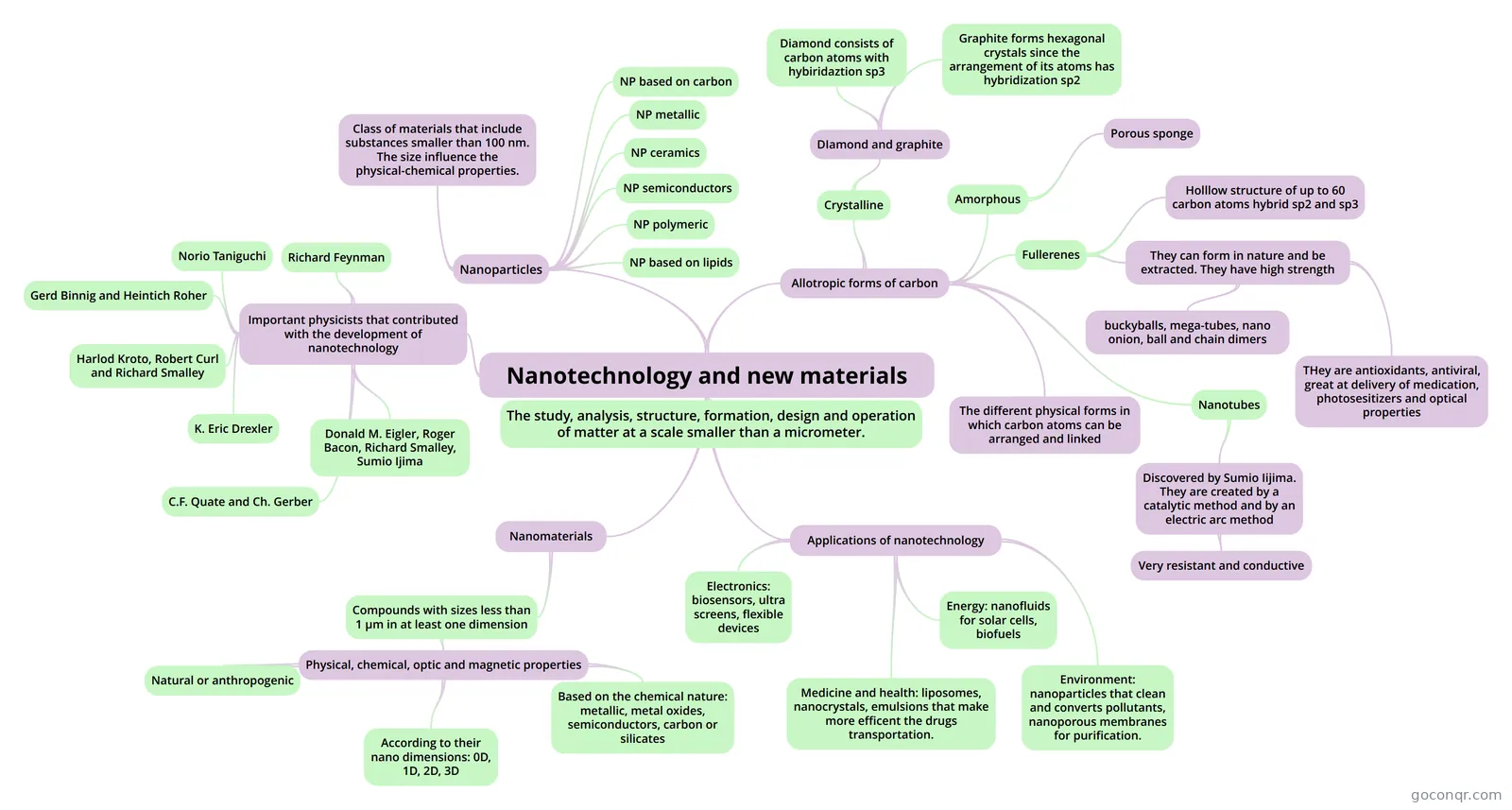
Mind map: Nanotechnology and new materials
Contenido del mapa
Nanotechnology and new materials
The study, analysis, structure, formation, design and operation of matter at a scale smaller than a micrometer.
Important physicists that contributed with the development of nanotechnology
- Richard Feynman
- Norio Taniguchi
- Gerd Binnig and Heintich Roher
- Harlod Kroto, Robert Curl and Richard Smalley
- K. Eric Drexler
- C.F. Quate and Ch. Gerber
- Donald M. Eigler, Roger Bacon, Richard Smalley, Sumio Ijima
Nanoparticles
- Class of materials that include substances smaller than 100 nm. The size influence the physical-chemical properties.
- NP based on carbon
- NP metallic
- NP ceramics
- NP semiconductors
- NP polymeric
- NP based on lipids
Allotropic forms of carbon
- The different physical forms in which carbon atoms can be arranged and linked
- Crystalline
- DIamond and graphite
- Graphite forms hexagonal crystals since the arrangement of its atoms has hybridization sp2
- Diamond consists of carbon atoms with hybiridaztion sp3
- DIamond and graphite
- Amorphous
- Porous sponge
- Fullerenes
- Holllow structure of up to 60 carbon atoms hybrid sp2 and sp3
- They can form in nature and be extracted. They have high strength
- buckyballs, mega-tubes, nano onion, ball and chain dimers
- THey are antioxidants, antiviral, great at delivery of medication, photosesitizers and optical properties
- Nanotubes
- Discovered by Sumio Iijima. They are created by a catalytic method and by an electric arc method
- Very resistant and conductive
- Discovered by Sumio Iijima. They are created by a catalytic method and by an electric arc method
Nanomaterials
- Compounds with sizes less than 1 µm in at least one dimension
- Physical, chemical, optic and magnetic properties
- Natural or anthropogenic
- According to their nano dimensions: 0D, 1D, 2D, 3D
- Based on the chemical nature: metallic, metal oxides, semiconductors, carbon or silicates
- Physical, chemical, optic and magnetic properties
- Compounds with sizes less than 1 µm in at least one dimension
Applications of nanotechnology
- Electronics: biosensors, ultra screens, flexible devices
- Medicine and health: liposomes, nanocrystals, emulsions that make more efficent the drugs transportation.
- Energy: nanofluids for solar cells, biofuels
- Environment: nanoparticles that clean and converts pollutants, nanoporous membranes for purification.
Información
- Descripción
- Mapa Mental sobre Nanotechnology and new materials, creado por Mayra Cabrera el 20/02/2022.
- Creado por
- Mayra Cabrera
- Visitas
- 1
- Valoración