
Material Properties and Materials Science
156 resources created by 134 users
This Material Properties and Materials Science page on GoConqr gathers community-made mind maps, flashcards, quizzes, flowcharts and notes, from composites and ceramics to metallurgy, creep and nanotechnology. It's built for university students and professional candidates, school students, and teachers after ready-made material. There are over 140 resources here, including more than 90 mind maps, over 30 flashcards decks and 10 quizzes, made by more than 120 contributors. Pick a topic, try a quiz to find your gaps, then make your own revision sets.
Top Material Properties and Materials Science resources
-
Mind map Composite Materials This diagram is composite materials
-
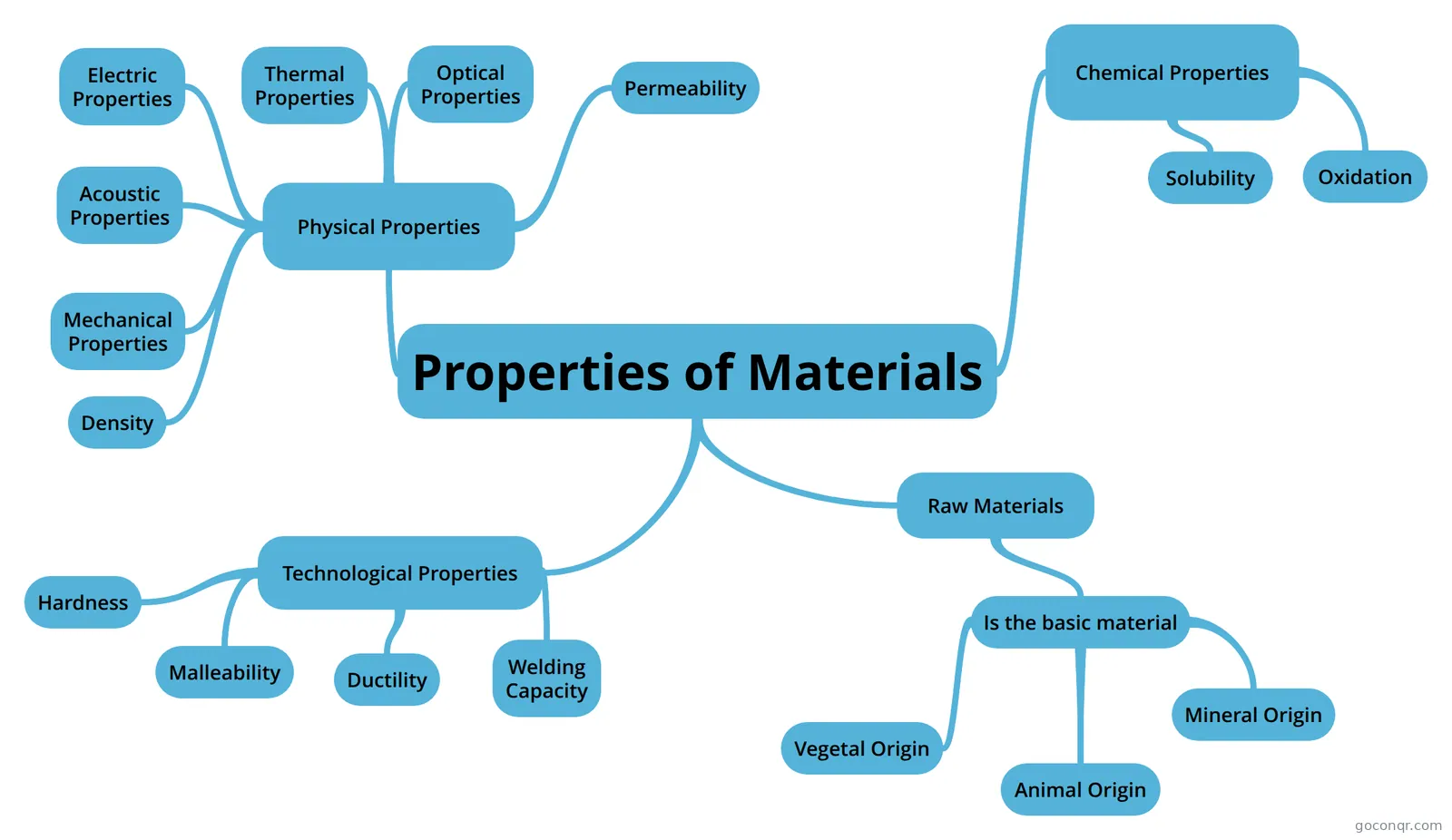 Mind map Properties of Materials
-
149 questionsGENERAL ENGINEERING II What type of bond exists predominantly in sodium chloride crystal ?
-
27 questionsMec1201 Multiple Choice Quiz Cold working process changes the mechanical properties of the metals in which
-
22 cardsResistant Materials- 1.1 Material properties What are physical properties?
-
23 cardsSteel - Eric Palmiere Define grain coarsening temperature
-
15 questionsMAT2210 - Eric - Lecture 1-3
-
9 cards3.2 Non-ferrous metals non ferrous metals
Quizzes
See all 13 quizzes-
149 questionsGENERAL ENGINEERING II What type of bond exists predominantly in sodium chloride crystal ?
-
27 questionsMec1201 Multiple Choice Quiz Cold working process changes the mechanical properties of the metals in which
-
15 questionsMAT2210 - Eric - Lecture 1-3
-
10 questionsQuiz #1 Explain the term Electropositive
Mind maps
See all 98 mind maps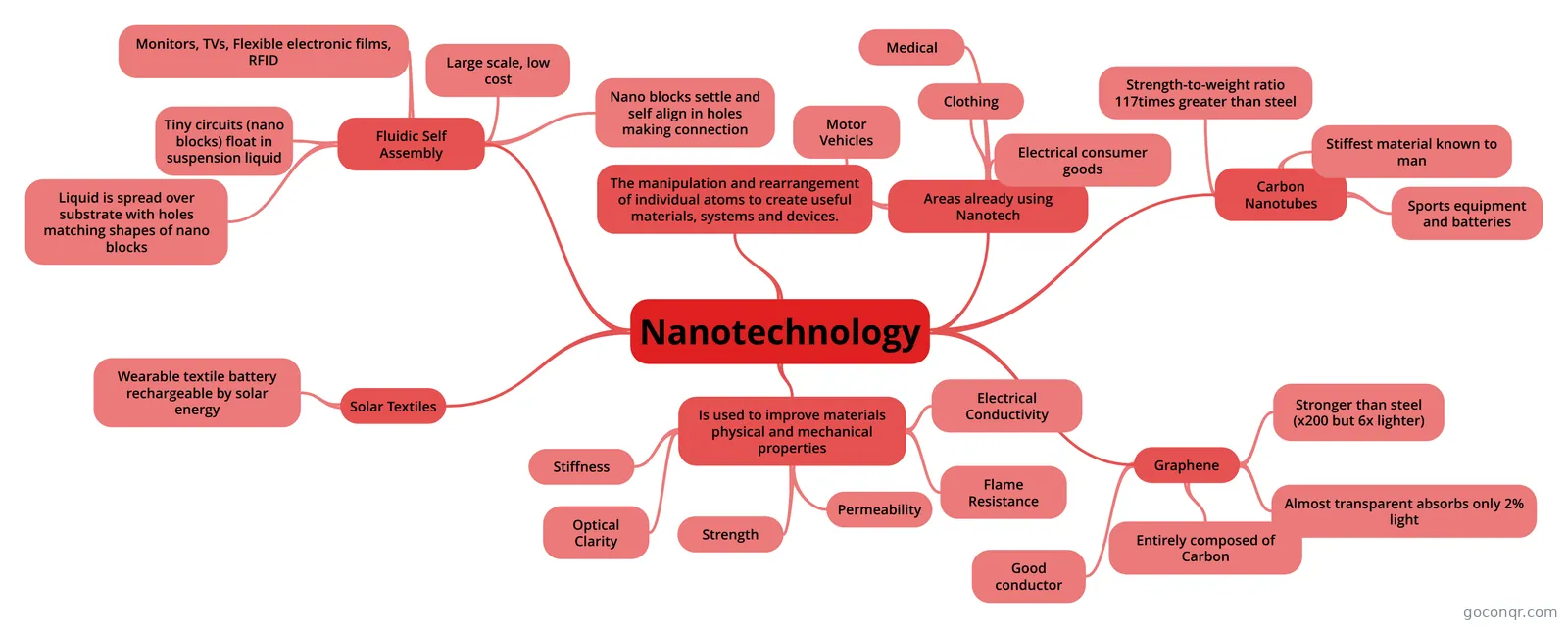
Flashcards
See all 33 flashcards-
22 cardsResistant Materials- 1.1 Material properties What are physical properties?
-
23 cardsSteel - Eric Palmiere Define grain coarsening temperature
-
9 cards3.2 Non-ferrous metals non ferrous metals
-
9 cards3.1 Steel
-
9 cardsMetals and Alloys What is a ferrous metal?
-
15 cards3 Material Types engeneering materlials can be divided into:
More Engineering and technology (general or other) topics
About Material Properties and Materials Science
GoConqr OriginalWhat this page covers
This page sits in the Materials strand of Engineering and technology (general or other). It collects resources on what materials are, how they behave and how they are chosen. Most are mind maps, with flashcard decks, quizzes, flowcharts and a few notes alongside them.
Where to start
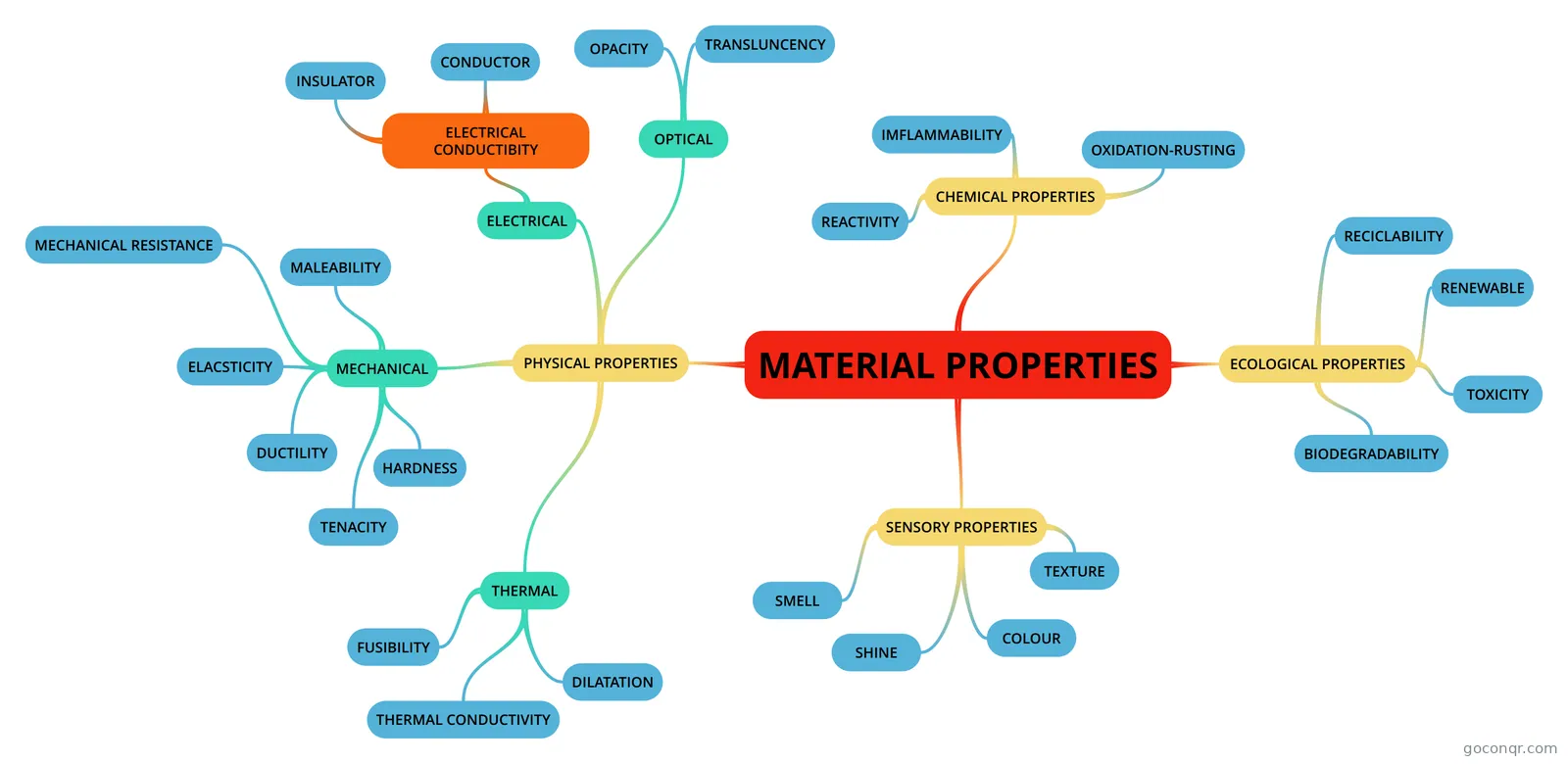
Begin with the overview maps. Properties of Materials sorts raw materials by origin, then walks through physical, electric, thermal, optical and acoustic properties. material properties lists headings such as mechanical, chemical, magnetic and radiological. Then try the Choosing a material flashcards, which cover strength, ductility, hardness, toughness and more.
- Read an overview map to see the whole topic.
- Learn the vocabulary with Definitions, which runs from alloy and annealing to Burgers vector.
- Move to a specific family of materials.
Material families
- Composites: the Composite Materials map covers fibreglass, carbon fibre, Kevlar and polymeric matrices, with properties such as corrosion resistance and thermal resistance.
- Ceramics and polymers: the Ceramics and Polymers deck has Frenkel and Schottky defects, vulcanization, copolymers and glass transition temperature.
- Metals: look at the notes on metallurgy, the deck on steel and the one on non-ferrous metals.
- Newer materials: the Nanotechnology map includes fluidic self assembly.
Using maps and quizzes together
Read a map first, then close it and test yourself. The lecture maps, such as Materials lecture 2(b), deal with true stress, true strain and Poisson's ratio, so they pair well with a quiz on mechanical behaviour. Several quizzes are named after courses or midterms, so check which ones match what you are studying. Teachers can use the maps and decks as ready-made starting points for a lesson.
Next step
Choose one family of materials, open its map, then take a quiz and see what you remember. If you want to go further, make a deck of your own for the terms you missed.
Frequently asked questions
Which resource should I open first?
Start with the Properties of Materials mind map or the material properties map. Both give a broad view of physical, thermal, electrical, optical and mechanical properties. After that, the Choosing a material flashcards help you learn the terms used to compare materials.
What do the composite materials resources cover?
The Composite Materials mind map covers fibres such as fibreglass, carbon fibre and Kevlar, along with polymeric matrices. It also lists properties like corrosion resistance, thermal resistance and electrical insulation. There is also a map comparing Kevlar, fibreglass and carbon fibre, plus one on ballistic fabrics.
Are the resources free to use?
Yes. Every resource on this page is free to open, study and take, with no account needed. They were made by GoConqr users rather than by GoConqr itself, so it is worth checking that each one matches your course.
Who are these resources for?
They suit university students and professional candidates most, with school students and teachers also served. Some resources are named after university courses and midterms, while others, such as the Resistant Materials deck, are more introductory. One listed resource mentions the Junior Certificate.
What if I cannot find the topic I need?
Try a related map or deck first, since topics such as diffusion, phase diagrams, creep and surface engineering each have their own maps. If your topic is still missing, you can make your own quiz, mind map, flashcards or notes with a free account.
Are there quizzes on this page?
Yes, there are more than 9 quizzes, including GENERAL ENGINEERING II, Material science 1 and Metallurgy-Corrosion and Plastics. Several are tied to midterms or lecture blocks. Use them after reading a map to see which areas need another look.