
Mapa mental
Communicative Approaches/CLT
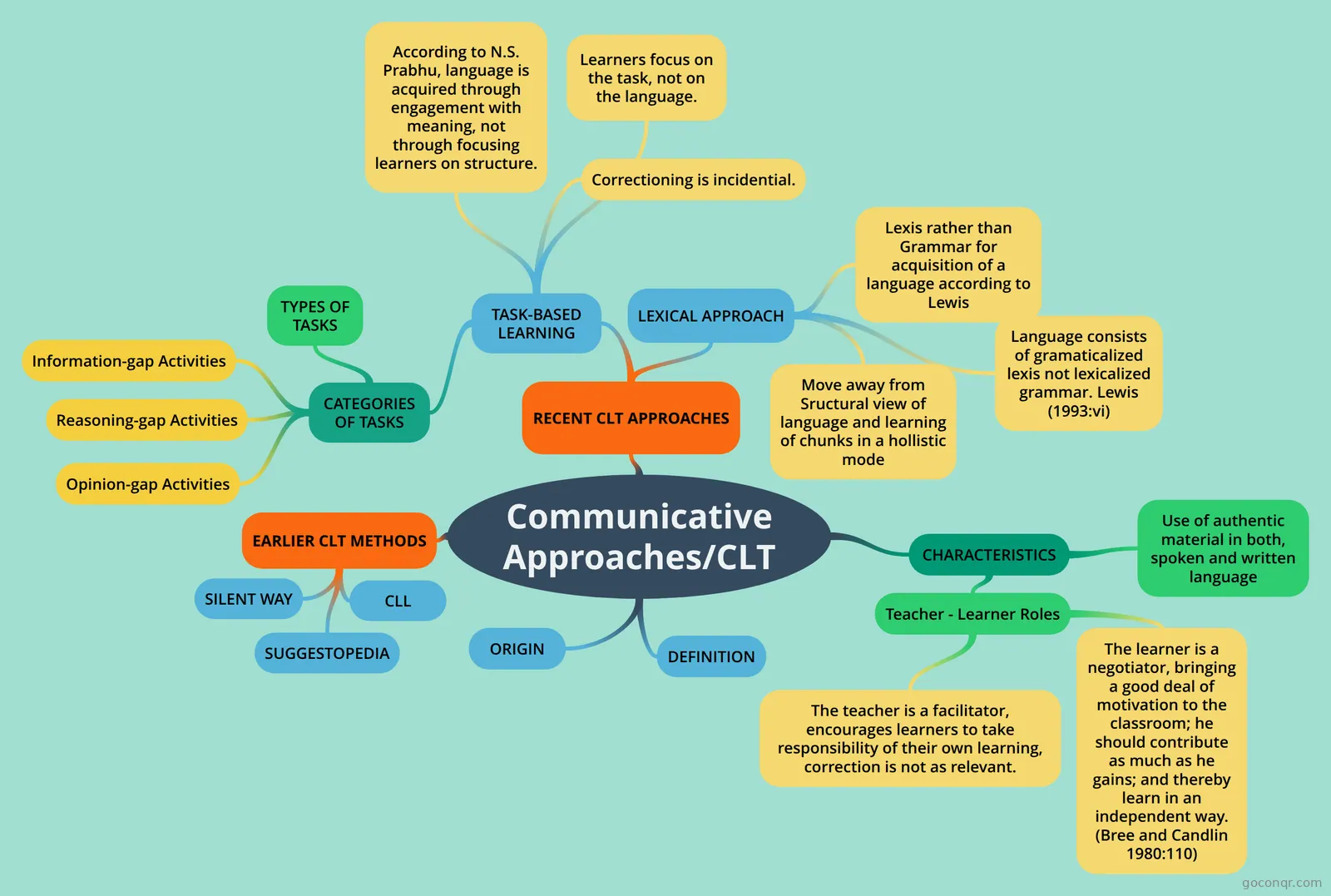
Mind map: Communicative approaches CLT
Contenido del mapa
Communicative Approaches/CLT
ORIGIN
- First appeared in the 1970s. Influenced by the new methods called Humanistic such as Silent Way, CLL and Suggestopedia.
CHARACTERISTICS
- It pays systematic attention to functional as well as structural apects of language. (Littlewood 1981) They prioritize the communicative nature of language
- According to Richards & Rodgers: - Language is a system for the expression of meaning; - The primary function of language is for interaction and communication; - The structure of language reflects its functional and communicative uses; - The primary units of language are categories of functional and communicative meaning as exemplified in discourse. Richards & Rodgers (1986:71)
- Teacher - Learner Roles
- The teacher is a facilitator, encourages learners to take responsibility of their own learning, correction is not as relevant.
- The learner is a negotiator, bringing a good deal of motivation to the classroom; he should contribute as much as he gains; and thereby learn in an independent way. (Bree and Candlin 1980:110)
- Use of authentic material in both, spoken and written language
DEFINITION
- It is a set of approaches more than a method. It concentrates on getting learners to do things with the language, to express concepts and to carry out communicative acts of various kinds... Widdowson 1990
RECENT CLT APPROACHES
- TASK-BASED LEARNING
- CATEGORIES OF TASKS
- Information-gap Activities
- Opinion-gap Activities
- Reasoning-gap Activities
- TYPES OF TASKS
- - Diagrams and Formations - Maps - Calculating - Stories and Dialogues - Personal
- According to N.S. Prabhu, language is acquired through engagement with meaning, not through focusing learners on structure.
- Learners focus on the task, not on the language.
- Correctioning is incidential.
- CATEGORIES OF TASKS
- LEXICAL APPROACH
- Lexis rather than Grammar for acquisition of a language according to Lewis
- Move away from Sructural view of language and learning of chunks in a hollistic mode
- Language consists of gramaticalized lexis not lexicalized grammar. Lewis (1993:vi)
- TASK-BASED LEARNING
EARLIER CLT METHODS
- SILENT WAY
- CLL
- SUGGESTOPEDIA
Información
- Descripción
- COMMUNICATIVE LEARNING MIND MAP
- Creado por
- Ricardo Cháidez
- Visitas
- 17
- Valoración