
Mapa mental
Processor Fundamentals
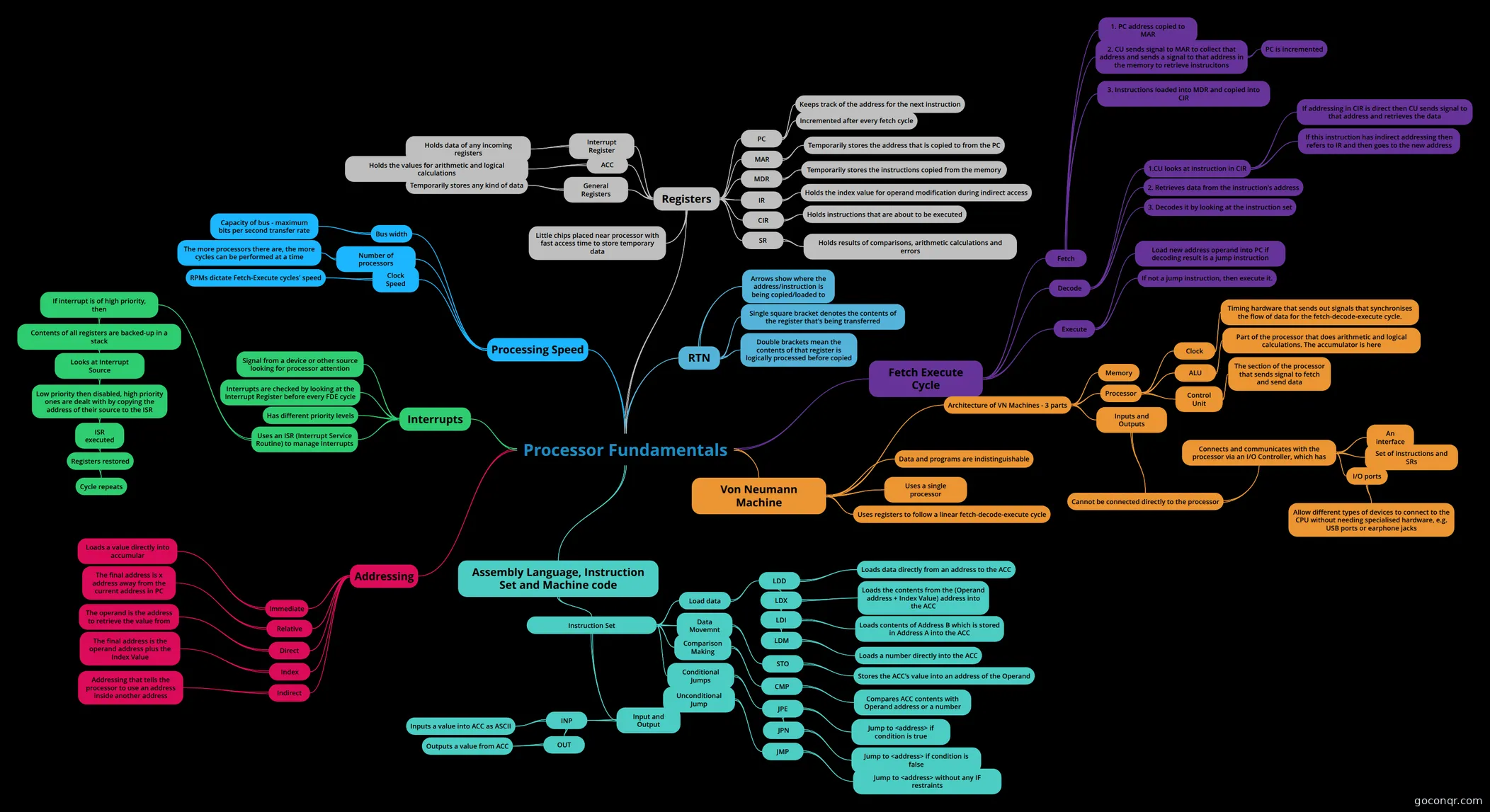
Mind map: Processor Fundamentals
Contenido del mapa
Processor Fundamentals
Von Neumann Machine
- Data and programs are indistinguishable
- Uses a single processor
- Uses registers to follow a linear fetch-decode-execute cycle
- Architecture of VN Machines - 3 parts
- Inputs and Outputs
- Cannot be connected directly to the processor
- Connects and communicates with the processor via an I/O Controller, which has
- An interface
- Set of instructions and SRs
- I/O ports
- Allow different types of devices to connect to the CPU without needing specialised hardware, e.g. USB ports or earphone jacks
- Connects and communicates with the processor via an I/O Controller, which has
- Cannot be connected directly to the processor
- Processor
- Clock
- Timing hardware that sends out signals that synchronises the flow of data for the fetch-decode-execute cycle.
- ALU
- Part of the processor that does arithmetic and logical calculations. The accumulator is here
- Control Unit
- The section of the processor that sends signal to fetch and send data
- Clock
- Memory
- Inputs and Outputs
Registers
- PC
- Keeps track of the address for the next instruction
- Incremented after every fetch cycle
- MAR
- Temporarily stores the address that is copied to from the PC
- MDR
- Temporarily stores the instructions copied from the memory
- IR
- Holds the index value for operand modification during indirect access
- CIR
- Holds instructions that are about to be executed
- ACC
- Holds the values for arithmetic and logical calculations
- General Registers
- Temporarily stores any kind of data
- Little chips placed near processor with fast access time to store temporary data
- SR
- Holds results of comparisons, arithmetic calculations and errors
- Interrupt Register
- Holds data of any incoming registers
- PC
RTN
- Arrows show where the address/instruction is being copied/loaded to
- Single square bracket denotes the contents of the register that's being transferred
- Double brackets mean the contents of that register is logically processed before copied
Interrupts
- Signal from a device or other source looking for processor attention
- Interrupts are checked by looking at the Interrupt Register before every FDE cycle
- Has different priority levels
- Uses an ISR (Interrupt Service Routine) to manage Interrupts
- If interrupt is of high priority, then
- Contents of all registers are backed-up in a stack
- Looks at Interrupt Source
- Low priority then disabled, high priority ones are dealt with by copying the address of their source to the ISR
- ISR executed
- Registers restored
- Cycle repeats
- Registers restored
- ISR executed
- Low priority then disabled, high priority ones are dealt with by copying the address of their source to the ISR
- Looks at Interrupt Source
- Contents of all registers are backed-up in a stack
- If interrupt is of high priority, then
Fetch Execute Cycle
- Fetch
- 1. PC address copied to MAR
- 2. CU sends signal to MAR to collect that address and sends a signal to that address in the memory to retrieve instrucitons
- PC is incremented
- 3. Instructions loaded into MDR and copied into CIR
- Decode
- 1.CU looks at instruction in CIR
- If addressing in CIR is direct then CU sends signal to that address and retrieves the data
- If this instruction has indirect addressing then refers to IR and then goes to the new address
- 2. Retrieves data from the instruction's address
- 3. Decodes it by looking at the instruction set
- 1.CU looks at instruction in CIR
- Execute
- Load new address operand into PC if decoding result is a jump instruction
- If not a jump instruction, then execute it.
- Fetch
Addressing
- Indirect
- Addressing that tells the processor to use an address inside another address
- Index
- The final address is the operand address plus the Index Value
- Relative
- The final address is x address away from the current address in PC
- Immediate
- Loads a value directly into accumular
- Direct
- The operand is the address to retrieve the value from
- Indirect
Assembly Language, Instruction Set and Machine code
- Instruction Set
- Load data
- LDD
- LDX
- LDI
- LDM
- Loads a number directly into the ACC
- Loads contents of Address B which is stored in Address A into the ACC
- LDM
- Loads the contents from the (Operand address + Index Value) address into the ACC
- LDI
- Loads data directly from an address to the ACC
- LDX
- LDD
- Data Movemnt
- STO
- Stores the ACC's value into an address of the Operand
- STO
- Comparison Making
- CMP
- Compares ACC contents with Operand address or a number
- CMP
- Conditional Jumps
- JPE
- Jump to <address> if condition is true
- JPN
- Jump to <address> if condition is false
- Unconditional Jump
- JMP
- Jump to <address> without any IF restraints
- JMP
- JPE
- Input and Output
- INP
- Inputs a value into ACC as ASCII
- OUT
- Outputs a value from ACC
- INP
- Load data
- Instruction Set
Processing Speed
- Bus width
- Capacity of bus - maximum bits per second transfer rate
- Number of processors
- The more processors there are, the more cycles can be performed at a time
- Clock Speed
- RPMs dictate Fetch-Execute cycles' speed
- Bus width
Información
- Descripción
- Advanced Level (A- Level) (Processor Fundamentals - Processor Instructions Set) Computer Science Mapa Mental sobre Processor Fundamentals, creado por TS P el 16/10/2015.
- Creado por
- TS P
- Visitas
- 2
- Valoración