
Mapa mental
Management Control Systems
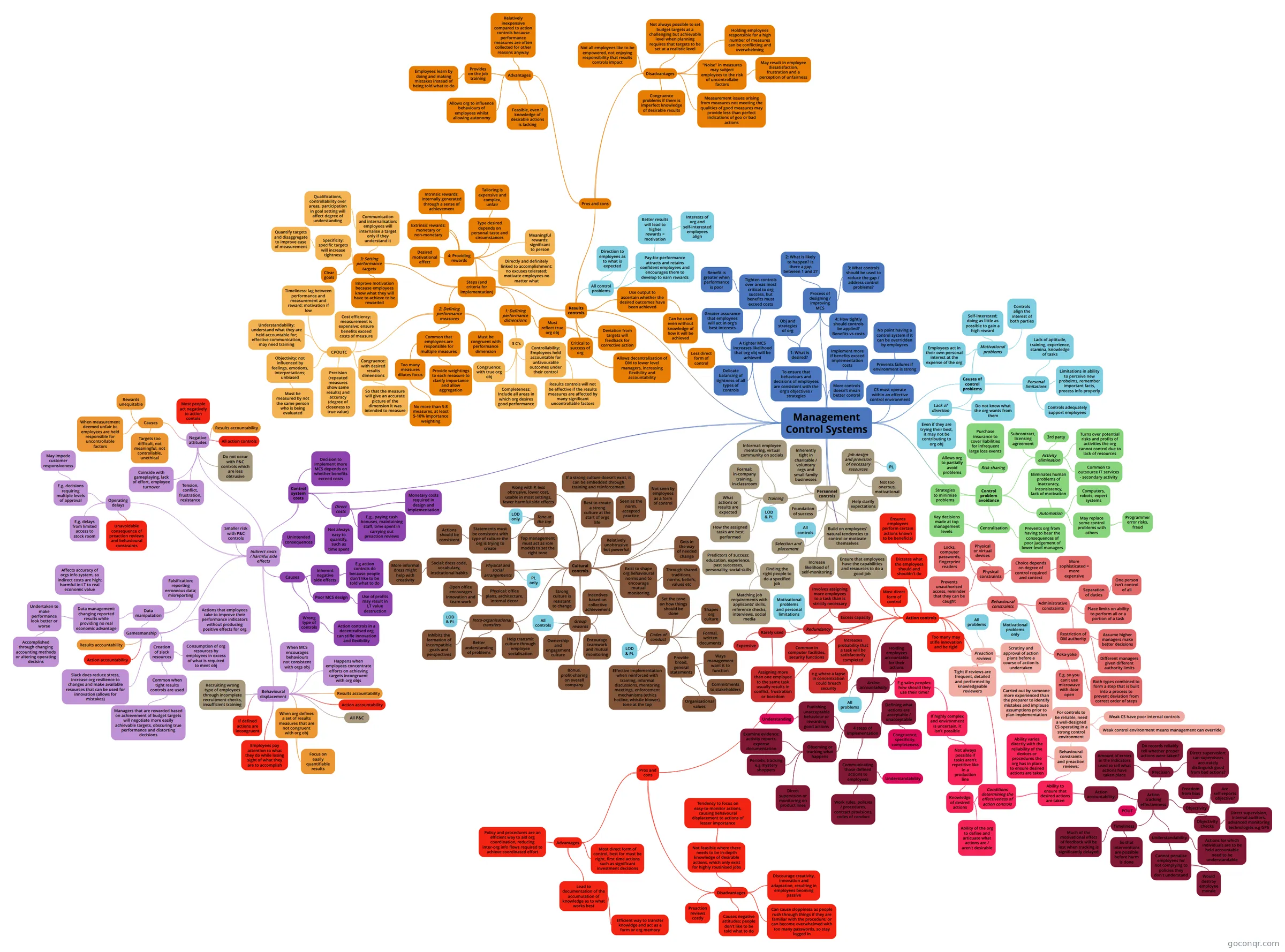
Mind map: Management control systems
Contenido del mapa
Management Control Systems
To ensure that behaviours and decisions of employees are consistent with the org's objectives / strategies
CS must operate within an effective control environment
- Prevents failures if environment is strong
- No point having a control system if it can be overridden by employees
- Prevents failures if environment is strong
More controls doesn't mean better control
- Implement more if benefits exceed implementation costs
Causes of control problems
- Motivational problems
- Employees act in their own personal interest at the expense of the org
- Self-interested; doing as little as possible to gain a high reward
- Controls align the interest of both parties
- Personal limitations
- Lack of aptitude, training, experience, stamina, knowledge of tasks
- Limitations in ability to perceive new probelms, remember important facts, process info properly
- Controls adequately support employees
- Lack of direction
- Do not know what the org wants from them
- Even if they are trying their best, it may not be contributing to org obj
- Motivational problems
Control problem avoidance
- Strategies to minimise problems
- Risk sharing
- Allows org to partially avoid problems
- Purchase insurance to cover liabilities for infrequent large loss events
- Activity elimination
- Turns over potential risks and profits of activities the org cannot control due to lack of resources
- Subcontract, licensing agreement
- 3rd party
- Common to outsource IT services - secondary activity
- Automation
- Eliminates human problems of inaccuracy, inconsistency, lack of motivation
- Computers, robots, expert systems
- May replace some control problems with others
- Programmer error risks, fraud
- Centralisation
- Key decisions made at top management levels
- Prevents org from having to bear the consequences of poor judgement of lower level managers
Action controls
- Most direct form of control
- Dictates what the employees should and shouldn't do
- Ensures employees perform certain actions known to be beneficial
- Behavioural constraints
- Physical constraints
- Physical or virtual devices
- Locks, computer passwords, fingerprint readers
- Prevents unauthorised access, reminder that they can be caught
- Choice depends on degree of control required and context
- More sophisticated = more expensive
- Administrative constraints
- Place limits on ability to perform all or a portion of a task
- Separation of duties
- One person isn't control of all
- Restriction of DM authority
- Assume higher managers make better decisions
- Different managers given different authority limits
- Motivational problems only
- Poka-yoke
- Both types combined to form a step that is built into a process to prevent deviation from correct order of steps
- E.g. so you can't use microwave with door open
- Physical constraints
- Preaction reviews
- Scrutiny and approval of action plans before a course of action is undertaken
- Carried out by someone more experienced than the preparer to identify mistakes and implause assumptions prior to plan implementation
- All problems
- Tight if reviews are frequent, detailed and performed by knowledgeable reviewers
- Action accountability
- Holding employees accountable for their actions
- 4 steps of implementation
- Defining what actions are acceptable / unacceptable
- Congruence, specificity, completeness
- Communicating those defined actions to employees
- Work rules, policies / procedures, contract provisions, codes of conduct
- Understandability
- Observing or tracking what happens
- Direct supervision or monitoring on product lines
- Periodic tracking e.g mystery shoppers
- Examine evidence: activity reports, expense documentation
- Punishing unacceptable behaviour or rewarding good actions
- Understanding
- Defining what actions are acceptable / unacceptable
- All problems
- Redundancy
- Involves assigning more employees to a task than is strictly necessary
- Excess capacity
- Increases probability that a task will be satisfactorily completed
- e.g where a lapse in concentration could breach security
- Common in computer facilities, security functions
- Rarely used
- Expensive
- Assigning more than one employee to the same task usually results in conflict, frustration or boredom
- Motivational problems and personal limitations
- Involves assigning more employees to a task than is strictly necessary
- Conditions determining the effectiveness of action controls
- Knowledge of desired actions
- Ability of the org to define and articuate what actions are / aren't desirable
- Not always possible if tasks aren't repetitive like in a production line
- If highly complex and environment is uncertain, it isn't possible
- E.g sales peoples: how should they use their time?
- If highly complex and environment is uncertain, it isn't possible
- Ability to ensure that desired actions are taken
- Behavioural constraints and preaction reviews:
- Ability varies directly with the reliability of the devices or procedures the org has in place to ensure desired actions are taken
- For controls to be reliable, need a well-designed CS operating in a strong control environment
- Weak CS have poor internal controls
- Weak control environment means management can override
- Action accountability:
- Action tracking effectiveness
- Precision
- Amount of errors in the indicators used to tell what actions have taken place
- Direct supervision: can supervisors accurately distinguish good from bad actions?
- Do records reliably tell whether proper actions were taken?
- Objectivity
- Freedom from bias
- Are self-reports objective?
- Objectivity checks
- Direct supervision, internal auditors, advanced monitoring technologies e.g GPS
- Understandability
- Actions for which individuals are to be held accountable need to be understandable
- Cannot penalise employees for not complying to policies they don't understand
- Would destroy employee morale
- Timeliness
- So that interventions are possible before harm is done
- Much of the motivational effect of feedback will be lost when tracking is significantly delayed
- POUT
- Precision
- Action tracking effectiveness
- Behavioural constraints and preaction reviews:
- Knowledge of desired actions
- Too many may stifle innovation and be rigid
- Pros and cons
- Disadvantages
- Not feasible where there needs to be in-depth knowledge of desirable actions, which only exist for highly routinised jobs
- Tendency to focus on easy-to-monitor actions, causing behavoural displacement to actions of lesser importance
- Discourage creativity, innovation and adaptation, resulting in employees beoming passive
- Can cause sloppiness as people rush through things if they are familiar with the procedure; or can become overwhelmed with too many passwords, so stay logged in
- Causes negative attitudes; people don't like to be told what to do
- Preaction reviews costly
- Not feasible where there needs to be in-depth knowledge of desirable actions, which only exist for highly routinised jobs
- Advantages
- Most direct form of control, best for must be right, first time actions such as significant investment decisions
- Lead to documentation of the accumulation of knowledge as to what works best
- Efficient way to transfer knowldge and act as a form or org memory
- Policy and procedures are an efficient way to aid org coordination, reducing inter-org info flows required to achieve coordinated effort
- Disadvantages
Cultural controls
- Exist to shape org behavioural norms and to encourage mutual monitoring
- Through shared traditions, norms, beliefs, values etc
- Relatively unobtrusive but powerful
- Seen as the norm, accepted practice
- Not seen by employees as a form of control
- Gets in the way of needed change
- Codes of conduct
- Set the tone on how things should be done
- Shapes org culture
- Formal, written documents
- Provide broad, general statements
- Organisational values
- Commitments to stakeholders
- Ways management want it to function
- Effective implementation when reinforced with training, informal discussions, mentoring meetings, enforcement mechanisms (ethics hotline, whistle blower), tone at the top
- LOD & PL
- Group rewards
- Incentives based on collective achievement
- Bonus, profit-sharing on overall company
- Encourage teamwork and mutual monitoring
- Ownership and engagement culture
- All controls
- Intra-organisational transfers
- Help transmit culture through employee socialisation
- Better understanding of problems
- Inhibits the formation of incompatible goals and perspectives
- LOD & PL
- Physical and social arrangements
- Physical: office plans, architecture, internal decor
- Open office encourages innovation and team work
- Social: dress code, vocabulary, institutional habits
- More informal dress might help with creativity
- PL only
- Physical: office plans, architecture, internal decor
- Tone at the top
- Top management must act as role models to set the right tone
- Statements must be consistent with type of culture the org is trying to create
- Actions should be consistent
- LOD only
- Best to create a strong culture at the start of orgs life
- If a strong culture doesn't exist, it can be embedded through training and reinforcement
- Strong culture is resistant to change
- Along with P, less obtrusive, lower cost, usable in most settings, fewer harmful side effects
- Exist to shape org behavioural norms and to encourage mutual monitoring
Personnel controls
- Build on employees' natural tendencies to control or motivate themselves
- Increase likelihood of self-monitoring
- Help clarify expectations
- Ensure that employees have the capabilities and resources to do a good job
- Selection and placement
- Finding the right people to do a specified job
- Predictors of success: education, experience, past successes, personality, social skills
- Matching job requirements with applicants' skills, reference checks, interviews, social media
- All controls
- Finding the right people to do a specified job
- Training
- What actions or results are expected
- How the assigned tasks are best performed
- Formal: in-company training, in-classroom
- Informal: employee mentoring, virtual community on socials
- LOD & PL
- Job design and provision of necessary resources
- Not too onerous, motivational
- PL
- Foundation of success
- Inherently tight in charitable / voluntary orgs and small family businesses
- Build on employees' natural tendencies to control or motivate themselves
Process of designing / improving MCS
- 1: What is desired?
- Obj and strategies of org
- 2: What is likely to happen? Is there a gap between 1 and 2?
- 3: What controls should be used to reduce the gap / address control problems?
- 4: How tightly should controls be applied? Benefits vs costs
- 1: What is desired?
Results controls
- Use output to ascertain whether the desired outcomes have been achieved
- Can be used even without knowledge of how it will be achieved
- Less direct form of control
- Can be used even without knowledge of how it will be achieved
- All control problems
- Direction to employees as to what is expected
- Better results will lead to higher rewards = motivation
- Interests of org and self-interested employees align
- Pay-for-performance attracts and retains confident employees and encourages them to develop to earn rewards
- Deviation from targets will feedback for corrective action
- Allows decentralisation of DM to lower level managers, increasing flexibility and accountability
- Steps (and criteria for implementation)
- 1: Defining performance dimensions
- Must reflect true org obj
- Critical to success of org
- 3 C's
- Congruence: with true org obj
- Completeness: Include all areas in which org desires good performance
- Controllability: Employees held accountable for unfavourable outcomes under their control
- Results controls will not be effective if the results measures are affected by many significant uncontrollable factors
- Must reflect true org obj
- 2: Defining performance measures
- Must be congruent with performance dimension
- Common that employees are responsible for multiple measures
- Provide weightings to each measure to clarify importance and allow aggregation
- Too many measures dilutes focus
- No more than 5-8 measures, at least 5-10% importance weighting
- CPOUTC
- Congruence: with desired results dimensions
- So that the measure will give an accurate picture of the dimension it was intended to measure
- Precision (repeated measures show same results) and accuracy (degree of closeness to true value)
- Objectivity: not influenced by feelings, emotions, interpretations; unbiased
- Must be measured by not the same person who is being evaluated
- Understandability: understand what they are held accountable for; effective communication, may need training
- Timeliness: lag between performance and measurement and reward; motivation if low
- Cost efficiency: measurement is expensive; ensure benefits exceed costs of measure
- Congruence: with desired results dimensions
- 3: Setting performance targets
- Improve motivation because employees know what they will have to achieve to be rewarded
- Clear goals
- Specificity: specific targets will increase tightness
- Quantify targets and disaggregate to improve ease of measurement
- Communication and internalisation: employees will internalise a target only if they understand it
- Qualifications, controllability over areas, participation in goal setting will affect degree of understanding
- 4: Providing rewards
- Desired motivational effect
- Extrinsic rewards: monetary or non-monetary
- Intrinsic rewards: internally generated through a sense of achievement
- Type desired depends on personal taste and circumstances
- Tailoring is expensive and complex, unfair
- Meaningful rewards: significant to person
- Directly and definitely linked to accomplishment: no excuses tolerated; motivate employees no matter what
- 1: Defining performance dimensions
- Pros and cons
- Advantages
- Feasible, even if knowledge of desirable actions is lacking
- Allows org to influence behaviours of employees whilst allowing autonomy
- Provides on the job training
- Employees learn by doing and making mistakes instead of being told what to do
- Relatively inexpensive compared to action controls because performance measures are often collected for other reasons anyway
- Disadvantages
- Congruence problems if there is imperfect knowledge of desirable results
- Measurement issues arising from measures not meeting the qualities of good measures may provide less than perfect indications of goo or bad actions
- "Noise" in measures may subject employees to the risk of uncontrollabe factors
- May result in employee dissatisfaction, frustration and a perception of unfairness
- Holding employees responsible for a high number of measures can be conflicting and overwhelming
- Not always possible to set budget targets at a challenging but achievable level when planning requires that targets to be set at a realistic level
- Not all employees like to be empowered, not enjoying responsibility that results controls impact
- Advantages
- Use output to ascertain whether the desired outcomes have been achieved
A tighter MCS increases likelihood that org obj will be achieved
- Greater assurance that employees will act in org's best interests
- Delicate balancing of tightness of all types of controls
- Tighten controls over areas most critical to org success, but benefits must exceed costs
- Benefit is greater when performance is poor
Control system costs
- Decision to implement more MCS depends on whether benefits exceed costs
- Direct costs
- Monetary costs required in design and implementation
- Not always easy to quantify, such as time spent
- E.g., paying cash bonuses, maintaining staff, time spent in carrying out preaction reviews
- Indirect costs / harmful side effects
- Unintended consequences
- Causes
- Inherent negative side effects
- E.g action controls do because people don't like to be told what to do
- Poor MCS design
- Use of profits may result in LT value destruction
- Wrong type of controls
- Action controls in a decentralised org can stifle innovation and flexibility
- Inherent negative side effects
- Behavioural displacement
- When MCS encourages behaviours not consistent with orgs obj
- Happens when employees concentrate efforts on achieving targets incongruent with org objs
- When org defines a set of results measures that are not congruent with org obj
- Focus on easily quantifiable results
- Employees pay attention to what they do while losing sight of what they are to accomplish
- If defined actions are incongruent
- Recruiting wrong type of employees through incomplete recruitment checks, insufficient training
- Results accountability
- Action accountability
- All P&C
- Gamesmanship
- Actions that employees take to improve their performance indicators without producing positive effects for org
- Creation of slack resources
- Consumption of org resources by employees in excess of what is required to meet obj
- Common when tight results controls are used
- Managers that are rewarded based on achievement of budget targets will negotiate more easily achievable targets, obscuring true performance and distorting decisions
- Slack does reduce stress, increase org resilience to changes and make available resources that can be used for innovation (allows for mistakes)
- Data manipulation
- Falsification: reporting erroneous data; misreporting
- Data management: changing reported results while providing no real economic advantage
- Undertaken to make performance look better or worse
- Accomplished through changing accounting methods or altering operating decisins
- Affects accuracy of orgs info system, so indirect costs are high; harmful in LT to real economic value
- Undertaken to make performance look better or worse
- Results accountability
- Action accountability
- Operating delays
- Unavoidable consequence of preaction reviews and behavioural constraints
- E.g. delays from limited access to stock room
- E.g. decisions requiring multiple levels of approval
- May impede customer responsiveness
- Negative attitudes
- Tension, conflict, frustration, resistance
- Coincide with gameplaying, lack of effort, employee turnover
- Do not occur with P&C controls which are less obtrusive
- Causes
- Targets too difficult, not meaningful, not controllable, unethical
- When measurement deemed unfair bc employees are held responsible for uncontrollable factors
- Rewards unequitable
- Most people act negatively to action contols
- Results accountability
- All action controls
- Smaller risk with P&C controls
Información
- Descripción
- Mapa Mental sobre Management Control Systems, creado por Abbie Goffin el 04/01/2023.
- Creado por
- Abbie Goffin
- Visitas
- 1
- Valoración