
Mapa mental
Private Nuisance
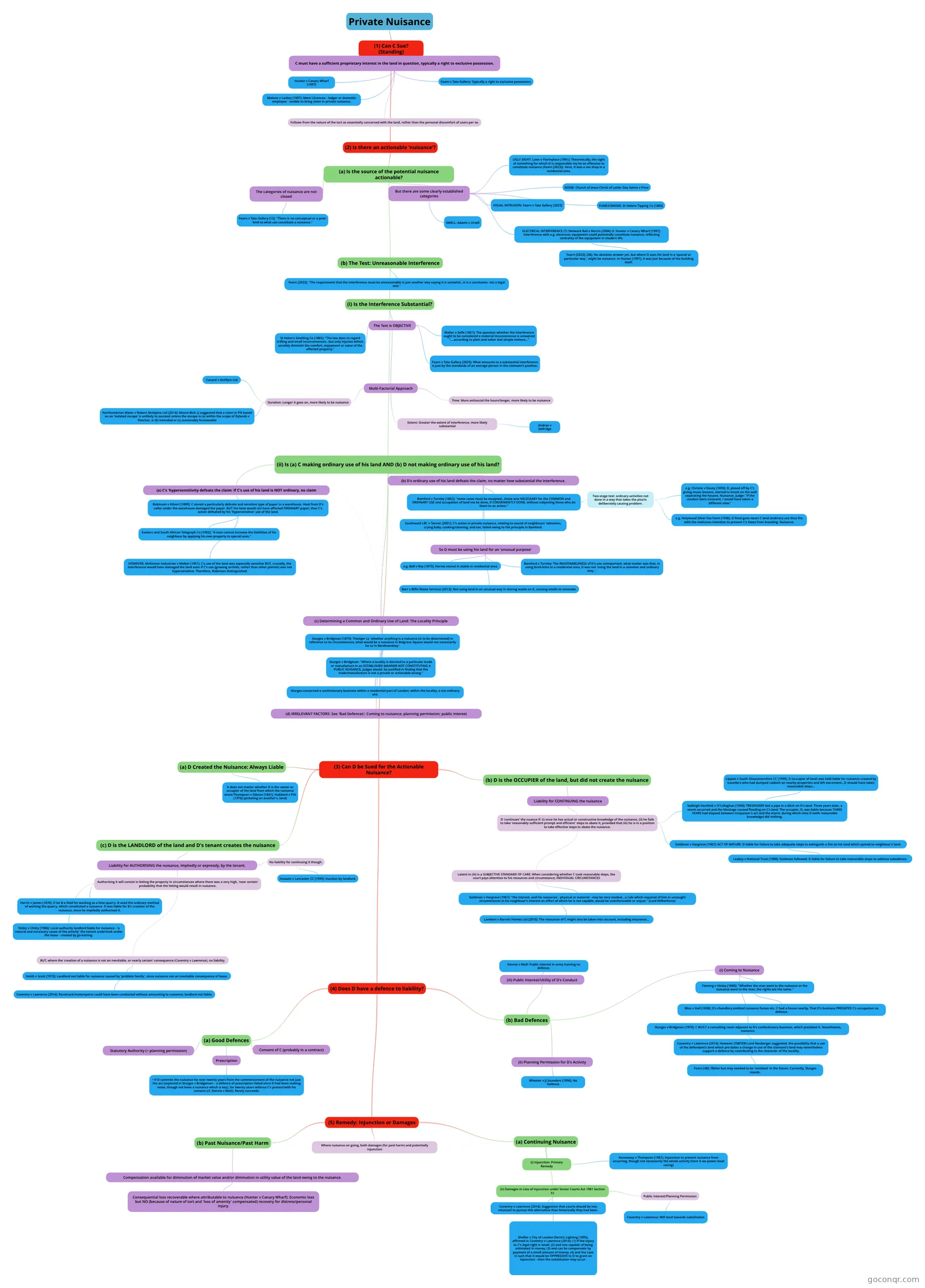
Mind map: Private nuisance
Contenido del mapa
Private Nuisance
(1) Can C Sue? (Standing)
- C must have a sufficient proprietary interest in the land in question, typically a right to exclusive possession.
- Hunter v Canary Wharf [1997]
- Fearn v Tate Gallery: Typically a right to exclusive possession.
- Follows from the nature of the tort as essentially concerned with the land, rather than the personal discomfort of users per se.
- Malone v Laskey [1907]: Mere Llicencee - lodger or domestic employee - unable to bring claim in private nuisance.
- (2) Is there an actionable 'nuisance'?
- (a) Is the source of the potential nuisance actionable?
- The categories of nuisance are not closed
- Fearn v Tate Gallery [12]: "There is no conceptual or a prior limit to what can constitute a nuisance."
- But there are some clearly established categories
- SMELL: Adams v Ursell
- NOISE: Church of Jesus Christ of Latter Day Saints v Price
- FUMES/SMOKE: St Helens Tipping Co [1865]
- ELECTRICAL INTERFERENCE (?): Network Rail v Morris [2004] cf. Hunter v Canary Wharf [1997]: Interference with e.g. electronic equipment could potentially constitute nuisance, reflecting centrality of the equipment in modern life.
- Fearn [2023]: [36]: No absolute answer yet, but where D uses his land in a 'special or particular way', might be nuisance. In Hunter [1997], it was just because of the building itself.
- UGLY SIGHT: Laws v Florinplace [1981]: Theoretically, the sight of something for which D is responsible my be so offensive to constitute nuisance (Fearn [2023]). Here, it was a sex shop in a residential area.
- VISUAL INTRUSION: Fearn v Tate Gallery [2023]
- (b) The Test: Unreasonable Interference
- Fearn [2023]: "The requirement that the interference must be unreasonable is just another way saying it is unlawful...it is a conclusion, not a legal test."
- (i) Is the Interference Substantial?
- The Test is OBJECTIVE
- St Helen's Smelting Co [1865]: "The law does to regard trifling and small inconveniences...but only injuries wihich sensibly diminish the comfort, enjoyment or value of the affected property."
- Walter v Selfe [1851]: The question whether the interference ought to be considered a material inconvenience is answered "....according to plain and sober and simple notions..."
- Fearn v Tate Gallery [2023]: What amounts to a substantial interference is just by the standards of an average person in the claimant's position.
- Multi-Factorial Approach
- Duration: Longer it goes on, more likely to be nuisance
- Cunard v Antifyre Ltd
- Northumbrian Water v Robert McAlpine Ltd [2014]: Moore-Bick LJ suggested that a claim in PN based on an ‘isolated escape’ is unlikely to succeed unless the escape is (a) within the scope of Rylands v Fletcher, is (b) intended or (c) reasonably foreseeable
- Time: More antisocial the hours/longer, more likely to be nuisance
- Extent: Greater the extent of interference, more likely substantial
- Andrae v Selfridge
- Duration: Longer it goes on, more likely to be nuisance
- (ii) Is (a) C making ordinary use of his land AND (b) D not making ordinary use of his land?
- (a) C's 'hypersensitivity defeats the claim: If C's use of his land is NOT ordinary, no claim
- Robinson v Kilvert [1889]: C stored a particularly delicate and sensitive type of paper in a warehouse. Heat from D's cellar under the warehouse damaged the paper. BUT the heat would not have affected ORDINARY paper; thus C's action defeated by his 'hypersensitive' use of the land.
- HOWEVER, McKinnon Industries v Walker [1951]: C's use of the land was especially sensitive BUT, crucially, the interference would have damaged the land even if C's use (growing orchids, rather than other plansts) was not hypersensitive. Therefore, Robinson distinguished.
- Eastern and South African Telegraph Co [1902]: "A man cannot increase the liabilities of his neighbour by applying his own property to special uses."
- Robinson v Kilvert [1889]: C stored a particularly delicate and sensitive type of paper in a warehouse. Heat from D's cellar under the warehouse damaged the paper. BUT the heat would not have affected ORDINARY paper; thus C's action defeated by his 'hypersensitive' use of the land.
- (b) D's ordinary use of his land defeats the claim, no matter how substantial the interference.
- Bamford v Turnley [1862]: "some cases must be excepted...those acts NECESSARY for the COMMON and ORDINARY USE and occupation of land ma be done, if CONVENIENTLY DONE, without subjecting those who do them to an action."
- Two-stage test: ordinary activities not done in a way that takes the piss/is deliberately causing problem.
- e.g. Christie v Davey [1893]: D, pissed off by C's giving music lessons, started to knock on the wall separating the houses. Nuisance. Judge: "If the conduct were innocent, I would have taken a different view."
- e.g. Holywood Silver Fox Farm [1936]: D fired guns nears C land (ordinary use thus fire with the malicious intention to prevent C's foxes from breeding. Nuisance.
- Two-stage test: ordinary activities not done in a way that takes the piss/is deliberately causing problem.
- So D must be using his land for an 'unusual purpose'
- e.g. Ball v Ray [1873]: Horses stored in stable in residential area.
- Bamford v Turnley: The REASONABLENESS of D's use unimportant: what matter was that, in using brick-kilns in a residential area, D was not 'using the land in a common and ordinary way...'
- Barr v Biffa Waste Services [2013]: Not using land in an unusual way in storing waste on it, causing smells to emanate.
- Southward LBC v Tanner [2001]: C's action in private nuisance, relating to sound of neighbours' television, crying baby, cooking/cleaning, and sex, failed owing to the principle in Bamford.
- Bamford v Turnley [1862]: "some cases must be excepted...those acts NECESSARY for the COMMON and ORDINARY USE and occupation of land ma be done, if CONVENIENTLY DONE, without subjecting those who do them to an action."
- (c) Determining a Common and Ordinary Use of Land: The Locality Principle
- Sturges v Bridgman [1879]: Thesiger LJ: ‘whether anything is a nuisance [is to be determined] in reference to its circumstances; what would be a nuisance in Belgrave Square would not necessarily be so in Berdmondsey.’
- Sturges concerned a confectionary business within a residential part of London: within the locality, a not ordinary use.
- Sturges v Bridgman: "Where a locality is devoted to a particular trade or manufacture in an ESTABLISHED MANNER NOT CONSTITUTING A PUBLIC NUISANCE, judges would. be justified in finding that the trade/manufacture is not a private or actionable wrong."
- (d) IRRELEVANT FACTORS: See 'Bad Defences': Coming to nuisance; planning permission; public interest
- Sturges v Bridgman [1879]: Thesiger LJ: ‘whether anything is a nuisance [is to be determined] in reference to its circumstances; what would be a nuisance in Belgrave Square would not necessarily be so in Berdmondsey.’
- (3) Can D be Sued for the Actionable Nuisance?
- (a) D Created the Nuisance: Always Liable
- It does not matter whether D is the owner or occupier of the land from which the nuisance arose:Thompson v Gibson [1841]; Hubbard v Pitt [1976] (picketing on another's. land)
- (b) D is the OCCUPIER of the land, but did not create the nuisance
- Liability for CONTINUING the nuisance
- D 'continues' the nuance if: (i) once he has actual or constructive knowledge of the nuisance, (ii) he fails to take 'reasonably sufficient prompt and efficient' steps to abate it, provided that (iii) he is in a position to take effective steps to abate the nuisance.
- Sedleigh-Denfield v O'Callaghan [1940]: TRESPASSER laid a pipe in a ditch on D's land. Three years later, a storm occurred and the blockage caused flooding on C's land. The occupier, D, was liable because THREE YEARS had elapsed between trespasser's act and the storm, during which time D (with reasonable knowledge) did nothing.
- Lippiat v South Gloucestershire CC [1999], D (occupier of land) was held liable for nuisance created by travellers who had dumped rubbish on nearby properties and left excrement…D should have taken reasonable steps…
- Goldman v Hargrove [1967]: ACT OF NATURE: D liable for failure to take adequate steps to extinguish a fire on his land which spread to neighbour's land.
- Leakey v National Trust [1980]: Goldman followed: D liable for failure to take reasonable steps to address subsidence.
- Latent in (iii) is a SUBJECTIVE STANDARD OF CARE: When considering whether C took reasonable steps, the court pays attention to his resources and circumstance; INDIVIDUAL CIRCUMSTANCES
- Goldman v Hargrove [1967]: "His interest, and his resources - physical or material - may be very modest...a rule which required of him in unsought circumstances in his neighbour's interest an effort of which he is not capable, would be unenforceable or unjust." (Lord Wilberforce)
- Lambert v Barrett Homes Ltd [2010]: The resources of C might also be taken into account, including insurance...
- Sedleigh-Denfield v O'Callaghan [1940]: TRESPASSER laid a pipe in a ditch on D's land. Three years later, a storm occurred and the blockage caused flooding on C's land. The occupier, D, was liable because THREE YEARS had elapsed between trespasser's act and the storm, during which time D (with reasonable knowledge) did nothing.
- D 'continues' the nuance if: (i) once he has actual or constructive knowledge of the nuisance, (ii) he fails to take 'reasonably sufficient prompt and efficient' steps to abate it, provided that (iii) he is in a position to take effective steps to abate the nuisance.
- Liability for CONTINUING the nuisance
- (4) Does D have a defence to liability?
- (b) Bad Defences
- (i) Coming to Nuisance
- Fleming v Hislop [1886]: "Whether the man went to the nuisance or the nuisance went to the man, the rights are the same."
- Bliss v Hall [1838]: D's chandlery emitted nuisance fumes etc. C had a house nearby. That D's business PREDATED C's occupation no defence.
- Sturges v Bridgman [1979]: C BUILT a consulting room adjacent to D's confectionery business, which predated it. Nonetheless, nuisance.
- Coventry v Lawrence [2014]: However (OBITER) Lord Neuberger suggested: the possibility that a use of the defendant’s land which pre-dates a change in use of the claimant’s land may nevertheless support a defence by contributing to the character of the locality.
- Fearn [46]: Obiter but may needed to be 'revisited' in the future. Currently, Sturges stands.
- Coventry v Lawrence [2014]: However (OBITER) Lord Neuberger suggested: the possibility that a use of the defendant’s land which pre-dates a change in use of the claimant’s land may nevertheless support a defence by contributing to the character of the locality.
- Fleming v Hislop [1886]: "Whether the man went to the nuisance or the nuisance went to the man, the rights are the same."
- (ii) Planning Permission for D's Activity
- Wheeler v JJ Saunders [1996]: No Defence
- (iii) Public Interest/Utility of D's Conduct
- Dennis v MoD: Public interest in army training no defence.
- (i) Coming to Nuisance
- (a) Good Defences
- Prescription
- • If D commits the nuisance for over twenty years from the commencement of the nuisance not just the act (explored in Sturges v Bridgeman – a defence of prescription failed since D had been making noise, though not been a nuisance which is key), for twenty years without C’s protest/with his consent (cf. Dennis v MoD). Rarely succeeds.
- Statutory Authority (≠ planning permission)
- Consent of C (probably in a contract)
- Prescription
- (5) Remedy: Injunction or Damages
- (a) Continuing Nuisance
- (i) Injunction: Primary Remedy
- Kennaway v Thompson [1981]: Injunction to prevent nuisance from occurring, though not necessarily the whole activity (here it wa power-boat racing)
- (ii) Damages in Lieu of Injunction under Senior Courts Act 1981 Section 51
- Coventry v Lawrence [2014]: Suggestion that courts should be less reluctant to pursue this alternative than historically they had been.
- Shelfer v City of London Electric Lighting [1895], affirmed in Coventry v Lawrence [2014]: (1) If the injury to C's legal right is small, (2) and one capable of being estimated in money, (3) and can be compensate by payment of a small amount of money, (4) and the case is such that it would be OPPRESSIVE to D to grant an injunction - then the substitution may occur.
- Public Interest/Planning Permission
- Coventry v Lawrence: Will tend towards substitution
- (i) Injunction: Primary Remedy
- (b) Past Nuisance/Past Harm
- Compensation available for diminution of market value and/or diminution in utility value of the land owing to the nuisance.
- Consequential loss recoverable where attributable to nuisance (Hunter v Canary Wharf): Economic loss but NO (because of nature of tort and 'loss of amenity' compensated) recovery for distress/personal injury.
- Compensation available for diminution of market value and/or diminution in utility value of the land owing to the nuisance.
- Where nuisance on going, both damages (for past harm) and potentially injunction
- (a) Continuing Nuisance
- (b) Bad Defences
- (c) D is the LANDLORD of the land and D's tenant creates the nuisance
- Liability for AUTHORISING the nuisance, impliedly or expressly, by the tenant.
- Authorising it will consist in letting the property in circumstances where there was a very high, 'near certain' probability that the letting would result in nuisance.
- Harris v James [1876]: D let B a field for working as a lime quarry. B used the ordinary method of working the quarry, which constituted a nuisance. D was liable for B's creation of the nuisance, since he impliedly authorised it.
- Tetley v Chitty [1986]: Local authority landlord liable for nuisance - 'a natural and necessary cause of the activity' the tenant undertook under the lease - created by go-karting.
- BUT, where the 'creation of a nuisance is not an inevitable, or nearly certain' consequence (Coventry v Lawrence), no liability.
- Smith v Scott [1973]: Landlord not liable for nuisance caused by 'problem family', since nuisance not an inevitable consequence of lease.
- Coventry v Lawrence [2014]: Racetrack/motorsports could have been conducted without amounting to nuisance; landlord not liable.
- No liability for continuing it though.
- Hussain v Lancaster CC [1999]: Inaction by landlord.
- Authorising it will consist in letting the property in circumstances where there was a very high, 'near certain' probability that the letting would result in nuisance.
- Liability for AUTHORISING the nuisance, impliedly or expressly, by the tenant.
- (a) D Created the Nuisance: Always Liable
- (a) C's 'hypersensitivity defeats the claim: If C's use of his land is NOT ordinary, no claim
- The Test is OBJECTIVE
- The categories of nuisance are not closed
- (a) Is the source of the potential nuisance actionable?
- C must have a sufficient proprietary interest in the land in question, typically a right to exclusive possession.
Información
- Descripción
- Mapa Mental sobre Private Nuisance, creado por Alex Scoby el 03/06/2023.
- Creado por
- Alex Scoby
- Visitas
- 0
- Valoración