
Mapa mental
computer science
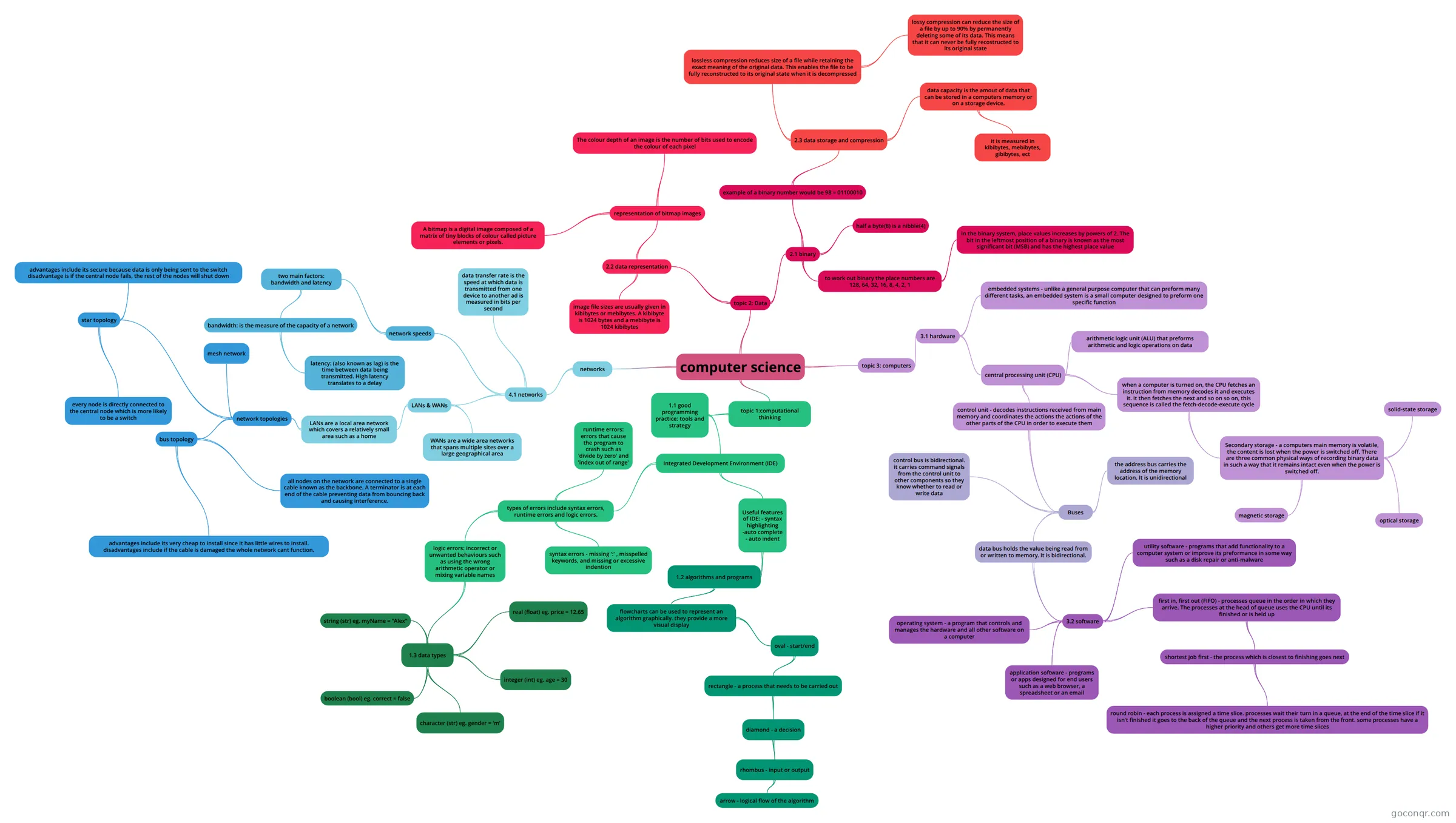
Mind map: computer science
Contenido del mapa
computer science
topic 1:computational thinking
- 1.1 good programming practice: tools and strategy
- Integrated Development Environment (IDE)
- Useful features of IDE: - syntax highlighting -auto complete - auto indent
- 1.2 algorithms and programs
- flowcharts can be used to represent an algorithm graphically. they provide a more visual display
- oval - start/end
- rectangle - a process that needs to be carried out
- diamond - a decision
- rhombus - input or output
- arrow - logical flow of the algorithm
- rhombus - input or output
- diamond - a decision
- rectangle - a process that needs to be carried out
- oval - start/end
- flowcharts can be used to represent an algorithm graphically. they provide a more visual display
- 1.2 algorithms and programs
- types of errors include syntax errors, runtime errors and logic errors.
- syntax errors - missing ':' , misspelled keywords, and missing or excessive indention
- runtime errors: errors that cause the program to crash such as 'divide by zero' and 'index out of range'
- logic errors: incorrect or unwanted behaviours such as using the wrong arithmetic operator or mixing variable names
- 1.3 data types
- integer (int) eg. age = 30
- real (float) eg. price = 12.65
- boolean (bool) eg. correct = false
- character (str) eg. gender = 'm'
- string (str) eg. myName = "Alex"
- 1.3 data types
- Useful features of IDE: - syntax highlighting -auto complete - auto indent
- Integrated Development Environment (IDE)
- 1.1 good programming practice: tools and strategy
topic 2: Data
- 2.1 binary
- half a byte(8) is a nibble(4)
- to work out binary the place numbers are 128, 64, 32, 16, 8, 4, 2, 1
- in the binary system, place values increases by powers of 2. The bit in the leftmost position of a binary is known as the most significant bit (MSB) and has the highest place value
- example of a binary number would be 98 = 01100010
- 2.3 data storage and compression
- data capacity is the amout of data that can be stored in a computers memory or on a storage device.
- it is measured in kibibytes, mebibytes, gibibytes, ect
- lossless compression reduces size of a file while retaining the exact meaning of the original data. This enables the file to be fully reconstructed to its original state when it is decompressed
- lossy compression can reduce the size of a file by up to 90% by permanently deleting some of its data. This means that it can never be fully recostructed to its original state
- data capacity is the amout of data that can be stored in a computers memory or on a storage device.
- 2.3 data storage and compression
- 2.2 data representation
- representation of bitmap images
- A bitmap is a digital image composed of a matrix of tiny blocks of colour called picture elements or pixels.
- The colour depth of an image is the number of bits used to encode the colour of each pixel
- image file sizes are usually given in kibibytes or mebibytes. A kibibyte is 1024 bytes and a mebibyte is 1024 kibibytes
- representation of bitmap images
- 2.1 binary
topic 3: computers
- 3.1 hardware
- central processing unit (CPU)
- control unit - decodes instructions received from main memory and coordinates the actions the actions of the other parts of the CPU in order to execute them
- Buses
- the address bus carries the address of the memory location. It is unidirectional
- data bus holds the value being read from or written to memory. It is bidirectional.
- 3.2 software
- operating system - a program that controls and manages the hardware and all other software on a computer
- application software - programs or apps designed for end users such as a web browser, a spreadsheet or an email
- utility software - programs that add functionality to a computer system or improve its preformance in some way such as a disk repair or anti-malware
- first in, first out (FIFO) - processes queue in the order in which they arrive. The processes at the head of queue uses the CPU until its finished or is held up
- shortest job first - the process which is closest to finishing goes next
- round robin - each process is assigned a time slice. processes wait their turn in a queue, at the end of the time slice if it isn't finished it goes to the back of the queue and the next process is taken from the front. some processes have a higher priority and others get more time slices
- shortest job first - the process which is closest to finishing goes next
- 3.2 software
- control bus is bidirectional. it carries command signals from the control unit to other components so they know whether to read or write data
- Buses
- arithmetic logic unit (ALU) that preforms arithmetic and logic operations on data
- when a computer is turned on, the CPU fetches an instruction from memory decodes it and executes it. it then fetches the next and so on so on, this sequence is called the fetch-decode-execute cycle
- Secondary storage - a computers main memory is volatile, the content is lost when the power is switched off. There are three common physical ways of recording binary data in such a way that it remains intact even when the power is switched off.
- magnetic storage
- optical storage
- solid-state storage
- Secondary storage - a computers main memory is volatile, the content is lost when the power is switched off. There are three common physical ways of recording binary data in such a way that it remains intact even when the power is switched off.
- control unit - decodes instructions received from main memory and coordinates the actions the actions of the other parts of the CPU in order to execute them
- embedded systems - unlike a general purpose computer that can preform many different tasks, an embedded system is a small computer designed to preform one specific function
- central processing unit (CPU)
- 3.1 hardware
networks
- 4.1 networks
- LANs & WANs
- LANs are a local area network which covers a relatively small area such as a home
- network topologies
- bus topology
- all nodes on the network are connected to a single cable known as the backbone. A terminator is at each end of the cable preventing data from bouncing back and causing interference.
- advantages include its very cheap to install since it has little wires to install. disadvantages include if the cable is damaged the whole network cant function.
- star topology
- every node is directly connected to the central node which is more likely to be a switch
- advantages include its secure because data is only being sent to the switch disadvantage is if the central node fails, the rest of the nodes will shut down
- mesh network
- bus topology
- network topologies
- WANs are a wide area networks that spans multiple sites over a large geographical area
- LANs are a local area network which covers a relatively small area such as a home
- network speeds
- two main factors: bandwidth and latency
- bandwidth: is the measure of the capacity of a network
- latency: (also known as lag) is the time between data being transmitted. High latency translates to a delay
- bandwidth: is the measure of the capacity of a network
- two main factors: bandwidth and latency
- data transfer rate is the speed at which data is transmitted from one device to another ad is measured in bits per second
- LANs & WANs
- 4.1 networks
Información
- Descripción
- computer science mindmap (not finished)
- Creado por
- Caitlin Rarity
- Visitas
- 17
- Valoración