
Mapa mental
Chapter 6: Learning
Contenido del mapa
Chapter 6: Learning
- Learning is any relatively durable change in behavior, attitude, of knowledge that is due to experience. Not to be confused with a reflex which is without control and peripheral.
Classical Conditioning
- Classical conditioning is a learning process in which an innate response to a potent stimulus comes to be elicited in response to a previously neutral stimulus; this is achieved by repeated pairings of the neutral stimulus with the potent stimulus
- 4 Key steps
- UCS
- The Unconditioned Stimulus: consistently produces a particular automatic response usually controlled by the nervous system. In Pavlov's = Dog food
- UCR
- The Unconditioned Response: Response that occurs when the UCS is presented. A reflex. In Pavlov's Dog: Salivation Always identical to CR
- CS
- Stimulus is neutral at start of conditioning process. Through association with UCS, the CS triggers the (U)CR. In Pavlov's Dog: sound of bell.
- CR
- Learned response produced by CS. Occurs after association. Similair to UCR but triggered by CR alone. In Pavlov's Dog: Salivation at bell.
- UCS
- Pavlov
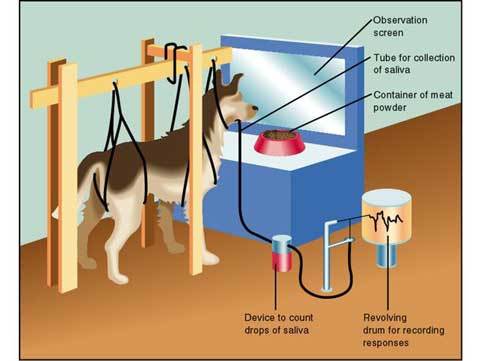
- Ivan Pavlov was a physiologist who paved the way for behavioral psychology. In his initial experiments, Pavlov presented a stimulus and then gave the dog food; after a few repetitions, the dogs started to salivate in response to the stimulus. Pavlov called the stimulus the conditioned (or conditional) stimulus (CS) because its effects depend on its association with food.
- Involuntary
- Little Albert
- The Little Albert experiment was a case study showing empirical evidence of classical conditioning in humans. The study also provides an example of stimulus generalization.
- Processes
- Stimuli - Response
- A stimuli is something that causes a reaction. A Response is the reaction to said stimuli In classical conditioning responses are elicited.
- Classical Acquisition
- Occurs when CS and UCS are paired gradually resulting in CR.
- Classical Extinction
- Occurs when CS is repeatedly presented alone until it no longer elicits a CR.
- Spontaneous Recovery
- the re-appearance of an extinguished response after a period of non exposure to the CS.
- Classical Generalization
- Occurs when a CR is elicited by a new stimulus that resembles the original CS.
- Classical Discrimination
- When a CR is not elicited by a new stimulus that resembles the original CS.
- Stimuli - Response
Operant Conditioning
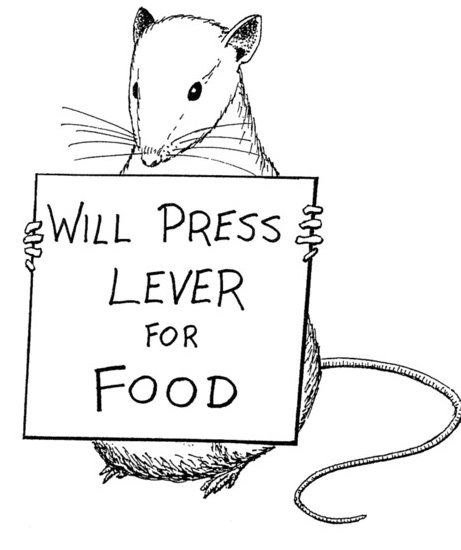
- Operant conditioning is a learning process in which behavior is sensitive to, or controlled by its consequences
- Voluntary
- Behavioral Programming
- Shape
- Reinforcing behavior to make them closer to goal behavior.
- Positive Reinforcement
- Rewarding favorable behavior
- Schedules
- Variable Ratio
- When using a variable-ratio (VR) schedule of reinforcement the delivery of reinforcement will “vary” but must average out at a specific number. Just like a fixed-ratio schedule, a variable-ratio schedule can be any number but must be defined.
- Fixed Ratio
- A fixed-ratio schedule of reinforcement means that reinforcement should be delivered after a constant or “fixed” number of correct responses. For example, a fixed ratio schedule of 2 means reinforcement is delivered after every 2 correct responses.
- Fixed Interval
- A fixed-interval schedule means that reinforcement becomes available after a specific period of time. The schedule is abbreviated into “FI” followed by the amount of time that must pass before reinforcement becomes available, e.g. an FI2 would mean reinforcement becomes available after 2 minutes has passed; an FI20 means 20 minutes must pass and so on.
- Variable Interval
- The variable-interval (VI) schedule of reinforcement means the time periods that must pass before reinforcement becomes available will “vary” but must average out at a specific time interval. Again the time interval can be any number but must be defined.
- Variable Ratio
- Negative reinforcement
- Relief: removing averse stimulus
- Diminish
- To decrease unwanted behavior through penalty or punishment.
- Punish
- Active Punishment
- Penalty
- Removal of privilege.
- Shape
- Processes
- Operant Acquisition
- Occurs when a response gradually increases due to contingent reinforcement.
- Operant Extinction
- Occurs when responding gradually slows and stops after reinforcement is terminated.
- Operant Generalization
- Occurs when responding increases in the presence of a stimulus that resembles the original discrimination stimulus.
- Operant Discrimination
- Occurs when responding does not increase in the presence of a stimulus that resembles the original discriminative stimulus.
- Operant Acquisition
Observational Learning
- Behavior learned through observation, thought to be connected to mirror neurons. A mirror neuron is a neuron that fires both when an animal acts and when the animal observes the same action performed by another. Thus, the neuron "mirrors" the behavior of the other, as though the observer were itself acting. Such neurons have been directly observed in primate species.
- 3 key steps
- Retention
- Remembering what you paid attention to: cooking lesson.
- Attention
- One's characteristics affect attention: capacity and arousal.
- Reproduction
- Being able to reproduce what is remembered: driving.
- Retention
- Motivation
- Intrinsic
- An ambition to motivate self.
- Extrinsic
- Motivated by external rewards.
- Intrinsic
- Dis-inhibition
- Weakening of inhibition through exposure to a model: mob mentality.
- Latent Learning
- Latent learning is a form of learning that is not immediately expressed in an overt response; it occurs without any obvious reinforcement of the behavior or associations that are learned.
- Modelling
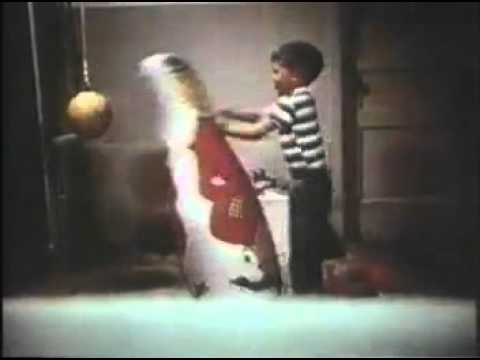
- A model for which others can observe behavior: BOBO Dolls
Evolutionary Perspectives
- Instinctive Drift
- When an animals inate response interferes with conditioning.
- Taste Aversion
- Biological and evolutionary response to consuming things that sicken us.
- Phobias
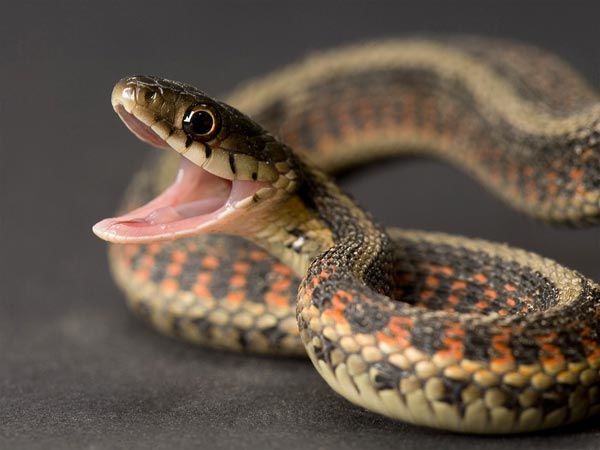
- Evolutionary to form fears of dangerous activities or animals.
- Instinctive Drift
Imágenes y archivos del mapa



Información
- Descripción
- My mind map for chapter 6
- Creado por
- Andrew Cooper
- Visitas
- 98
- Etiquetas
- Valoración