
Mapa mental
Virtue Ethics
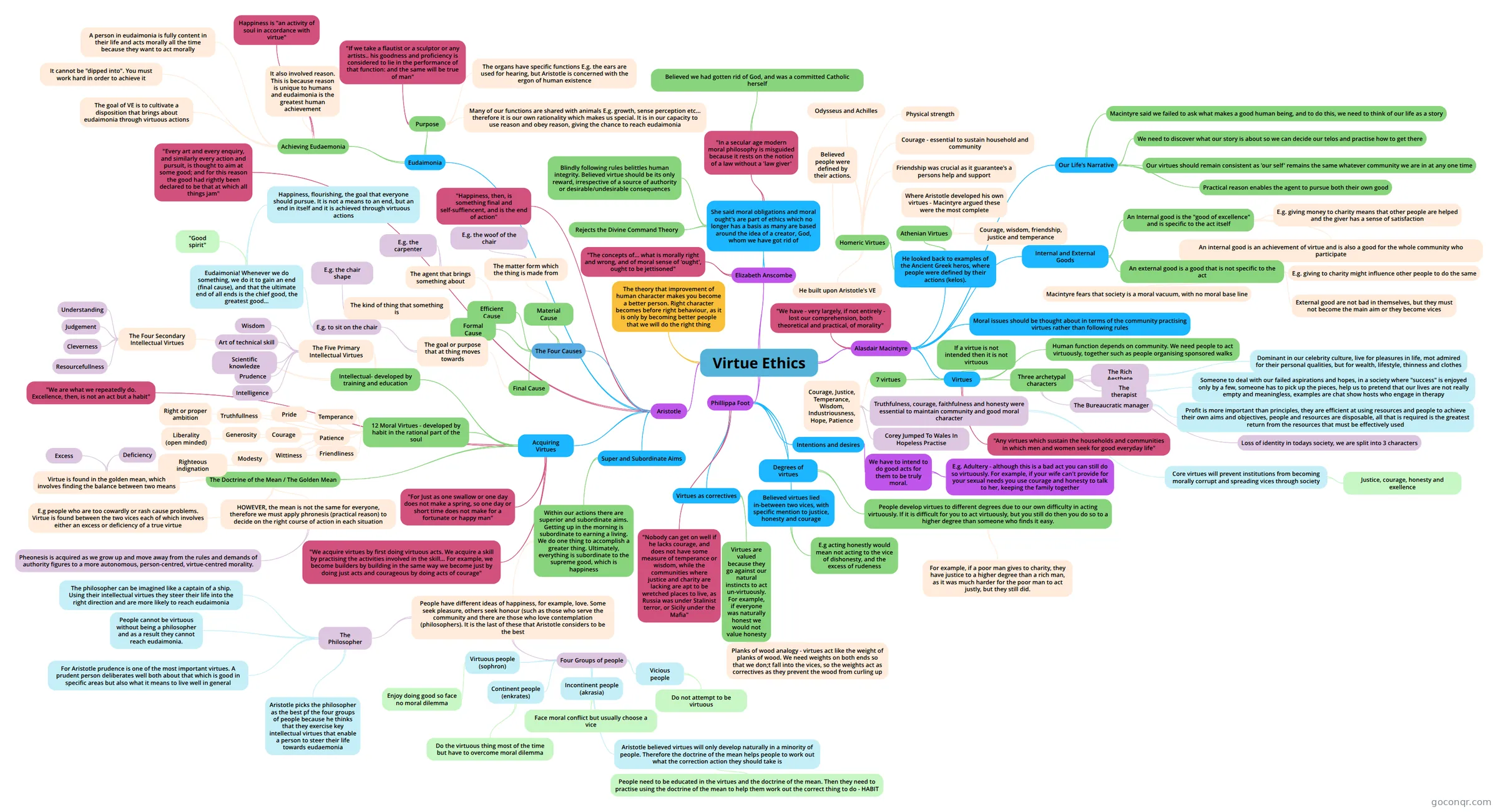
Mind map: Virtue ethics
Contenido del mapa
Virtue Ethics
The theory that improvement of human character makes you become a better person. Right character becomes before right behaviour, as it is only by becoming better people that we will do the right thing
Aristotle
- The Four Causes
- Material Cause
- The matter form which the thing is made from
- E.g. the woof of the chair
- The matter form which the thing is made from
- Efficient Cause
- The agent that brings something about
- E.g. the carpenter
- The agent that brings something about
- Formal Cause
- The kind of thing that something is
- E.g. the chair shape
- The kind of thing that something is
- Final Cause
- The goal or purpose that at thing moves towards
- E.g. to sit on the chair
- Eudaimonia! Whenever we do something, we do it to gain an end (final cause), and that the ultimate end of all ends is the chief good, the greatest good...
- "Good spirit"
- Happiness, flourishing, the goal that everyone should pursue. It is not a means to an end, but an end in itself and it is achieved through virtuous actions
- Eudaimonia! Whenever we do something, we do it to gain an end (final cause), and that the ultimate end of all ends is the chief good, the greatest good...
- E.g. to sit on the chair
- The goal or purpose that at thing moves towards
- Material Cause
- "Happiness, then, is something final and self-suffiencent, and is the end of action"
- "Every art and every enquiry, and similarly every action and pursuit, is thought to aim at some good; and for this reason the good had rightly been declared to be that at which all things jam"
- Acquiring Virtues
- Intellectual- developed by training and education
- The Five Primary Intellectual Virtues
- Art of technical skill
- Scientific knowledge
- Prudence
- Intelligence
- Wisdom
- The Four Secondary Intellectual Virtues
- Understanding
- Judgement
- Cleverness
- Resourcefullness
- The Five Primary Intellectual Virtues
- 12 Moral Virtues - developed by habit in the rational part of the soul
- Courage
- Temperance
- Liberality (open minded)
- Generosity
- Pride
- Patience
- Truthfullness
- Wittiness
- Right or proper ambition
- Friendliness
- Modesty
- Righteous indignation
- The Doctrine of the Mean / The Golden Mean
- Virtue is found in the golden mean, which involves finding the balance between two means
- Excess
- Deficiency
- E.g people who are too cowardly or rash cause problems. Virtue is found between the two vices each of which involves either an excess or deficiency of a true virtue
- HOWEVER, the mean is not the same for everyone, therefore we must apply phronesis (practical reason) to decide on the right course of action in each situation
- Pheonesis is acquired as we grow up and move away from the rules and demands of authority figures to a more autonomous, person-centred, virtue-centred morality.
- Virtue is found in the golden mean, which involves finding the balance between two means
- "For Just as one swallow or one day does not make a spring, so one day or short time does not make for a fortunate or happy man"
- "We acquire virtues by first doing virtuous acts. We acquire a skill by practising the activities involved in the skill... For example, we become builders by building in the same way we become just by doing just acts and courageous by doing acts of courage"
- "We are what we repeatedly do. Excellence, then, is not an act but a habit"
- Intellectual- developed by training and education
- Super and Subordinate Aims
- Within our actions there are superior and subordinate aims. Getting up in the morning is subordinate to earning a living. We do one thing to accomplish a greater thing. Ultimately, everything is subordinate to the supreme good, which is happiness
- People have different ideas of happiness, for example, love. Some seek pleasure, others seek honour (such as those who serve the community and there are those who love contemplation (philosophers). It is the last of these that Aristotle considers to be the best
- Four Groups of people
- Virtuous people (sophron)
- Enjoy doing good so face no moral dilemma
- Continent people (enkrates)
- Do the virtuous thing most of the time but have to overcome moral dilemma
- Incontinent people (akrasia)
- Face moral conflict but usually choose a vice
- Vicious people
- Do not attempt to be virtuous
- Aristotle believed virtues will only develop naturally in a minority of people. Therefore the doctrine of the mean helps people to work out what the correction action they should take is
- People need to be educated in the virtues and the doctrine of the mean. Then they need to practise using the doctrine of the mean to help them work out the correct thing to do - HABIT
- Virtuous people (sophron)
- The Philosopher
- Aristotle picks the philosopher as the best pf the four groups of people because he thinks that they exercise key intellectual virtues that enable a person to steer their life towards eudaemonia
- People cannot be virtuous without being a philosopher and as a result they cannot reach eudaimonia.
- The philosopher can be imagined like a captain of a ship. Using their intellectual virtues they steer their life into the right direction and are more likely to reach eudaimonia
- For Aristotle prudence is one of the most important virtues. A prudent person deliberates well both about that which is good in specific areas but also what it means to live well in general
- Four Groups of people
- People have different ideas of happiness, for example, love. Some seek pleasure, others seek honour (such as those who serve the community and there are those who love contemplation (philosophers). It is the last of these that Aristotle considers to be the best
- Within our actions there are superior and subordinate aims. Getting up in the morning is subordinate to earning a living. We do one thing to accomplish a greater thing. Ultimately, everything is subordinate to the supreme good, which is happiness
- Eudaimonia
- Achieving Eudaemonia
- The goal of VE is to cultivate a disposition that brings about eudaimonia through virtuous actions
- It cannot be "dipped into". You must work hard in order to achieve it
- A person in eudaimonia is fully content in their life and acts morally all the time because they want to act morally
- It also involved reason. This is because reason is unique to humans and eudaimonia is the greatest human achievement
- Happiness is "an activity of soul in accordance with virtue"
- Purpose
- "If we take a flautist or a sculptor or any artists.. his goodness and proficiency is considered to lie in the performance of that function: and the same will be true of man"
- The organs have specific functions E.g. the ears are used for hearing, but Aristotle is concerned with the ergon of human existence
- Many of our functions are shared with animals E.g. growth, sense perception etc... therefore it is our own rationality which makes us special. It is in our capacity to use reason and obey reason, giving the chance to reach eudaimonia
- Achieving Eudaemonia
- The Four Causes
Elizabeth Anscombe
- "The concepts of... what is morally right and wrong, and of moral sense of 'ought', ought to be jettisoned"
- She said moral obligations and moral ought's are part of ethics which no longer has a basis as many are based around the idea of a creator, God, whom we have got rid of
- Rejects the Divine Command Theory
- Blindly following rules belittles human integrity. Believed virtue should be its only reward, irrespective of a source of authority or desirable/undesirable consequences
- "In a secular age modern moral philosophy is misguided because it rests on the notion of a law without a 'law giver'
- Believed we had gotten rid of God, and was a committed Catholic herself
Alasdair Macintyre
- "We have - very largely, if not entirely - lost our comprehension, both theoretical and practical, of morality"
- He looked back to examples of the Ancient Greek heros, where people were defined by their actions (kelos).
- Homeric Virtues
- He built upon Aristotle's VE
- Odysseus and Achilles
- Believed people were defined by their actions.
- Courage - essential to sustain household and community
- Friendship was crucial as it guarantee's a persons help and support
- Physical strength
- Athenian Virtues
- Courage, wisdom, friendship, justice and temperance
- Where Aristotle developed his own virtues - Macintyre argued these were the most complete
- Homeric Virtues
- Internal and External Goods
- An Internal good is the "good of excellence" and is specific to the act itself
- E.g. giving money to charity means that other people are helped and the giver has a sense of satisfaction
- An internal good is an achievement of virtue and is also a good for the whole community who participate
- An external good is a good that is not specific to the act
- E.g. giving to charity might influence other people to do the same
- External good are not bad in themselves, but they must not become the main aim or they become vices
- Macintyre fears that society is a moral vacuum, with no moral base line
- An Internal good is the "good of excellence" and is specific to the act itself
- Virtues
- 7 virtues
- Courage, Justice, Temperance, Wisdom, Industriousness, Hope, Patience
- Corey Jumped To Wales In Hopeless Practise
- Truthfulness, courage, faithfulness and honesty were essential to maintain community and good moral character
- Core virtues will prevent institutions from becoming morally corrupt and spreading vices through society
- Justice, courage, honesty and exellence
- Core virtues will prevent institutions from becoming morally corrupt and spreading vices through society
- Courage, Justice, Temperance, Wisdom, Industriousness, Hope, Patience
- "Any virtues which sustain the households and communities in which men and women seek for good everyday life"
- Human function depends on community. We need people to act virtuously, together such as people organising sponsored walks
- Three archetypal characters
- The Bureaucratic manager
- Profit is more important than principles, they are efficient at using resources and people to achieve their own aims and objectives, people and resources are disposable, all that is required is the greatest return from the resources that must be effectively used
- The Rich Aesthete
- Dominant in our celebrity culture, live for pleasures in life, mot admired for their personal qualities, but for wealth, lifestyle, thinness and clothes
- The therapist
- Someone to deal with our failed aspirations and hopes, in a society where "success" is enjoyed only by a few, someone has to pick up the pieces, help us to pretend that our lives are not really empty and meaningless, examples are chat show hosts who engage in therapy
- Loss of identity in todays society, we are split into 3 characters
- The Bureaucratic manager
- If a virtue is not intended then it is not virtuous
- 7 virtues
- Moral issues should be thought about in terms of the community practising virtues rather than following rules
- Our Life's Narrative
- Macintyre said we failed to ask what makes a good human being, and to do this, we need to think of our life as a story
- We need to discover what our story is about so we can decide our telos and practise how to get there
- Our virtues should remain consistent as 'our self' remains the same whatever community we are in at any one time
- Practical reason enables the agent to pursue both their own good
Phillippa Foot
- "Nobody can get on well if he lacks courage, and does not have some measure of temperance or wisdom, while the communities where justice and charity are lacking are apt to be wretched places to live, as Russia was under Stalinist terror, or Sicily under the Mafia"
- Believed virtues lied in-between two vices, with specific mention to justice, honesty and courage
- E.g acting honestly would mean not acting to the vice of dishonesty, and the excess of rudeness
- Intentions and desires
- We have to intend to do good acts for them to be truly moral.
- E.g. Adultery - although this is a bad act you can still do so virtuously. For example, if your wife can't provide for your sexual needs you use courage and honesty to talk to her, keeping the family together
- We have to intend to do good acts for them to be truly moral.
- Virtues as correctives
- Virtues are valued because they go against our natural instincts to act un-virtuously. For example, if everyone was naturally honest we would not value honesty
- Planks of wood analogy - virtues act like the weight of planks of wood. We need weights on both ends so that we don;t fall into the vices, so the weights act as correctives as they prevent the wood from curling up
- Virtues are valued because they go against our natural instincts to act un-virtuously. For example, if everyone was naturally honest we would not value honesty
- Degrees of virtues
- People develop virtues to different degrees due to our own difficulty in acting virtuously. If it is difficult for you to act virtuously, but you still do then you do so to a higher degree than someone who finds it easy.
- For example, if a poor man gives to charity, they have justice to a higher degree than a rich man, as it was much harder for the poor man to act justly, but they still did.
- People develop virtues to different degrees due to our own difficulty in acting virtuously. If it is difficult for you to act virtuously, but you still do then you do so to a higher degree than someone who finds it easy.
Información
- Descripción
- Mapa Mental sobre Virtue Ethics, creado por Grace Gregory el 18/11/2015.
- Creado por
- Grace Gregory
- Visitas
- 0
- Valoración