
Mapa mental
TLOC
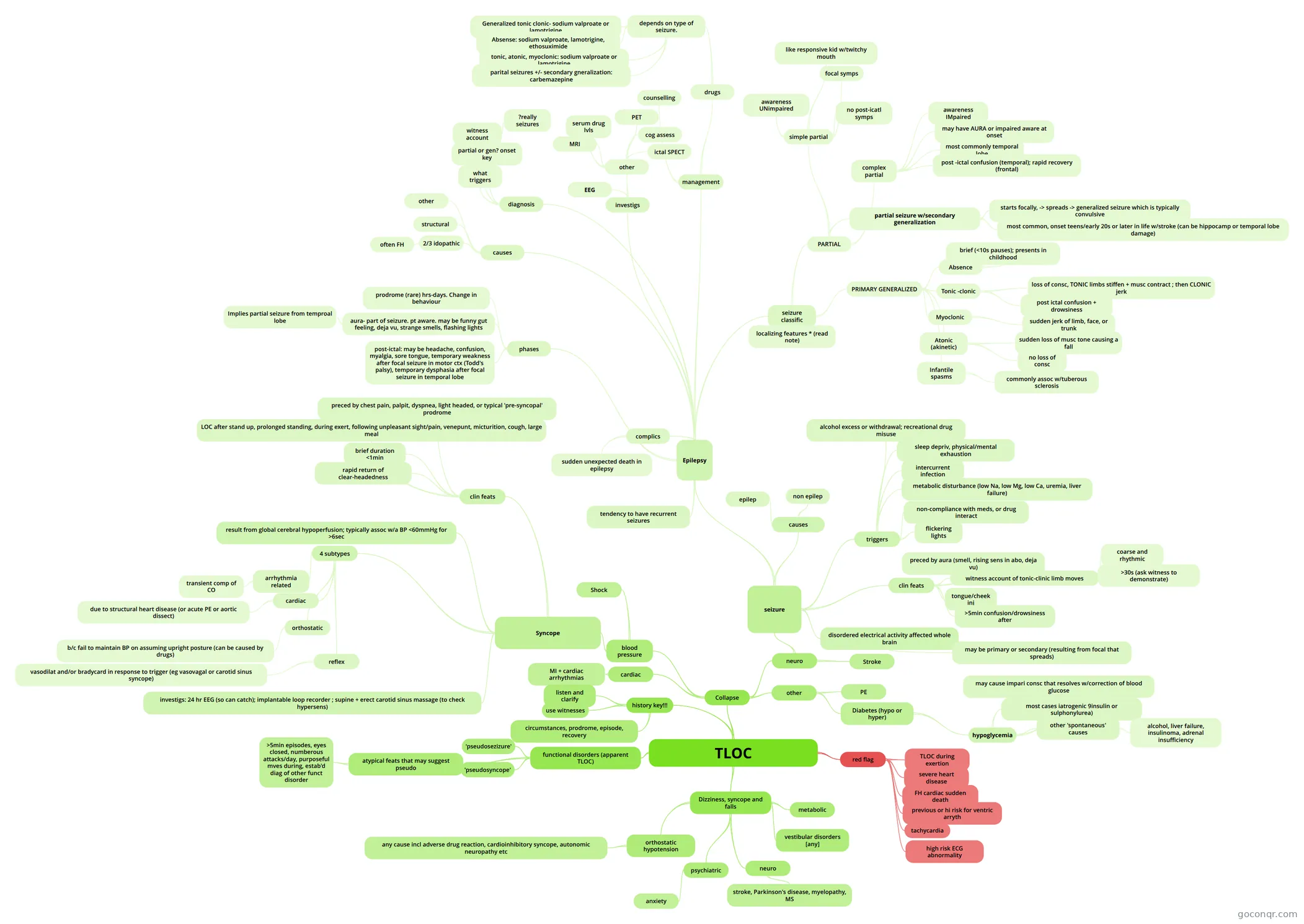
Mind map: TLOC
Contenido del mapa
TLOC
- if not tonic clonic seiz or syncope rare: cataplexy, narcolepsy, atypical seizures (abscence) or mimicking condits falls, funct disorders, drug/alc intox trauma- concussion NB- TIAs rarely cause TLOC
Collapse
- cardiac
- MI + cardiac arrhythmias
- blood pressure
- Shock
- cardiac, hypovolemia incl hemorrhagic incl ectopic preg, septic incl peritonitis, adrenal insufficiency
- Syncope
- 4 subtypes
- arrhythmia related
- transient comp of CO
- cardiac
- due to structural heart disease (or acute PE or aortic dissect)
- orthostatic
- b/c fail to maintain BP on assuming upright posture (can be caused by drugs)
- reflex
- vasodilat and/or bradycard in response to trigger (eg vasovagal or carotid sinus syncope)
- arrhythmia related
- result from global cerebral hypoperfusion; typically assoc w/a BP <60mmHg for >6sec
- clin feats
- preced by chest pain, palpit, dyspnea, light headed, or typical 'pre-syncopal' prodrome
- LOC after stand up, prolonged standing, during exert, following unpleasant sight/pain, venepunt, micturition, cough, large meal
- brief duration <1min
- rapid return of clear-headedness
- investigs: 24 hr EEG (so can catch); implantable loop recorder ; supine + erect carotid sinus massage (to check hypersens)
- 4 subtypes
- Shock
- neuro
- Stroke
- seizure
- Epilepsy
- tendency to have recurrent seizures
- convulsions = the motor signs of electrical discharges
- phases
- prodrome (rare) hrs-days. Change in behaviour
- aura- part of seizure. pt aware. may be funny gut feeling, deja vu, strange smells, flashing lights
- Implies partial seizure from temproal lobe
- post-ictal: may be headache, confusion, myalgia, sore tongue, temporary weakness after focal seizure in motor ctx (Todd's palsy), temporary dysphasia after focal seizure in temporal lobe
- causes
- 2/3 idopathic
- often FH
- structural
- cortical scarring (eg prev head inj), developmental, SOL, stroke, hippocampal sclerosis, vasc malforms
- other
- tuberous sclerosis, sarcoid, SLE, PAN
- 2/3 idopathic
- diagnosis
- 1. are they really seizures? -get witness account -chee/tongue bit + slow recovery v suggestive -try not to diag incorrectly- syncope can have convulsions too 2. what type of seizure is it? -partial or generalized? ONSET KEY- if it begins w/focal, is partial however rapidly it generalizes 3. what triggers? -flicker lights, alch? can this be avoided? (TV induced seizures rarely req drugs) Also if 1st - really the 1st? -ask about prior odd behaviour -was it provoked (see non-epileptic cause) -admiss for 24h may be indicated
- witness account
- ?really seizures
- partial or gen? onset key
- what triggers
- seizure classific
- PARTIAL
- focal onset, feats referable to a part of one hemisphere -often seen w/underlying structural disease
- simple partial
- awareness unimparied (focal motor, sens, autonomc or psychiatric symps)
- awareness UNimpaired
- focal symps
- no post-icatl symps
- like responsive kid w/twitchy mouth
- complex partial
- awareness IMpaired
- may have AURA or impaired aware at onset
- most commonly temporal lobe
- post -ictal confusion (temporal); rapid recovery (frontal)
- partial seizure w/secondary generalization
- 2/3 of pts w/partials
- starts focally, -> spreads -> generalized seizure which is typically convulsive
- most common, onset teens/early 20s or later in life w/stroke (can be hippocamp or temporal lobe damage)
- PRIMARY GENERALIZED
- simultaneous onset of elect discharge throughout ctx (no localiz feats referable to only one hemis)
- Absence
- brief (<10s pauses); presents in childhood
- eg suddenly stops talking mid-sentence, then carries on where left off
- brief (<10s pauses); presents in childhood
- Tonic -clonic
- loss of consc, TONIC limbs stiffen + musc contract ; then CLONIC jerk
- may have one without the other
- post ictal confusion + drowsiness
- loss of consc, TONIC limbs stiffen + musc contract ; then CLONIC jerk
- Myoclonic
- sudden jerk of limb, face, or trunk
- pt may be thrown suddenly to ground or have disobedient limb
- sudden jerk of limb, face, or trunk
- Atonic (akinetic)
- sudden loss of musc tone causing a fall
- no loss of consc
- Infantile spasms
- commonly assoc w/tuberous sclerosis
- localizing features * (read note)
- Localizing features of partial (focal) seizures Temporal lobe -automatisms (w/no recollection of) -dysphasia (ictal or post ictal) -abdo rising sens (or pain +/-vomit) -memory phenomena (deja vu or jamais vu) -hippocampal involve- (emotional disturb, religiosity) -uncal involve- (hallucincations of smell or taste or dream like state) -delusional behaviour -bizzare story.. (see pg 495) Frontal lobe -motor feats (posturing, eye moves, peddling moves of legs) -jacksonian march- (spreading focal motor seiz but retain awareness) -motor arest -subtle behaviour disturbs -dysphasia or speech arrest -post ictal Todd's palsy Parietal lboe -sensory disturbs (rare) -motor symps Occiptial lobe -visual phenomena
- PARTIAL
- complics
- sudden unexpected death in epilepsy
- more common in uncontrolled (maybe relat to nocturnal seizure-assoc apnea or asystole)
- sudden unexpected death in epilepsy
- investigs
- EEG
- helps context for diag -> don't do if likely syncope b/c false +ves only do emergency EEG if non-convulsive status epilepticus is the problem unprovoked inter-ictal EEG (ofte normal in ppl w/seizures; so often abnorm in ppl without) SO DO PROVOVOCATION (sleep depriv) + prolonged and /or video recording
- other
- further options: neurological resection- if single focus eg hippocampal sclerosis, small tumor vagal nerve stimulation
- MRI
- structural lesions
- serum drug lvls
- are they taking tablets?
- PET
- cog assess
- ictal SPECT
- EEG
- management
- involve pt!! essential for compliance
- counselling
- -after a seizure advise agisnt possible dangers (eg swimming, driving, heights) until diag estab'd then individual counselling after diag -> employment, insurance, conception *driving- can't drive until seizure free >1yr
- drugs
- probably start treatment after 2nd fit discuss w/pt- if low freq eg 1fit/2yr, don't drive, may choose no treat treat w/one drug by one doc, build up over months
- depends on type of seizure.
- Generalized tonic clonic- sodium valproate or lamotrigine
- 2nd line carbamazepine, topiramate
- Absense: sodium valproate, lamotrigine, ethosuximide
- tonic, atonic, myoclonic: sodium valproate or lamotrigine
- avoid carbemazepine
- parital seizures +/- secondary gneralization: carbemazepine
- then sodium valproate, lamotrigine, oxcarbazepine, topiramate
- Generalized tonic clonic- sodium valproate or lamotrigine
- tendency to have recurrent seizures
- disordered electrical activity affected whole brain
- may be primary or secondary (resulting from focal that spreads)
- if py doesnt' become secondary, partial seizures may cause altered consciousness without LOC
- may be primary or secondary (resulting from focal that spreads)
- triggers
- alcohol excess or withdrawal; recreational drug misuse
- sleep depriv, physical/mental exhaustion
- intercurrent infection
- metabolic disturbance (low Na, low Mg, low Ca, uremia, liver failure)
- non-compliance with meds, or drug interact
- flickering lights
- clin feats
- preced by aura (smell, rising sens in abo, deja vu)
- witness account of tonic-clinic limb moves
- coarse and rhythmic
- >30s (ask witness to demonstrate)
- tongue/cheek inj
- >5min confusion/drowsiness after
- causes
- epilep
- non epilep
- trauma, storke, hemorrhage, rasie dICP, alcohol or benzo withdrawal, metabolic disturbance (hypoxia, hypo/hyper natremia, hypocalcemia, hypo/hyper glucose, uremia), liver disease, infection, raised temp, drugs (TCAs, cocaine, tramadol, theophylline), pseudoseizures,
- Epilepsy
- other
- Diabetes (hypo or hyper)
- hypoglycemia
- may cause impari consc that resolves w/correction of blood glucose
- most cases iatrogenic 9insulin or sulphonylurea)
- other 'spontaneous' causes
- alcohol, liver failure, insulinoma, adrenal insufficiency
- hypoglycemia
- PE
- Diabetes (hypo or hyper)
- cardiac
Dizziness, syncope and falls
- orthostatic hypotension
- any cause incl adverse drug reaction, cardioinhibitory syncope, autonomic neuropathy etc
- psychiatric
- anxiety
- neuro
- stroke, Parkinson's disease, myelopathy, MS
- vestibular disorders [any]
- metabolic
- orthostatic hypotension
functional disorders (apparent TLOC)
- 'pseudosezizure'
- 'pseudosyncope'
- atypical feats that may suggest pseudo
- >5min episodes, eyes closed, numberous attacks/day, purposeful mves during, estab'd diag of other funct disorder
red flag
- TLOC during exertion
- severe heart disease
- FH cardiac sudden death
- previous or hi risk for ventric arryth
- tachycardia
- high risk ECG abnormality
history key!!!
- listen and clarify
- use witnesses
- circumstances, prodrome, episode, recovery
Información
- Descripción
- Neuro + Head and Neck Mapa Mental sobre TLOC, creado por greenfylde el 09/12/2013.
- Creado por
- greenfylde
- Visitas
- 56
- Etiquetas
- Valoración