
Mapa mental
Gender Development
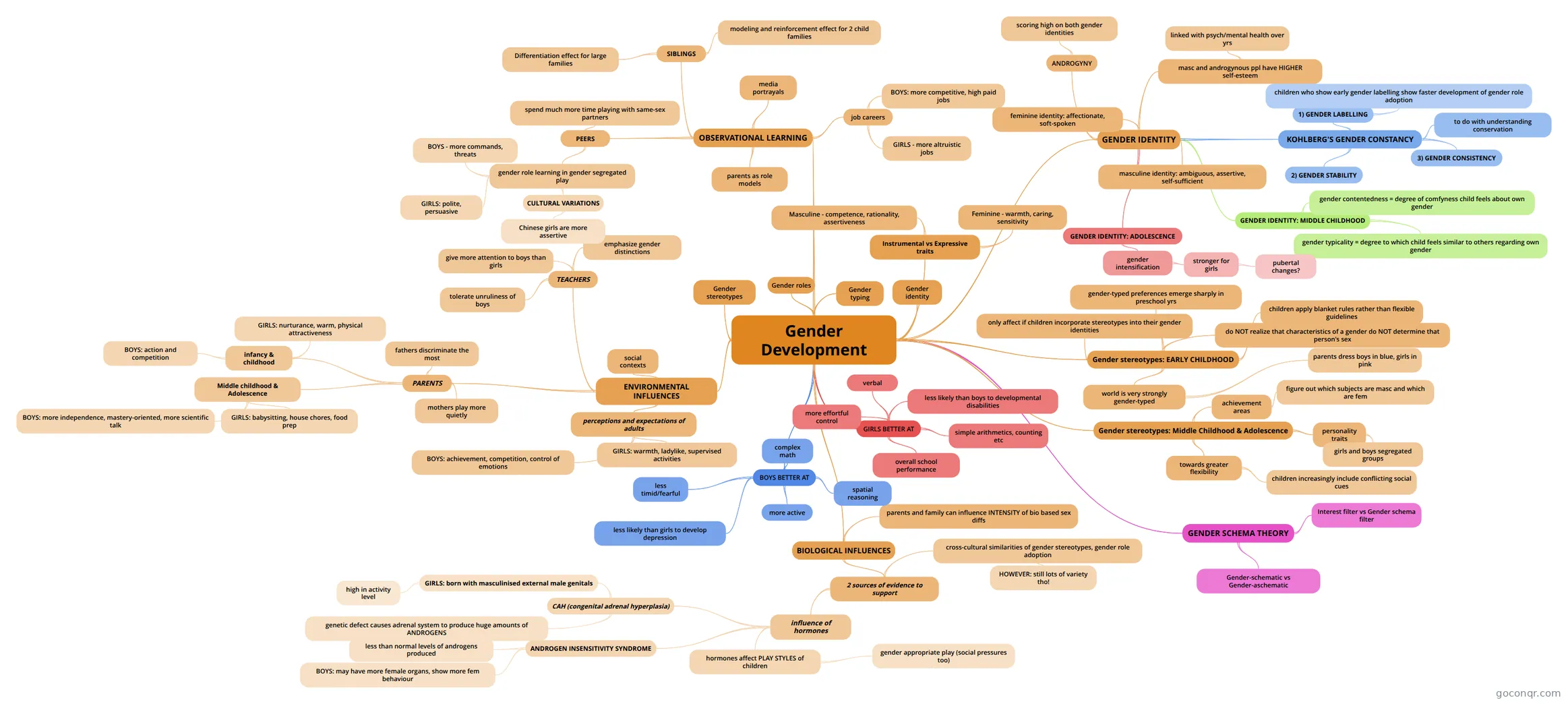
Mind map: Gender development
Contenido del mapa
Gender Development
Instrumental vs Expressive traits
- Masculine - competence, rationality, assertiveness
- Feminine - warmth, caring, sensitivity
Gender stereotypes
Gender roles
Gender identity
Gender typing
Gender stereotypes: EARLY CHILDHOOD
- children apply blanket rules rather than flexible guidelines
- world is very strongly gender-typed
- parents dress boys in blue, girls in pink
- do NOT realize that characteristics of a gender do NOT determine that person's sex
- gender-typed preferences emerge sharply in preschool yrs
- only affect if children incorporate stereotypes into their gender identities
Gender stereotypes: Middle Childhood & Adolescence
- personality traits
- girls and boys segregated groups
- achievement areas
- figure out which subjects are masc and which are fem
- towards greater flexibility
- children increasingly include conflicting social cues
- personality traits
BIOLOGICAL INFLUENCES
- parents and family can influence INTENSITY of bio based sex diffs
- 2 sources of evidence to support
- cross-cultural similarities of gender stereotypes, gender role adoption
- HOWEVER: still lots of variety tho!
- influence of hormones
- hormones affect PLAY STYLES of children
- gender appropriate play (social pressures too)
- CAH (congenital adrenal hyperplasia)
- genetic defect causes adrenal system to produce huge amounts of ANDROGENS
- GIRLS: born with masculinised external male genitals
- high in activity level
- ANDROGEN INSENSITIVITY SYNDROME
- less than normal levels of androgens produced
- BOYS: may have more female organs, show more fem behaviour
- hormones affect PLAY STYLES of children
- cross-cultural similarities of gender stereotypes, gender role adoption
ENVIRONMENTAL INFLUENCES
- social contexts
- perceptions and expectations of adults
- BOYS: achievement, competition, control of emotions
- GIRLS: warmth, ladylike, supervised activities
- PARENTS
- infancy & childhood
- BOYS: action and competition
- GIRLS: nurturance, warm, physical attractiveness
- Middle childhood & Adolescence
- BOYS: more independence, mastery-oriented, more scientific talk
- GIRLS: babysitting, house chores, food prep
- fathers discriminate the most
- mothers play more quietly
- infancy & childhood
- TEACHERS
- give more attention to boys than girls
- emphasize gender distinctions
- tolerate unruliness of boys
OBSERVATIONAL LEARNING
- job careers
- GIRLS - more altruistic jobs
- BOYS: more competitive, high paid jobs
- media portrayals
- parents as role models
- PEERS
- spend much more time playing with same-sex partners
- gender role learning in gender segregated play
- BOYS - more commands, threats
- GIRLS: polite, persuasive
- CULTURAL VARIATIONS
- Chinese girls are more assertive
- SIBLINGS
- modeling and reinforcement effect for 2 child families
- Differentiation effect for large families
- job careers
GENDER IDENTITY
- masculine identity: ambiguous, assertive, self-sufficient
- feminine identity: affectionate, soft-spoken
- ANDROGYNY
- scoring high on both gender identities
- masc and androgynous ppl have HIGHER self-esteem
- linked with psych/mental health over yrs
- KOHLBERG'S GENDER CONSTANCY
- 1) GENDER LABELLING
- children who show early gender labelling show faster development of gender role adoption
- 2) GENDER STABILITY
- 3) GENDER CONSISTENCY
- to do with understanding conservation
- 1) GENDER LABELLING
- GENDER IDENTITY: MIDDLE CHILDHOOD
- gender typicality = degree to which child feels similar to others regarding own gender
- gender contentedness = degree of comfyness child feels about own gender
- GENDER IDENTITY: ADOLESCENCE
- gender intensification
- stronger for girls
- pubertal changes?
- stronger for girls
- gender intensification
GENDER SCHEMA THEORY
- Gender-schematic vs Gender-aschematic
- Interest filter vs Gender schema filter
GIRLS BETTER AT
- verbal
- simple arithmetics, counting etc
- overall school performance
- more effortful control
- less likely than boys to developmental disabilities
BOYS BETTER AT
- complex math
- spatial reasoning
- less timid/fearful
- more active
- less likely than girls to develop depression
Información
- Descripción
- Mapa Mental sobre Gender Development, creado por Helen Li el 11/12/2013.
- Creado por
- Helen Li
- Visitas
- 34
- Valoración