
Mapa mental
Module 3- Thermal Physics
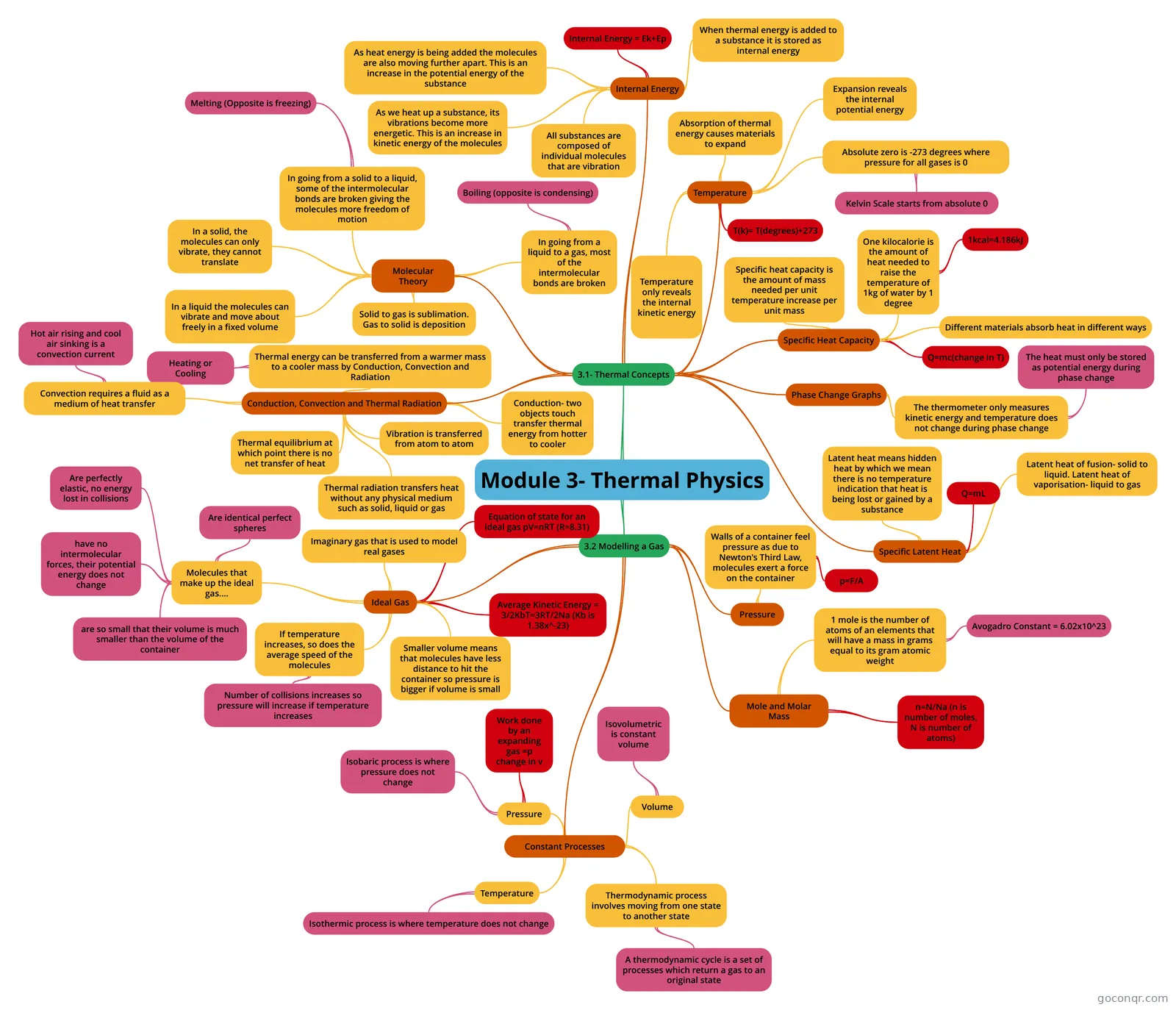
Mind map: Module 3 thermal physics
Contenido del mapa
Module 3- Thermal Physics
3.1- Thermal Concepts
- Molecular Theory
- In a solid, the molecules can only vibrate, they cannot translate
- In a liquid the molecules can vibrate and move about freely in a fixed volume
- In going from a solid to a liquid, some of the intermolecular bonds are broken giving the molecules more freedom of motion
- Melting (Opposite is freezing)
- In going from a liquid to a gas, most of the intermolecular bonds are broken
- Boiling (opposite is condensing)
- Solid to gas is sublimation. Gas to solid is deposition
- Internal Energy
- All substances are composed of individual molecules that are vibration
- As we heat up a substance, its vibrations become more energetic. This is an increase in kinetic energy of the molecules
- As heat energy is being added the molecules are also moving further apart. This is an increase in the potential energy of the substance
- Internal Energy = Ek+Ep
- When thermal energy is added to a substance it is stored as internal energy
- Temperature
- Absorption of thermal energy causes materials to expand
- Temperature only reveals the internal kinetic energy
- Expansion reveals the internal potential energy
- Absolute zero is -273 degrees where pressure for all gases is 0
- Kelvin Scale starts from absolute 0
- T(k)= T(degrees)+273
- Specific Heat Capacity
- One kilocalorie is the amount of heat needed to raise the temperature of 1kg of water by 1 degree
- 1kcal=4.186kJ
- Different materials absorb heat in different ways
- Specific heat capacity is the amount of mass needed per unit temperature increase per unit mass
- Q=mc(change in T)
- One kilocalorie is the amount of heat needed to raise the temperature of 1kg of water by 1 degree
- Phase Change Graphs
- The thermometer only measures kinetic energy and temperature does not change during phase change
- The heat must only be stored as potential energy during phase change
- The thermometer only measures kinetic energy and temperature does not change during phase change
- Specific Latent Heat
- Latent heat means hidden heat by which we mean there is no temperature indication that heat is being lost or gained by a substance
- Q=mL
- Latent heat of fusion- solid to liquid. Latent heat of vaporisation- liquid to gas
- Conduction, Convection and Thermal Radiation
- Thermal energy can be transferred from a warmer mass to a cooler mass by Conduction, Convection and Radiation
- Heating or Cooling
- Thermal radiation transfers heat without any physical medium such as solid, liquid or gas
- Conduction- two objects touch transfer thermal energy from hotter to cooler
- Vibration is transferred from atom to atom
- Thermal equilibrium at which point there is no net transfer of heat
- Convection requires a fluid as a medium of heat transfer
- Hot air rising and cool air sinking is a convection current
- Thermal energy can be transferred from a warmer mass to a cooler mass by Conduction, Convection and Radiation
- Molecular Theory
3.2 Modelling a Gas
- Pressure
- Walls of a container feel pressure as due to Newton's Third Law, molecules exert a force on the container
- p=F/A
- Walls of a container feel pressure as due to Newton's Third Law, molecules exert a force on the container
- Ideal Gas
- Imaginary gas that is used to model real gases
- Molecules that make up the ideal gas....
- Are identical perfect spheres
- Are perfectly elastic, no energy lost in collisions
- have no intermolecular forces, their potential energy does not change
- are so small that their volume is much smaller than the volume of the container
- If temperature increases, so does the average speed of the molecules
- Number of collisions increases so pressure will increase if temperature increases
- Smaller volume means that molecules have less distance to hit the container so pressure is bigger if volume is small
- Equation of state for an ideal gas pV=nRT (R=8.31)
- Average Kinetic Energy = 3/2KbT=3RT/2Na (Kb is 1.38x^-23)
- Mole and Molar Mass
- 1 mole is the number of atoms of an elements that will have a mass in grams equal to its gram atomic weight
- Avogadro Constant = 6.02x10^23
- n=N/Na (n is number of moles, N is number of atoms)
- 1 mole is the number of atoms of an elements that will have a mass in grams equal to its gram atomic weight
- Constant Processes
- Pressure
- Isobaric process is where pressure does not change
- Work done by an expanding gas =p change in v
- Volume
- Isovolumetric is constant volume
- Temperature
- Isothermic process is where temperature does not change
- Thermodynamic process involves moving from one state to another state
- A thermodynamic cycle is a set of processes which return a gas to an original state
- Pressure
- Pressure
Información
- Descripción
- Higher Physics Mapa Mental sobre Module 3- Thermal Physics, creado por Will Thorpe el 20/01/2016.
- Creado por
- Will Thorpe
- Visitas
- 0
- Valoración