
Mapa mental
Second Language Acquisition Processes & Theories
Contenido del mapa
Second Language Acquisition Processes & Theories
Behaviorist Theory
- John B Watson & B.F. Skinner
- 1940s, 1950s
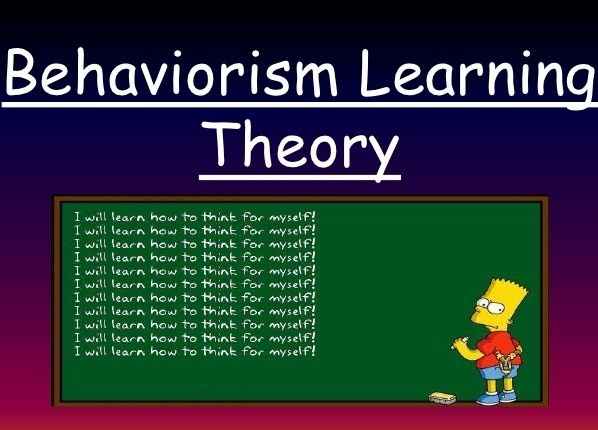
- Argues acquisition of new behavior is based on environmental conditions. Behavior can be learned through a process of stimuli, response and positive or negative reinforcement.
- Classroom Application: Repetitive drilling of language, correcting errors as they happen and rewarding students when performing correctly. Rewards could include a sticker, piece of candy, or bonus points.
- Classroom Application: Repetitive drilling of language, correcting errors as they happen and rewarding students when performing correctly. Rewards could include a sticker, piece of candy, or bonus points.
- Argues acquisition of new behavior is based on environmental conditions. Behavior can be learned through a process of stimuli, response and positive or negative reinforcement.
- 1940s, 1950s
- John B Watson & B.F. Skinner
Language Acquisition Device (LAD)
- Noam Chomsky
- 1950s
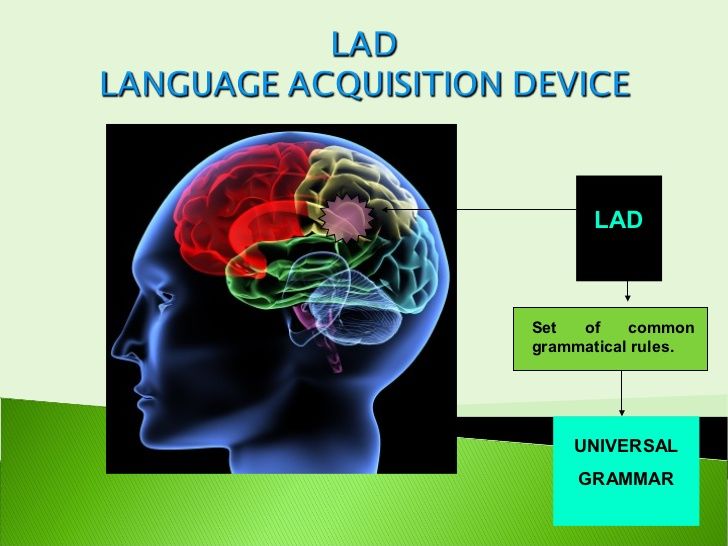
- Argues that children are born with an understanding of the rules of language, they simply need to acquire the vocabulary. This is because every language has something that is like a noun and verb and has ability to make things positive or negative. Later evolved into Universal Grammar.
- Argues that children are born with an understanding of the rules of language, they simply need to acquire the vocabulary. This is because every language has something that is like a noun and verb and has ability to make things positive or negative. Later evolved into Universal Grammar.
- 1950s
- Noam Chomsky
Universal Grammar
- Noam Chomsky
- 1960s, 1970s
- Argues babies are born with an innate system of grammar. Linguistic ability manifests without being taught because all languages have a common structural basis. When material is meaningful, students are able to relate the new information to elements in their cognitive structure. Evolved from Language Acquisition Device.
- Classroom Application: Make the material and assignments meaningful. Give students a general assignment with creative freedom to choose a topic in which they have interest. Example: Have them demonstrate their Microsoft Publisher skills. They can create a brochure on anything they like such as their favorite city, sports team or dream job.
- Argues babies are born with an innate system of grammar. Linguistic ability manifests without being taught because all languages have a common structural basis. When material is meaningful, students are able to relate the new information to elements in their cognitive structure. Evolved from Language Acquisition Device.
- 1960s, 1970s
- Noam Chomsky
Information Processing
- George A. Miller
- 1960s
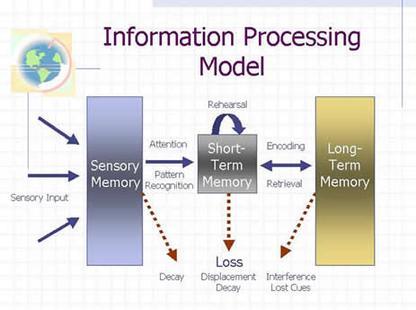
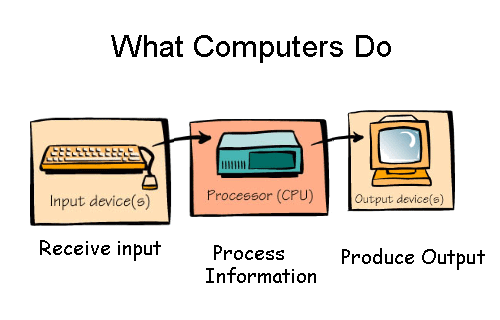
- Compares human brain to that of a computer and requiring brain processing to learn which goes beyond the simple stimulus-response pattern. Argues that input from the environment goes through the cognitive system which is then measured as output. Maintains that language acquisition is a hierarchy of skills where higher level components depend on attainment of lower level components.
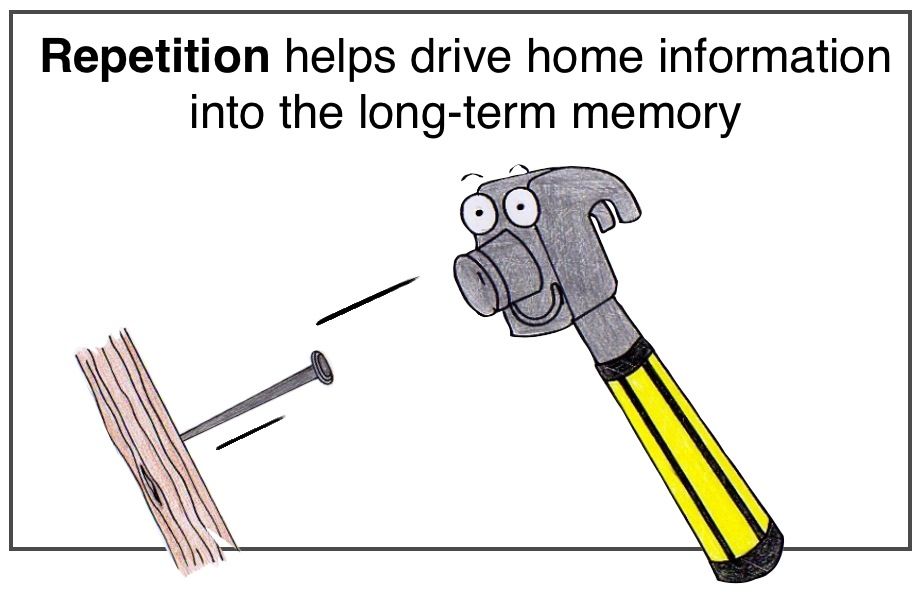
- Classroom Application: Continually expose students to target language to help move information from short term to long term memory. Review material frequently to refresh information that may be slipping out of short term memory. Have a bell ringer quiz, quick learning game or "check your knowledge" at the beginning of every class to determine what students recall and to refresh memory by reviewing correct answers.
- Classroom Application: Continually expose students to target language to help move information from short term to long term memory. Review material frequently to refresh information that may be slipping out of short term memory. Have a bell ringer quiz, quick learning game or "check your knowledge" at the beginning of every class to determine what students recall and to refresh memory by reviewing correct answers.
- Compares human brain to that of a computer and requiring brain processing to learn which goes beyond the simple stimulus-response pattern. Argues that input from the environment goes through the cognitive system which is then measured as output. Maintains that language acquisition is a hierarchy of skills where higher level components depend on attainment of lower level components.
- 1960s
- George A. Miller
Audiolingual Method
- C.C. Fries & Robert Lado
- 1940s
- Uses dialog as the main form of language presentation and drills as the main training techniques. Emphasizes listening and speaking before reading and writing. Practice techniques include mimicry, memorization and pattern drills.
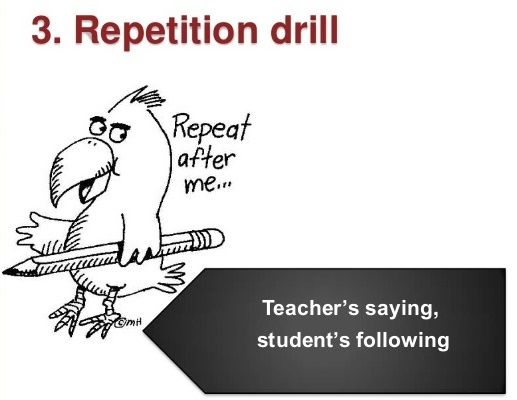
- Classroom Application: Repetition training and drills that are directed and controlled by the teacher. Students repeat the teacher's model as accurately as possible. Errors are immediately corrected to discourage bad habit formation.
- Classroom Application: Repetition training and drills that are directed and controlled by the teacher. Students repeat the teacher's model as accurately as possible. Errors are immediately corrected to discourage bad habit formation.
- Uses dialog as the main form of language presentation and drills as the main training techniques. Emphasizes listening and speaking before reading and writing. Practice techniques include mimicry, memorization and pattern drills.
- 1940s
- C.C. Fries & Robert Lado
Direct Method
- Charles Berlitz
- early 1900s
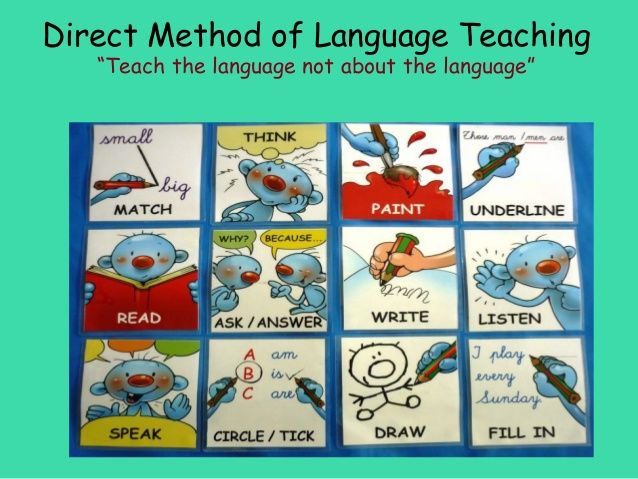
- Uses explicit instructional objectives and promotes the learning of facts, sequenced steps or rules. Aims to build direct relation between experience and language, word and idea, thought and expression. Vocabulary introduced in context, demonstrations and pictures. Considered first real method of language teaching.
- Classroom Application: Utilize reading programs, scripted lessons and lectures which are divided into small units that move in lockstep pace. Frequently test over material and provide immediate remediation. Implement dictation where the teacher reads aloud a passage. Employ"Question-Answer" where a teacher asks a question and the students answer.
- Classroom Application: Utilize reading programs, scripted lessons and lectures which are divided into small units that move in lockstep pace. Frequently test over material and provide immediate remediation. Implement dictation where the teacher reads aloud a passage. Employ"Question-Answer" where a teacher asks a question and the students answer.
- Uses explicit instructional objectives and promotes the learning of facts, sequenced steps or rules. Aims to build direct relation between experience and language, word and idea, thought and expression. Vocabulary introduced in context, demonstrations and pictures. Considered first real method of language teaching.
- early 1900s
- Charles Berlitz
Imágenes y archivos del mapa





Información
- Descripción
- SLA processes and theories for my CTRD 6006 class
- Creado por
- Farrah S
- Visitas
- 100
- Etiquetas
- Valoración