
Mapa mental
1.1.4
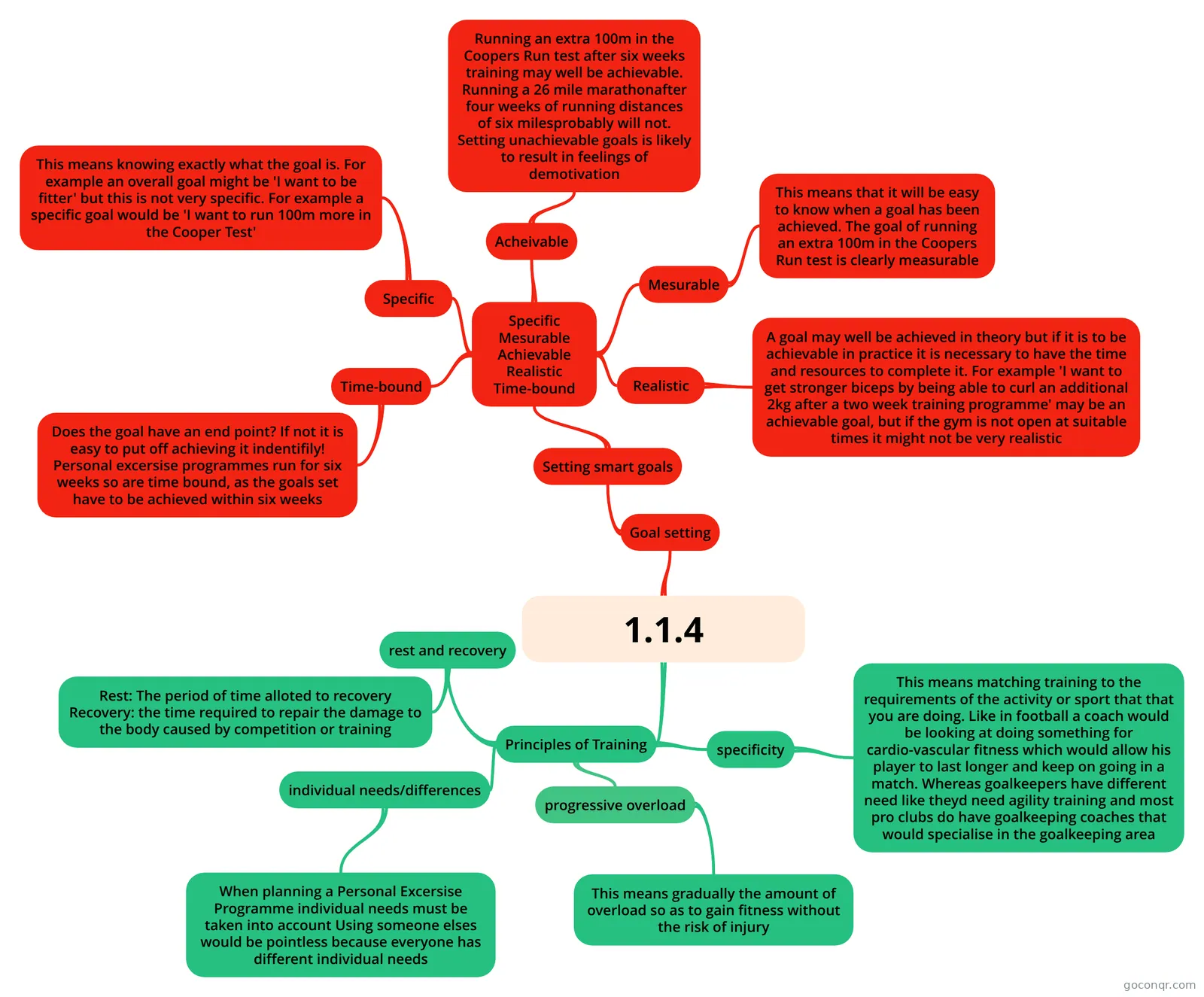
Mind map: principles of training
Contenido del mapa
1.1.4
Principles of Training
- individual needs/differences
- When planning a Personal Excersise Programme individual needs must be taken into account Using someone elses would be pointless because everyone has different individual needs
- specificity
- This means matching training to the requirements of the activity or sport that that you are doing. Like in football a coach would be looking at doing something for cardio-vascular fitness which would allow his player to last longer and keep on going in a match. Whereas goalkeepers have different need like theyd need agility training and most pro clubs do have goalkeeping coaches that would specialise in the goalkeeping area
- progressive overload
- This means gradually the amount of overload so as to gain fitness without the risk of injury
- rest and recovery
- Rest: The period of time alloted to recovery Recovery: the time required to repair the damage to the body caused by competition or training
- individual needs/differences
Goal setting
- Setting smart goals
- Specific Mesurable Achievable Realistic Time-bound
- Specific
- This means knowing exactly what the goal is. For example an overall goal might be 'I want to be fitter' but this is not very specific. For example a specific goal would be 'I want to run 100m more in the Cooper Test'
- Mesurable
- This means that it will be easy to know when a goal has been achieved. The goal of running an extra 100m in the Coopers Run test is clearly measurable
- Acheivable
- Running an extra 100m in the Coopers Run test after six weeks training may well be achievable. Running a 26 mile marathonafter four weeks of running distances of six milesprobably will not. Setting unachievable goals is likely to result in feelings of demotivation
- Realistic
- A goal may well be achieved in theory but if it is to be achievable in practice it is necessary to have the time and resources to complete it. For example 'I want to get stronger biceps by being able to curl an additional 2kg after a two week training programme' may be an achievable goal, but if the gym is not open at suitable times it might not be very realistic
- Time-bound
- Does the goal have an end point? If not it is easy to put off achieving it indentifily! Personal excersise programmes run for six weeks so are time bound, as the goals set have to be achieved within six weeks
- Specific
- Specific Mesurable Achievable Realistic Time-bound
- Setting smart goals
Información
- Descripción
- Mapa Mental sobre 1.1.4, creado por callum.grist el 22/02/2016.
- Creado por
- callum.grist
- Visitas
- 4
- Valoración