
Mapa mental
Introduction to DNA 2
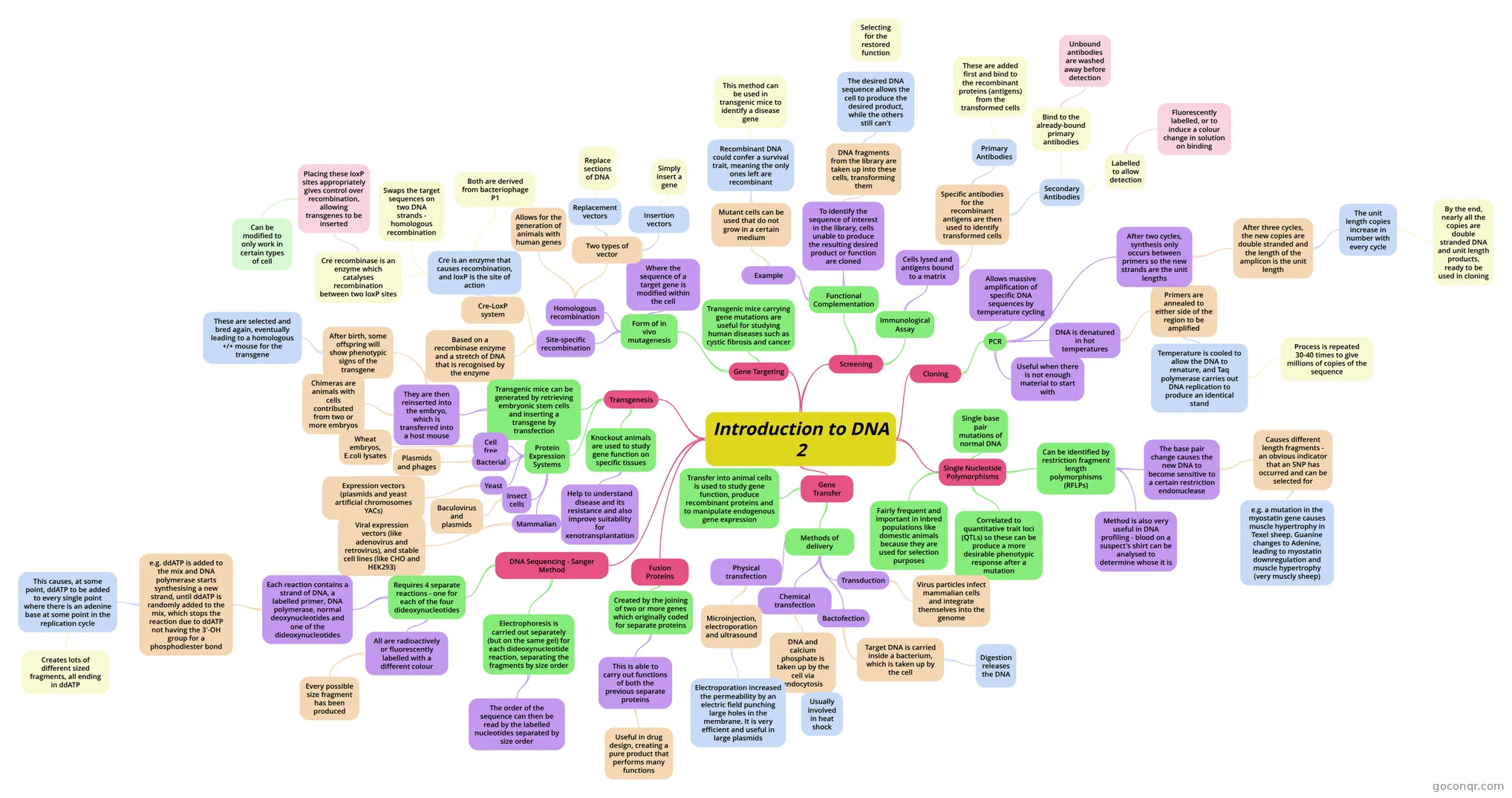
Mind map: Introduction to DNA
Contenido del mapa
Introduction to DNA 2
Screening
- Immunological Assay
- Cells lysed and antigens bound to a matrix
- Specific antibodies for the recombinant antigens are then used to identify transformed cells
- Primary Antibodies
- These are added first and bind to the recombinant proteins (antigens) from the transformed cells
- Secondary Antibodies
- Bind to the already-bound primary antibodies
- Unbound antibodies are washed away before detection
- Labelled to allow detection
- Fluorescently labelled, or to induce a colour change in solution on binding
- Bind to the already-bound primary antibodies
- Primary Antibodies
- Specific antibodies for the recombinant antigens are then used to identify transformed cells
- Cells lysed and antigens bound to a matrix
- Functional Complementation
- To identify the sequence of interest in the library, cells unable to produce the resulting desired product or function are cloned
- DNA fragments from the library are taken up into these cells, transforming them
- The desired DNA sequence allows the cell to produce the desired product, while the others still can't
- Selecting for the restored function
- The desired DNA sequence allows the cell to produce the desired product, while the others still can't
- DNA fragments from the library are taken up into these cells, transforming them
- Example
- Mutant cells can be used that do not grow in a certain medium
- Recombinant DNA could confer a survival trait, meaning the only ones left are recombinant
- This method can be used in transgenic mice to identify a disease gene
- Recombinant DNA could confer a survival trait, meaning the only ones left are recombinant
- Mutant cells can be used that do not grow in a certain medium
- To identify the sequence of interest in the library, cells unable to produce the resulting desired product or function are cloned
- Immunological Assay
Cloning
- PCR
- Useful when there is not enough material to start with
- Allows massive amplification of specific DNA sequences by temperature cycling
- DNA is denatured in hot temperatures
- Primers are annealed to either side of the region to be amplified
- Temperature is cooled to allow the DNA to renature, and Taq polymerase carries out DNA replication to produce an identical stand
- Process is repeated 30-40 times to give millions of copies of the sequence
- Temperature is cooled to allow the DNA to renature, and Taq polymerase carries out DNA replication to produce an identical stand
- Primers are annealed to either side of the region to be amplified
- After two cycles, synthesis only occurs between primers so the new strands are the unit lengths
- After three cycles, the new copies are double stranded and the length of the amplicon is the unit length
- The unit length copies increase in number with every cycle
- By the end, nearly all the copies are double stranded DNA and unit length products, ready to be used in cloning
- The unit length copies increase in number with every cycle
- After three cycles, the new copies are double stranded and the length of the amplicon is the unit length
- PCR
Single Nucleotide Polymorphisms
- Single base pair mutations of normal DNA
- Fairly frequent and important in inbred populations like domestic animals because they are used for selection purposes
- Correlated to quantitative trait loci (QTLs) so these can be produce a more desirable phenotypic response after a mutation
- Can be identified by restriction fragment length polymorphisms (RFLPs)
- The base pair change causes the new DNA to become sensitive to a certain restriction endonuclease
- Causes different length fragments - an obvious indicator that an SNP has occurred and can be selected for
- e.g. a mutation in the myostatin gene causes muscle hypertrophy in Texel sheep. Guanine changes to Adenine, leading to myostatin downregulation and muscle hypertrophy (very muscly sheep)
- Causes different length fragments - an obvious indicator that an SNP has occurred and can be selected for
- Method is also very useful in DNA profiling - blood on a suspect's shirt can be analysed to determine whose it is
- The base pair change causes the new DNA to become sensitive to a certain restriction endonuclease
Gene Transfer
- Transfer into animal cells is used to study gene function, produce recombinant proteins and to manipulate endogenous gene expression
- Methods of delivery
- Transduction
- Virus particles infect mammalian cells and integrate themselves into the genome
- Bactofection
- Target DNA is carried inside a bacterium, which is taken up by the cell
- Digestion releases the DNA
- Target DNA is carried inside a bacterium, which is taken up by the cell
- Chemical transfection
- DNA and calcium phosphate is taken up by the cell via endocytosis
- Usually involved in heat shock
- DNA and calcium phosphate is taken up by the cell via endocytosis
- Physical transfection
- Microinjection, electroporation and ultrasound
- Electroporation increased the permeability by an electric field punching large holes in the membrane. It is very efficient and useful in large plasmids
- Microinjection, electroporation and ultrasound
- Transduction
Gene Targeting
- Transgenic mice carrying gene mutations are useful for studying human diseases such as cystic fibrosis and cancer
- Form of in vivo mutagenesis
- Where the sequence of a target gene is modified within the cell
- Homologous recombination
- Two types of vector
- Insertion vectors
- Simply insert a gene
- Replacement vectors
- Replace sections of DNA
- Insertion vectors
- Allows for the generation of animals with human genes
- Two types of vector
- Site-specific recombination
- Based on a recombinase enzyme and a stretch of DNA that is recognised by the enzyme
- Cre-LoxP system
- Cre is an enzyme that causes recombination, and loxP is the site of action
- Swaps the target sequences on two DNA strands - homologous recombination
- Both are derived from bacteriophage P1
- Cre recombinase is an enzyme which catalyses recombination between two loxP sites
- Placing these loxP sites appropriately gives control over recombination, allowing transgenes to be inserted
- Can be modified to only work in certain types of cell
- Placing these loxP sites appropriately gives control over recombination, allowing transgenes to be inserted
- Cre is an enzyme that causes recombination, and loxP is the site of action
Transgenesis
- Transgenic mice can be generated by retrieving embryonic stem cells and inserting a transgene by transfection
- They are then reinserted into the embryo, which is transferred into a host mouse
- After birth, some offspring will show phenotypic signs of the transgene
- These are selected and bred again, eventually leading to a homologous +/+ mouse for the transgene
- Chimeras are animals with cells contributed from two or more embryos
- After birth, some offspring will show phenotypic signs of the transgene
- They are then reinserted into the embryo, which is transferred into a host mouse
- Knockout animals are used to study gene function on specific tissues
- Help to understand disease and its resistance and also improve suitability for xenotransplantation
- Protein Expression Systems
- Cell free
- Wheat embryos, E.coli lysates
- Bacterial
- Plasmids and phages
- Yeast
- Expression vectors (plasmids and yeast artificial chromosomes YACs)
- Insect cells
- Baculovirus and plasmids
- Mammalian
- Viral expression vectors (like adenovirus and retrovirus), and stable cell lines (like CHO and HEK293)
- Cell free
- Transgenic mice can be generated by retrieving embryonic stem cells and inserting a transgene by transfection
Fusion Proteins
- Created by the joining of two or more genes which originally coded for separate proteins
- This is able to carry out functions of both the previous separate proteins
- Useful in drug design, creating a pure product that performs many functions
- This is able to carry out functions of both the previous separate proteins
- Created by the joining of two or more genes which originally coded for separate proteins
DNA Sequencing - Sanger Method
- Requires 4 separate reactions - one for each of the four dideoxynucleotides
- Each reaction contains a strand of DNA, a labelled primer, DNA polymerase, normal deoxynucleotides and one of the dideoxynucleotides
- e.g. ddATP is added to the mix and DNA polymerase starts synthesising a new strand, until ddATP is randomly added to the mix, which stops the reaction due to ddATP not having the 3'-OH group for a phosphodiester bond
- This causes, at some point, ddATP to be added to every single point where there is an adenine base at some point in the replication cycle
- Creates lots of different sized fragments, all ending in ddATP
- This causes, at some point, ddATP to be added to every single point where there is an adenine base at some point in the replication cycle
- e.g. ddATP is added to the mix and DNA polymerase starts synthesising a new strand, until ddATP is randomly added to the mix, which stops the reaction due to ddATP not having the 3'-OH group for a phosphodiester bond
- All are radioactively or fluorescently labelled with a different colour
- Every possible size fragment has been produced
- Each reaction contains a strand of DNA, a labelled primer, DNA polymerase, normal deoxynucleotides and one of the dideoxynucleotides
- Electrophoresis is carried out separately (but on the same gel) for each dideoxynucleotide reaction, separating the fragments by size order
- The order of the sequence can then be read by the labelled nucleotides separated by size order
- Requires 4 separate reactions - one for each of the four dideoxynucleotides
Información
- Descripción
- Undergraduate Biotechnology in Animal Physiology Mapa Mental sobre Introduction to DNA 2, creado por Lydia Buckmaster el 16/01/2014.
- Creado por
- Lydia Buckmaster
- Visitas
- 33
- Etiquetas
- Valoración