
Mapa mental
Virtue Ethics.
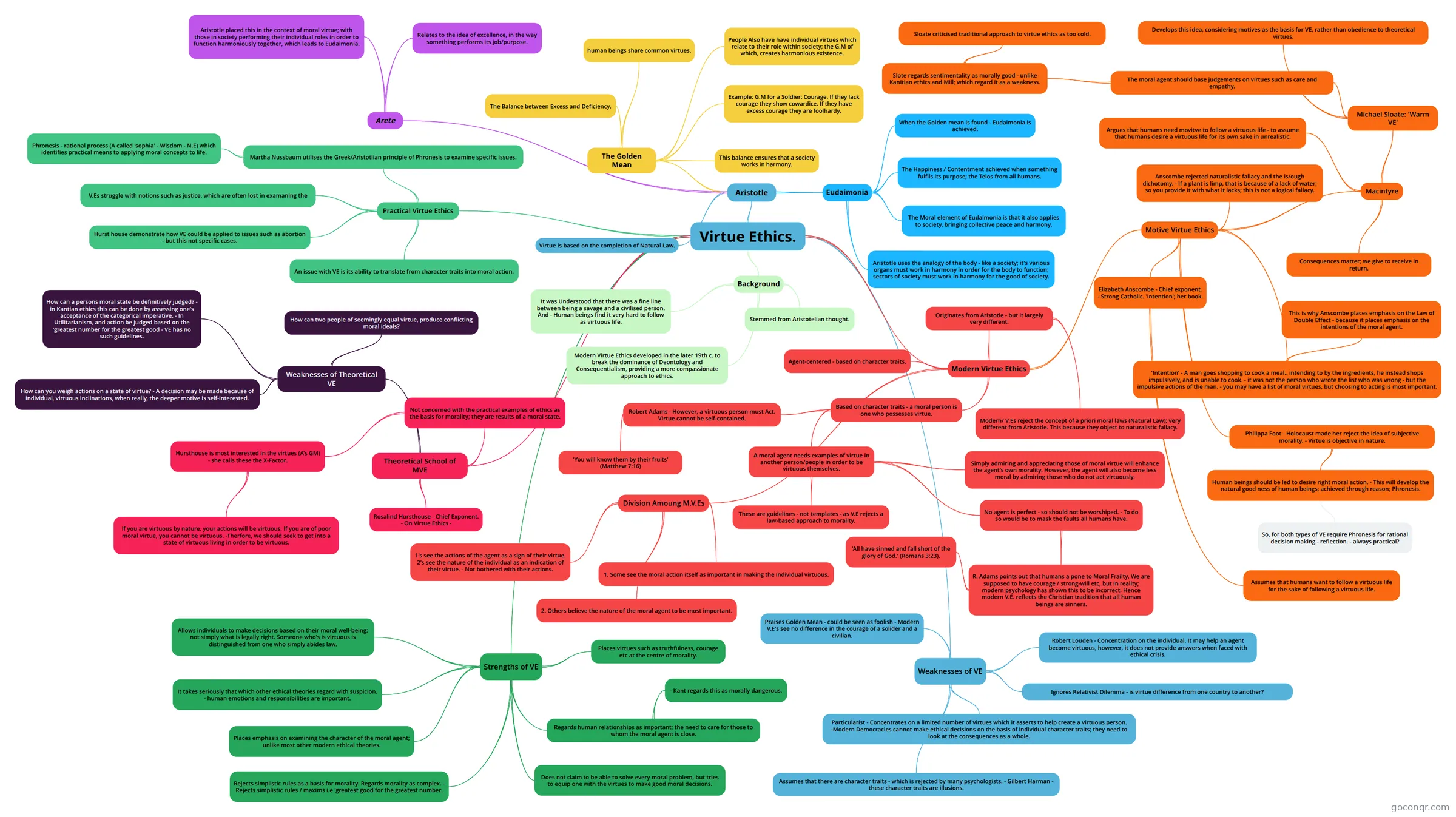
Mind map: Virtue ethics
Contenido del mapa
Virtue Ethics.
Background
- Stemmed from Aristotelian thought.
- Modern Virtue Ethics developed in the later 19th c. to break the dominance of Deontology and Consequentialism, providing a more compassionate approach to ethics.
- It was Understood that there was a fine line between being a savage and a civilised person. And - Human beings find it very hard to follow as virtuous life.
Aristotle
- Arete
- Relates to the idea of excellence, in the way something performs its job/purpose.
- Aristotle placed this in the context of moral virtue; with those in society performing their individual roles in order to function harmoniously together, which leads to Eudaimonia.
- The Golden Mean
- The Balance between Excess and Deficiency.
- This balance ensures that a society works in harmony.
- Example: G.M for a Soldier: Courage. If they lack courage they show cowardice. If they have excess courage they are foolhardy.
- human beings share common virtues.
- People Also have have individual virtues which relate to their role within society; the G.M of which, creates harmonious existence.
- Eudaimonia
- When the Golden mean is found - Eudaimonia is achieved.
- The Happiness / Contentment achieved when something fulfils its purpose; the Telos from all humans.
- The Moral element of Eudaimonia is that it also applies to society, bringing collective peace and harmony.
- Aristotle uses the analogy of the body - like a society; it's various organs must work in harmony in order for the body to function; sectors of society must work in harmony for the good of society.
- Virtue is based on the completion of Natural Law.
- Arete
Modern Virtue Ethics
- Originates from Aristotle - but it largely very different.
- Modern/ V.Es reject the concept of a priori moral laws (Natural Law); very different from Aristotle. This because they object to naturalistic fallacy.
- Agent-centered - based on character traits.
- Based on character traits - a moral person is one who possesses virtue.
- Robert Adams - However, a virtuous person must Act. Virtue cannot be self-contained.
- 'You will know them by their fruits' (Matthew 7:16)
- A moral agent needs examples of virtue in another person/people in order to be virtuous themselves.
- These are guidelines - not templates - as V.E rejects a law-based approach to morality.
- Simply admiring and appreciating those of moral virtue will enhance the agent's own morality. However, the agent will also become less moral by admiring those who do not act virtuously.
- No agent is perfect - so should not be worshiped. - To do so would be to mask the faults all humans have.
- R. Adams points out that humans a pone to Moral Frailty. We are supposed to have courage / strong-will etc, but in reality; modern psychology has shown this to be incorrect. Hence modern V.E. reflects the Christian tradition that all human beings are sinners.
- 'All have sinned and fall short of the glory of God.' (Romans 3:23).
- R. Adams points out that humans a pone to Moral Frailty. We are supposed to have courage / strong-will etc, but in reality; modern psychology has shown this to be incorrect. Hence modern V.E. reflects the Christian tradition that all human beings are sinners.
- Robert Adams - However, a virtuous person must Act. Virtue cannot be self-contained.
- Division Amoung M.V.Es
- 1. Some see the moral action itself as important in making the individual virtuous.
- 2. Others believe the nature of the moral agent to be most important.
- 1's see the actions of the agent as a sign of their virtue. 2's see the nature of the individual as an indication of their virtue. - Not bothered with their actions.
- Motive Virtue Ethics
- Elizabeth Anscombe - Chief exponent. - Strong Catholic. 'intention'; her book.
- Assumes that humans want to follow a virtuous life for the sake of following a virtuous life.
- Anscombe rejected naturalistic fallacy and the is/ough dichotomy. - If a plant is limp, that is because of a lack of water; so you provide it with what it lacks; this is not a logical fallacy.
- 'Intention' - A man goes shopping to cook a meal.. intending to by the ingredients, he instead shops impulsively, and is unable to cook. - it was not the person who wrote the list who was wrong - but the impulsive actions of the man. - you may have a list of moral virtues, but choosing to acting is most important.
- This is why Anscombe places emphasis on the Law of Double Effect - because it places emphasis on the intentions of the moral agent.
- Philippa Foot - Holocaust made her reject the idea of subjective morality. - Virtue is objective in nature.
- Human beings should be led to desire right moral action. - This will develop the natural good ness of human beings; achieved through reason; Phronesis.
- So, for both types of VE require Phronesis for rational decision making - reflection. - always practical?
- Human beings should be led to desire right moral action. - This will develop the natural good ness of human beings; achieved through reason; Phronesis.
- Macintyre
- Argues that humans need movitve to follow a virtuous life - to assume that humans desire a virtuous life for its own sake in unrealistic.
- Consequences matter; we give to receive in return.
- Michael Sloate: 'Warm VE'
- Develops this idea, considering motives as the basis for VE, rather than obedience to theoretical virtues.
- The moral agent should base judgements on virtues such as care and empathy.
- Slote regards sentimentality as morally good - unlike Kanitian ethics and Mill; which regard it as a weakness.
- Sloate criticised traditional approach to virtue ethics as too cold.
- Slote regards sentimentality as morally good - unlike Kanitian ethics and Mill; which regard it as a weakness.
- Elizabeth Anscombe - Chief exponent. - Strong Catholic. 'intention'; her book.
- Originates from Aristotle - but it largely very different.
Theoretical School of MVE
- Rosalind Hursthouse - Chief Exponent. - On Virtue Ethics -
- Not concerned with the practical examples of ethics as the basis for morality; they are results of a moral state.
- Hursthouse is most interested in the virtues (A's GM) - she calls these the X-Factor.
- If you are virtuous by nature, your actions will be virtuous. If you are of poor moral virtue, you cannot be virtuous. -Therfore, we should seek to get into a state of virtuous living in order to be virtuous.
- Hursthouse is most interested in the virtues (A's GM) - she calls these the X-Factor.
- Weaknesses of Theoretical VE
- How can you weigh actions on a state of virtue? - A decision may be made because of individual, virtuous inclinations, when really, the deeper motive is self-interested.
- How can two people of seemingly equal virtue, produce conflicting moral ideals?
- How can a persons moral state be definitively judged? - in Kantian ethics this can be done by assessing one's acceptance of the categorical imperative. - In Utilitarianism, and action be judged based on the 'greatest number for the greatest good - VE has no such guidelines.
Practical Virtue Ethics
- An issue with VE is its ability to translate from character traits into moral action.
- Hurst house demonstrate how VE could be applied to issues such as abortion - but this not specific cases.
- Martha Nussbaum utilises the Greek/Aristotlian principle of Phronesis to examine specific issues.
- Phronesis - rational process (A called 'sophia' - Wisdom - N.E) which identifies practical means to applying moral concepts to life.
- V.Es struggle with notions such as justice, which are often lost in examaning the
Strengths of VE
- Places emphasis on examining the character of the moral agent; unlike most other modern ethical theories.
- Regards human relationships as important; the need to care for those to whom the moral agent is close.
- - Kant regards this as morally dangerous.
- It takes seriously that which other ethical theories regard with suspicion. - human emotions and responsibilities are important.
- Allows individuals to make decisions based on their moral well-being; not simply what is legally right. Someone who's is virtuous is distinguished from one who simply abides law.
- Rejects simplistic rules as a basis for morality. Regards morality as complex. - Rejects simplistic rules / maxims i.e 'greatest good for the greatest number.
- Does not claim to be able to solve every moral problem, but tries to equip one with the virtues to make good moral decisions.
- Places virtues such as truthfulness, courage etc at the centre of morality.
Weaknesses of VE
- Robert Louden - Concentration on the individual. It may help an agent become virtuous, however, it does not provide answers when faced with ethical crisis.
- Particularist - Concentrates on a limited number of virtues which it asserts to help create a virtuous person. -Modern Democracies cannot make ethical decisions on the basis of individual character traits; they need to look at the consequences as a whole.
- Assumes that there are character traits - which is rejected by many psychologists. - Gilbert Harman - these character traits are illusions.
- Praises Golden Mean - could be seen as foolish - Modern V.E's see no difference in the courage of a solider and a civilian.
- Ignores Relativist Dilemma - is virtue difference from one country to another?
Información
- Descripción
- Mapa Mental sobre Virtue Ethics., creado por 11coatesj el 31/03/2016.
- Creado por
- 11coatesj
- Visitas
- 1
- Valoración