
Mapa mental
Consequentialism
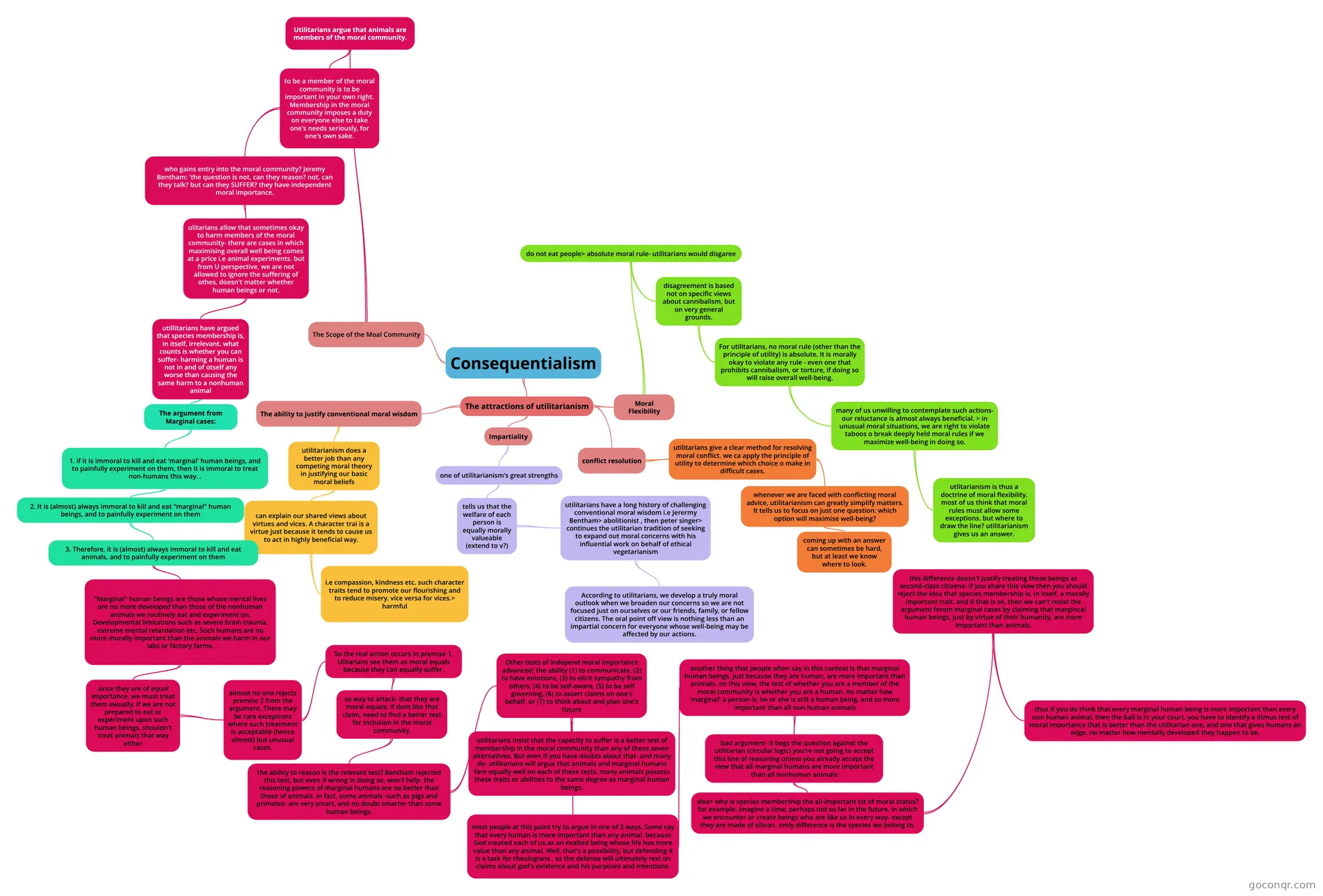
Mind map: Consequentialism
Contenido del mapa
Consequentialism
The attractions of utilitarianism
- Impartiality
- one of utilitarianism's great strengths
- tells us that the welfare of each person is equally morally valueable (extend to v?)
- utilitarians have a long history of challenging conventional moral wisdom i.e Jerermy Bentham> abolitionist , then peter singer> continues the utilitarian tradition of seeking to expand out moral concerns with his influential work on behalf of ethical vegetarianism
- According to utilitarians, we develop a truly moral outlook when we broaden our concerns so we are not focused just on ourselves or our friends, family, or fellow citizens. The oral point off view is nothing less than an impartial concern for everyone whose well-being may be affected by our actions.
- utilitarians have a long history of challenging conventional moral wisdom i.e Jerermy Bentham> abolitionist , then peter singer> continues the utilitarian tradition of seeking to expand out moral concerns with his influential work on behalf of ethical vegetarianism
- tells us that the welfare of each person is equally morally valueable (extend to v?)
- one of utilitarianism's great strengths
- The ability to justify conventional moral wisdom
- utilitarianism does a better job than any competing moral theory in justifying our basic moral beliefs
- can explain our shared views about virtues and vices. A character trai is a virtue just because it tends to cause us to act in highly beneficial way.
- i.e compassion, kindness etc. such character traits tend to promote our flourishing and to reduce misery. vice versa for vices.> harmful
- can explain our shared views about virtues and vices. A character trai is a virtue just because it tends to cause us to act in highly beneficial way.
- utilitarianism does a better job than any competing moral theory in justifying our basic moral beliefs
- conflict resolution
- utilitarians give a clear method for resolving moral conflict. we ca apply the principle of utility to determine which choice o make in difficult cases.
- whenever we are faced with conflicting moral advice, utilitarianism can greatly simplify matters. It tells us to focus on just one question: which option will maximise well-being?
- coming up with an answer can sometimes be hard, but at least we know where to look.
- whenever we are faced with conflicting moral advice, utilitarianism can greatly simplify matters. It tells us to focus on just one question: which option will maximise well-being?
- utilitarians give a clear method for resolving moral conflict. we ca apply the principle of utility to determine which choice o make in difficult cases.
- Moral Flexibility
- do not eat people> absolute moral rule- utilitarians would disgaree
- disagreement is based not on specific views about cannibalism, but on very general grounds.
- For utilitarians, no moral rule (other than the principle of utility) is absolute. It is morally okay to violate any rule - even one that prohibits cannibalism, or torture, if doing so will raise overall well-being.
- many of us unwilling to contemplate such actions- our reluctance is almost always beneficial. > in unusual moral situations, we are right to violate taboos o break deeply held moral rules if we maximize well-being in doing so.
- utlitarianism is thus a doctrine of moral flexibility. most of us think that moral rules must allow some exceptions. but where to draw the line? utilitarianism gives us an answer.
- many of us unwilling to contemplate such actions- our reluctance is almost always beneficial. > in unusual moral situations, we are right to violate taboos o break deeply held moral rules if we maximize well-being in doing so.
- For utilitarians, no moral rule (other than the principle of utility) is absolute. It is morally okay to violate any rule - even one that prohibits cannibalism, or torture, if doing so will raise overall well-being.
- disagreement is based not on specific views about cannibalism, but on very general grounds.
- do not eat people> absolute moral rule- utilitarians would disgaree
- Impartiality
The Scope of the Moal Community
- Utilitarians argue that animals are members of the moral community.
- to be a member of the moral community is to be important in your own right. Membership in the moral community imposes a duty on everyone else to take one's needs seriously, for one's own sake.
- who gains entry into the moral community? Jeremy Bentham: 'the question is not, can they reason? not, can they talk? but can they SUFFER? they have independent moral importance.
- ulitarians allow that sometimes okay to harm members of the moral community- there are cases in which maximising overall well being comes at a price i.e animal experiments. but from U perspective, we are not allowed to ignore the suffering of othes, doesn't matter whether human beings or not.
- utillitarians have argued that species membership is, in itself, irrelevant. what counts is whether you can suffer- harming a human is not in and of otself any worse than causing the same harm to a nonhuman animal
- The argument from Marginal cases:
- 1. if it is immoral to kill and eat 'marginal' human beings, and to painfully experiment on them, then it is immoral to treat non-humans this way. .
- 2. It is (almost) always immoral to kill and eat "marginal" human beings, and to painfully experiment on them
- 3. Therefore, it is (almost) always immoral to kill and eat animals, and to painfully experiment on them
- "Marginal" human beings are those whose mental lives are no more developed than those of the nonhuman animals we routinely eat and experiment on. Developmental limitations such as severe brain trauma, extreme mental retardation etc. Such humans are no more morally important than the animals we harm in our labs or factory farms.
- since they are of equal importance, we must treat them ewually. if we are not prepared to eat or experiment upon such human beings, shouldn't treat animals that way either
- almost no one rejects premise 2 from the argument. There may be rare exceptions where such treatment is acceptable (hence almost) but unusual cases.
- So the real action occurs in premise 1. Ulitarians see them as moral equals because they can equally suffer.
- so way to attack- that they are moral equals. if dont like that claim, need to find a better test for inclusion in the moral community.
- the ability to reason is the relevant test? Bentham rejected this test, but even if wrong in doing so, won't help- the reasoning powers of marginal humans are no better than those of animals. in fact, some animals -such as pigs and primates- are very smart, and no doubt smarter than some human beings.
- Other tests of independ moral importance advanced: the ability (1) to communicate, (2) to have emotions, (3) to elicit sympathy from others, (4) to be self-aware, (5) to be self governing, (6) to assert claims on one's behalf, or (7) to think about and plan one's future
- utilitarians insist that the capacity to suffer is a better test of membership in the moral community than any of these seven alternatives. But even if you have doubts about that- and many do- utilitarians will argue that animals and marginal humans fare equally well on each of these tests. many animals possess these traits or abilities to the same degree as marginal human beings.
- most people at this point try to argue in one of 2 ways. Some say that every human is more important than any animal, because God created each of us as an exalted being whose life has more value than any animal. Well, that's a possibility, but defending it is a task for theologians , as the defense will ultimately rest on claims about god's existence and his purposes and intentions.
- another thing that people often say in this context is that marginal human beings, just because they are human, are more important than animals. on this view, the test of whether you are a member of the moral community is whether you are a human. no matter how 'marginal' a person is, he or she is still a human being, and so more important than all non human animals
- bad argument- it begs the question against the utilitarian (circular logic) you're not going to accept this line of reasoning unless you already accept the view that all marginal humans are more important than all nonhuman animals
- also> why is species membership the all-important tst of moral status? for example, imagine a time, perhaps not so far in the future, in which we encounter or create beings who are like us in every way- except they are made of silicon. omly difference is the species we belong to.
- this difference doesn't justify treating these beings as second-class citixens- if you share this view then you should reject the idea that species membership is, in itself, a morally important trait. and if that is so, then we can't resist the argument forom marginal cases by claiming that margincal human beings, just by virtue of their humanity, are more important than animals.
- thus if you do think that every marginal human being is more important than every non human animal, then the ball is in your court. you have to identify a litmus test of moral importance that is better than the utilitarian one, and one that gives humans an edge, no matter how mentally developed they happen to be.
- this difference doesn't justify treating these beings as second-class citixens- if you share this view then you should reject the idea that species membership is, in itself, a morally important trait. and if that is so, then we can't resist the argument forom marginal cases by claiming that margincal human beings, just by virtue of their humanity, are more important than animals.
- also> why is species membership the all-important tst of moral status? for example, imagine a time, perhaps not so far in the future, in which we encounter or create beings who are like us in every way- except they are made of silicon. omly difference is the species we belong to.
- bad argument- it begs the question against the utilitarian (circular logic) you're not going to accept this line of reasoning unless you already accept the view that all marginal humans are more important than all nonhuman animals
- another thing that people often say in this context is that marginal human beings, just because they are human, are more important than animals. on this view, the test of whether you are a member of the moral community is whether you are a human. no matter how 'marginal' a person is, he or she is still a human being, and so more important than all non human animals
- Other tests of independ moral importance advanced: the ability (1) to communicate, (2) to have emotions, (3) to elicit sympathy from others, (4) to be self-aware, (5) to be self governing, (6) to assert claims on one's behalf, or (7) to think about and plan one's future
- the ability to reason is the relevant test? Bentham rejected this test, but even if wrong in doing so, won't help- the reasoning powers of marginal humans are no better than those of animals. in fact, some animals -such as pigs and primates- are very smart, and no doubt smarter than some human beings.
- so way to attack- that they are moral equals. if dont like that claim, need to find a better test for inclusion in the moral community.
- So the real action occurs in premise 1. Ulitarians see them as moral equals because they can equally suffer.
- almost no one rejects premise 2 from the argument. There may be rare exceptions where such treatment is acceptable (hence almost) but unusual cases.
- since they are of equal importance, we must treat them ewually. if we are not prepared to eat or experiment upon such human beings, shouldn't treat animals that way either
- "Marginal" human beings are those whose mental lives are no more developed than those of the nonhuman animals we routinely eat and experiment on. Developmental limitations such as severe brain trauma, extreme mental retardation etc. Such humans are no more morally important than the animals we harm in our labs or factory farms.
- 3. Therefore, it is (almost) always immoral to kill and eat animals, and to painfully experiment on them
- 2. It is (almost) always immoral to kill and eat "marginal" human beings, and to painfully experiment on them
- 1. if it is immoral to kill and eat 'marginal' human beings, and to painfully experiment on them, then it is immoral to treat non-humans this way. .
- The argument from Marginal cases:
- utillitarians have argued that species membership is, in itself, irrelevant. what counts is whether you can suffer- harming a human is not in and of otself any worse than causing the same harm to a nonhuman animal
- ulitarians allow that sometimes okay to harm members of the moral community- there are cases in which maximising overall well being comes at a price i.e animal experiments. but from U perspective, we are not allowed to ignore the suffering of othes, doesn't matter whether human beings or not.
- who gains entry into the moral community? Jeremy Bentham: 'the question is not, can they reason? not, can they talk? but can they SUFFER? they have independent moral importance.
- to be a member of the moral community is to be important in your own right. Membership in the moral community imposes a duty on everyone else to take one's needs seriously, for one's own sake.
- Utilitarians argue that animals are members of the moral community.
Información
- Descripción
- Diploma Philosophy and English Lit Mapa Mental sobre Consequentialism, creado por penguinolympics el 12/04/2016.
- Creado por
- penguinolympics
- Visitas
- 0
- Valoración