
Mapa mental
Chemical Resources
Contenido del mapa
Chemical Resources
Structure of the Earth
- Lithosphere, crust & top of mantle
- Earth's core transfers energy
- Deeper = Hotter
- Plate tectonic theory
- Pangea: Old supercontinent
- Explains wide range of evidence e.g. 'Puzzle Piece' atlas
- Wegener's continental drift theory (1914) not initially accepted.
- Magma + Rocks:
- Iron-rich Basalt: Runny lava
- Silica-rich Rhyolite: Viscous lava
- Explosions!
Construction Materials
- Hardness compared by rubbing rocks together
- E.g. Granite > Marble > Limestone
- Granite
- Cooled Magma
- Igneous
- Interlocking Crystals
- Marble
- Metamorphic
- Limestone changed by heat+pressure
- Baked, therefore Marble>limestone
- Limestone
- Sedimentary - compressed and cemented sediment
- Granite
- E.g. Granite > Marble > Limestone
- Thermal Decomposition
- One material heated --> 2+ new substances
- Calcium Carbonate (Limestone):
- CACO3 --> CaO + CO2
- (Limestone) -->
- (Calcium oxide + Carbon Diox.)
- CACO3 --> CaO + CO2
- Cement = Limestone + Clay + HEAT
- Concrete = Cement + Sand/Stones + Water
- Reinforced concrete: Steel rods/mesh
- Composite material: Both distinguishable
- Concrete weak under tension
- Steel stops stretching/cracking
- Reinforced concrete: Steel rods/mesh
- Concrete = Cement + Sand/Stones + Water
- Hardness compared by rubbing rocks together
Metals + Alloys
- Alloys
- Mixtures containing 2+ metals
- Amalgam (Mercury): Fillings
- Brass (Copper + Zinc)
- Solder (Lead + Tin)
- Smart alloys - Retain shape when heated
- E.g. Glasses frames of Nititol (Nickel-Titanium)
- Extracting Copper (Electrolysis)
- Advantages:
- Low melting point, little energy
- Reduces mining
- Reduces copper cost
- Disadvantages:
- Small amounts in electrical equipment
- Difficult to separate
- Pure and impure cannot be mixed (e.g. Solder)
- Fewer mining jobs
- May produce pollution
- Small amounts in electrical equipment
- Pure Cathode (-)
- Gains mass
- Cu(2+) Ions + 2e- --> Cu atoms
- Impure Anode (+)
- Loses mass
- Drops impurities
- Cu atoms --> Cu(2+) +2e-
- Advantages:
- Alloys
Making Cars
- Rusting
- Iron and Steel rust: Other metals corrode
- Acid rain + Salt water accelerate
- Is Oxidation:
- Iron + Oxygen + Water --> Hydrated Iron (III) Oxide
- Materials used:
- Aluminium: lightweight, malleable, no corrosion
- Iron/Steel: Malleable, strong
- Plastics: No corrosion, cheap
- Alloys - More useful properties than original metals
- Steel stronger than iron
- Steel less likely to corrode than iron
- Lighter materials e.g. Aluminium:
- Improve fuel economy
- Less corrosion, will last
- Recycling
- Advantages: Less mining, less crude oil in plastics, less landfill
- Disadvantages: Fewer mining jobs, difficult to separate, can pollute, expensive
- Minimum Recyclable % laws in place
- Rusting
Manufacturing Chemicals
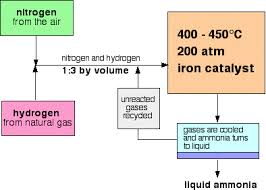
- The Haber Process
- Cover in Detail
- Optimum Conditions
- Iron Catalyst incr. rate of reaction (NOT percentage yield)
- High pressure incr. Ammonia yield
- High temperature incr. rate of reaction
- High temp. REDUCES Ammonia yield
- Optimum temp. 450'C
- Quick, low yield
- Optimum temp. 450'C
- Costs of Manufacture
- High pressure = High plant costs
- High temp = High energy costs
- Catalysts increase reaction
- Automation reduces wage costs (workers)
- Aim for cheapest yield, not fastest/ largest
- The Haber Process
Acids + Bases
- Bases
- Metal oxides/hydroxides
- Those soluble in water called ALKALIS
- Sodium hydroxide, calc. hydroxide
- Alkalis contain OH- ions
- Neutralisation
- Acid + Base --> Salt + Water
- H+ (Acid) + OH- (Alkali) <---> H2O
- Acid + Base --> Salt + Water
- Universal indicator is a mix of diff. indicators
- Shows gradual changes
- Acids
- All contain H+ ions
- Higher the H+ concentration, lower the pH
- Salts
- Acid + Metal carbonate --> Salt + Water + CO2
- Two-part names:
- Sulfate, nitrate, chloride, phosphate
- E.g: Hydrochloric acid + copper carbonate --> Copper chloride + water + carbon dioxide
- Bases
Fertilisers + Crop Yields
- Crops
- Fertilisers must be dissolved in water for plant roots to absorb
- Some dissolve easily, others designed for slow energy release
- Yield increased by:
- Provide extra essential elements
- (Fertiliser)
- Provide nitrogen encorporated into plant protein
- Increased growth
- Provide extra essential elements
- Eutrophication
- Excess fertiliser runoff causes algal bloom in river systems
- Sunlight blocked out
- Plants stop respiring
- Aerobic bacteria use all oxygen
- Fish die
- Aerobic bacteria use all oxygen
- Plants stop respiring
- Sunlight blocked out
- Caused by nitrate / phosphate levels
- Excess fertiliser runoff causes algal bloom in river systems
- Preparing Fertilisers
- Most fertilisers are salts
- (Water is heavy to transport)
- Step 1: Titrate alkali and acid using indicator to find neutral
- Step 2: Use these ratios to scale up alkali + acid
- Step 3: Boil off most water, leave to crystalise
- Step 2: Use these ratios to scale up alkali + acid
- Most fertilisers are salts
- Crops
Chemicals from the Sea
- Mining / Subsidence
- Rock salt mined from ground
- Pump water underground, collect salt solution
- Can cause subsidence - destroys land + homes
- Leaking brine solution affects habitats
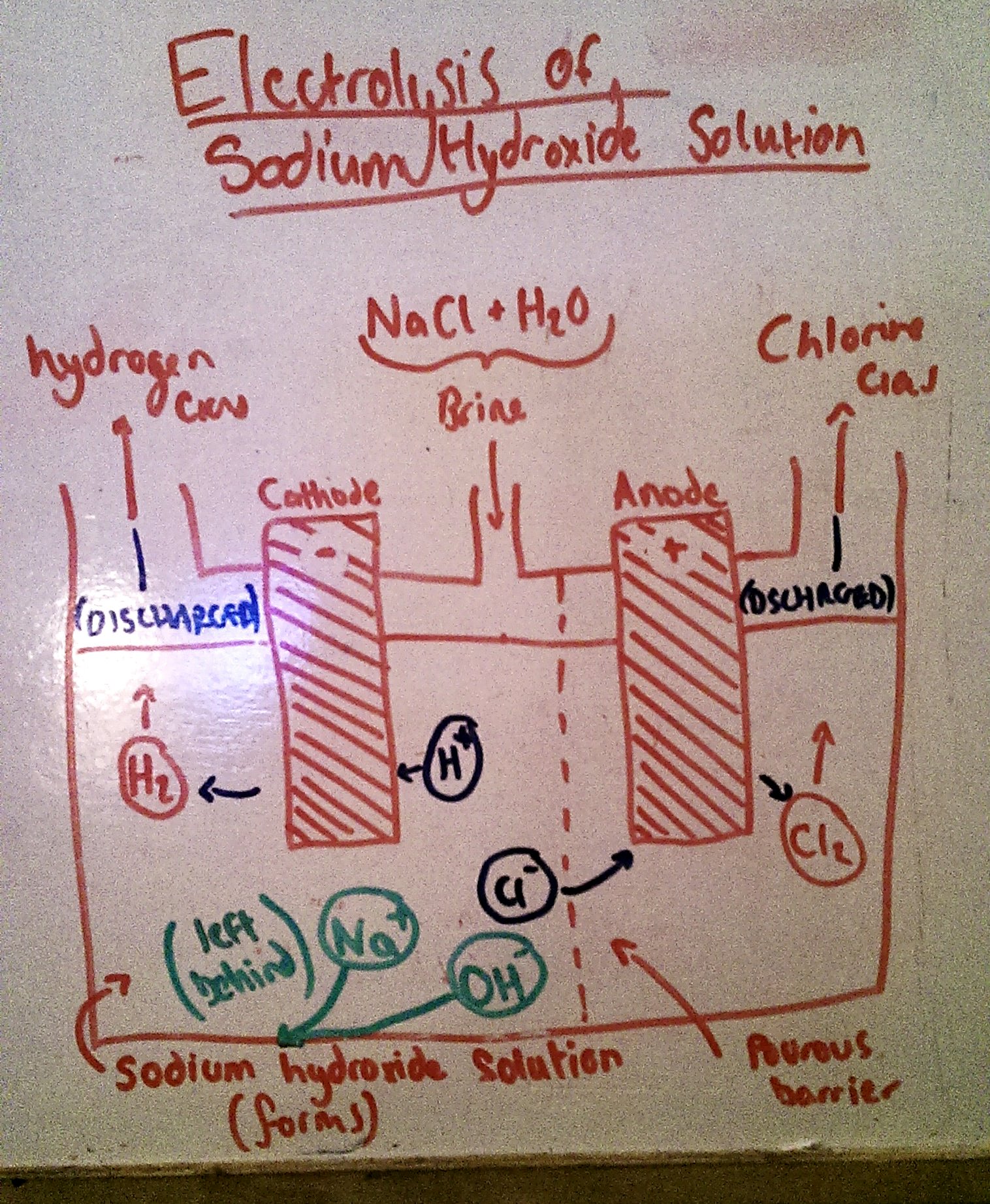
- Electrolysis of Sodium Hydroxide solution
- Brine can be separated using electrolysis.
- Important the electrodes are INERT
- (Chlorine and Hyrdogen are highly reactive)
- Equations:
- Ions not discharged make Sodium Hydroxide solution
- Na+ + OH- --> NaOH
- Chlorine OXIDISED at anode
- 2Cl- - 2e- --> Cl2
- Hydrogen REDUCED at cathode
- 2H+ + 2e- --> H2
- Ions not discharged make Sodium Hydroxide solution
- Chlor-Alkali industry
- Chlorine and Sodium Hydroxide important raw materials
- Bleach
- Paints
- Solvents
- Plastics
- Foods
- Chlorine and Sodium Hydroxide important raw materials
- Mining / Subsidence
Imágenes y archivos del mapa
Información
- Descripción
- AS Level (C2: Chemical Resources) Chemistry Mapa Mental sobre Chemical Resources, creado por Oliver Wood el 04/02/2014.
- Creado por
- Oliver Wood
- Visitas
- 91
- Etiquetas
- Valoración