
Mapa mental
Lecture 2 - The self
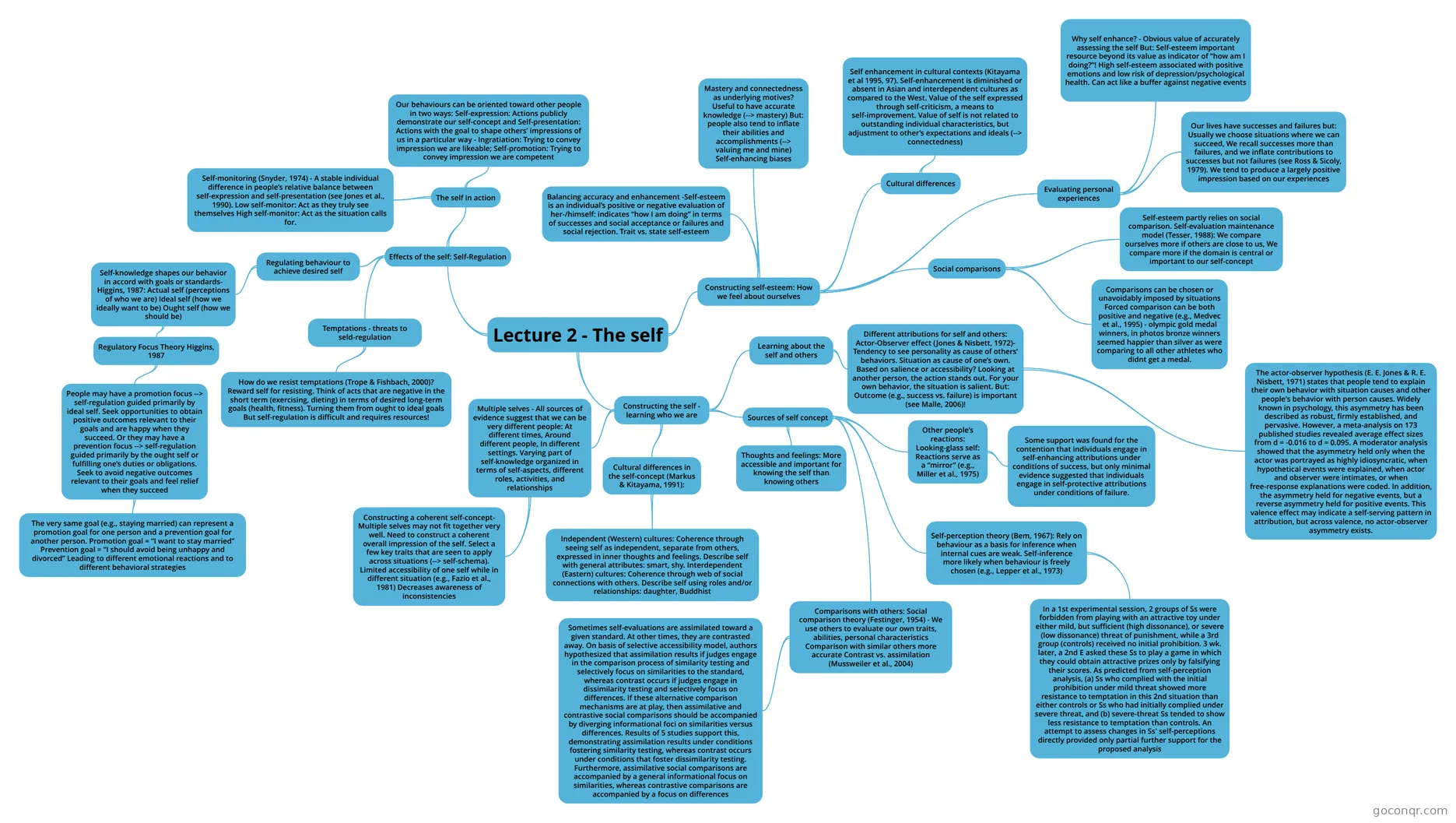
Mind map: The self
Contenido del mapa
Lecture 2 - The self
Constructing the self - learning who we are
- Sources of self concept
- Self-perception theory (Bem, 1967): Rely on behaviour as a basis for inference when internal cues are weak. Self-inference more likely when behaviour is freely chosen (e.g., Lepper et al., 1973)
- In a 1st experimental session, 2 groups of Ss were forbidden from playing with an attractive toy under either mild, but sufficient (high dissonance), or severe (low dissonance) threat of punishment, while a 3rd group (controls) received no initial prohibition. 3 wk. later, a 2nd E asked these Ss to play a game in which they could obtain attractive prizes only by falsifying their scores. As predicted from self-perception analysis, (a) Ss who complied with the initial prohibition under mild threat showed more resistance to temptation in this 2nd situation than either controls or Ss who had initially complied under severe threat, and (b) severe-threat Ss tended to show less resistance to temptation than controls. An attempt to assess changes in Ss' self-perceptions directly provided only partial further support for the proposed analysis
- Thoughts and feelings: More accessible and important for knowing the self than knowing others
- Other people’s reactions: Looking-glass self: Reactions serve as a “mirror” (e.g., Miller et al., 1975)
- Some support was found for the contention that individuals engage in self-enhancing attributions under conditions of success, but only minimal evidence suggested that individuals engage in self-protective attributions under conditions of failure.
- Comparisons with others: Social comparison theory (Festinger, 1954) - We use others to evaluate our own traits, abilities, personal characteristics Comparison with similar others more accurate Contrast vs. assimilation (Mussweiler et al., 2004)
- Sometimes self-evaluations are assimilated toward a given standard. At other times, they are contrasted away. On basis of selective accessibility model, authors hypothesized that assimilation results if judges engage in the comparison process of similarity testing and selectively focus on similarities to the standard, whereas contrast occurs if judges engage in dissimilarity testing and selectively focus on differences. If these alternative comparison mechanisms are at play, then assimilative and contrastive social comparisons should be accompanied by diverging informational foci on similarities versus differences. Results of 5 studies support this, demonstrating assimilation results under conditions fostering similarity testing, whereas contrast occurs under conditions that foster dissimilarity testing. Furthermore, assimilative social comparisons are accompanied by a general informational focus on similarities, whereas contrastive comparisons are accompanied by a focus on differences
- Self-perception theory (Bem, 1967): Rely on behaviour as a basis for inference when internal cues are weak. Self-inference more likely when behaviour is freely chosen (e.g., Lepper et al., 1973)
- Learning about the self and others
- Different attributions for self and others: Actor-Observer effect (Jones & Nisbett, 1972)- Tendency to see personality as cause of others’ behaviors. Situation as cause of one’s own. Based on salience or accessibility? Looking at another person, the action stands out. For your own behavior, the situation is salient. But: Outcome (e.g., success vs. failure) is important (see Malle, 2006)!
- The actor-observer hypothesis (E. E. Jones & R. E. Nisbett, 1971) states that people tend to explain their own behavior with situation causes and other people's behavior with person causes. Widely known in psychology, this asymmetry has been described as robust, firmly established, and pervasive. However, a meta-analysis on 173 published studies revealed average effect sizes from d = -0.016 to d = 0.095. A moderator analysis showed that the asymmetry held only when the actor was portrayed as highly idiosyncratic, when hypothetical events were explained, when actor and observer were intimates, or when free-response explanations were coded. In addition, the asymmetry held for negative events, but a reverse asymmetry held for positive events. This valence effect may indicate a self-serving pattern in attribution, but across valence, no actor-observer asymmetry exists.
- Different attributions for self and others: Actor-Observer effect (Jones & Nisbett, 1972)- Tendency to see personality as cause of others’ behaviors. Situation as cause of one’s own. Based on salience or accessibility? Looking at another person, the action stands out. For your own behavior, the situation is salient. But: Outcome (e.g., success vs. failure) is important (see Malle, 2006)!
- Multiple selves - All sources of evidence suggest that we can be very different people: At different times, Around different people, In different settings. Varying part of self-knowledge organized in terms of self-aspects, different roles, activities, and relationships
- Constructing a coherent self-concept- Multiple selves may not fit together very well. Need to construct a coherent overall impression of the self. Select a few key traits that are seen to apply across situations (--> self-schema). Limited accessibility of one self while in different situation (e.g., Fazio et al., 1981) Decreases awareness of inconsistencies
- Cultural differences in the self-concept (Markus & Kitayama, 1991):
- Independent (Western) cultures: Coherence through seeing self as independent, separate from others, expressed in inner thoughts and feelings. Describe self with general attributes: smart, shy. Interdependent (Eastern) cultures: Coherence through web of social connections with others. Describe self using roles and/or relationships: daughter, Buddhist
- Sources of self concept
Constructing self-esteem: How we feel about ourselves
- Balancing accuracy and enhancement -Self-esteem is an individual’s positive or negative evaluation of her-/himself: indicates “how I am doing” in terms of successes and social acceptance or failures and social rejection. Trait vs. state self-esteem
- Mastery and connectedness as underlying motives? Useful to have accurate knowledge (--> mastery) But: people also tend to inflate their abilities and accomplishments (--> valuing me and mine) Self-enhancing biases
- Evaluating personal experiences
- Our lives have successes and failures but: Usually we choose situations where we can succeed, We recall successes more than failures, and we inflate contributions to successes but not failures (see Ross & Sicoly, 1979). We tend to produce a largely positive impression based on our experiences
- Why self enhance? - Obvious value of accurately assessing the self But: Self-esteem important resource beyond its value as indicator of “how am I doing?”! High self-esteem associated with positive emotions and low risk of depression/psychological health. Can act like a buffer against negative events
- Social comparisons
- Self-esteem partly relies on social comparison. Self-evaluation maintenance model (Tesser, 1988): We compare ourselves more if others are close to us, We compare more if the domain is central or important to our self-concept
- Comparisons can be chosen or unavoidably imposed by situations Forced comparison can be both positive and negative (e.g., Medvec et al., 1995) - olympic gold medal winners, in photos bronze winners seemed happier than silver as were comparing to all other athletes who didnt get a medal.
- Cultural differences
- Self enhancement in cultural contexts (Kitayama et al 1995, 97). Self-enhancement is diminished or absent in Asian and interdependent cultures as compared to the West. Value of the self expressed through self-criticism, a means to self-improvement. Value of self is not related to outstanding individual characteristics, but adjustment to other’s expectations and ideals (--> connectedness)
Effects of the self: Self-Regulation
- The self in action
- Our behaviours can be oriented toward other people in two ways: Self-expression: Actions publicly demonstrate our self-concept and Self-presentation: Actions with the goal to shape others’ impressions of us in a particular way - Ingratiation: Trying to convey impression we are likeable; Self-promotion: Trying to convey impression we are competent
- Self-monitoring (Snyder, 1974) - A stable individual difference in people’s relative balance between self-expression and self-presentation (see Jones et al., 1990). Low self-monitor: Act as they truly see themselves High self-monitor: Act as the situation calls for.
- Regulating behaviour to achieve desired self
- Self-knowledge shapes our behavior in accord with goals or standards- Higgins, 1987: Actual self (perceptions of who we are) Ideal self (how we ideally want to be) Ought self (how we should be)
- Regulatory Focus Theory Higgins, 1987
- People may have a promotion focus --> self-regulation guided primarily by ideal self. Seek opportunities to obtain positive outcomes relevant to their goals and are happy when they succeed. Or they may have a prevention focus --> self-regulation guided primarily by the ought self or fulfilling one’s duties or obligations. Seek to avoid negative outcomes relevant to their goals and feel relief when they succeed
- The very same goal (e.g., staying married) can represent a promotion goal for one person and a prevention goal for another person. Promotion goal = “I want to stay married” Prevention goal = “I should avoid being unhappy and divorced” Leading to different emotional reactions and to different behavioral strategies
- People may have a promotion focus --> self-regulation guided primarily by ideal self. Seek opportunities to obtain positive outcomes relevant to their goals and are happy when they succeed. Or they may have a prevention focus --> self-regulation guided primarily by the ought self or fulfilling one’s duties or obligations. Seek to avoid negative outcomes relevant to their goals and feel relief when they succeed
- Regulatory Focus Theory Higgins, 1987
- Self-knowledge shapes our behavior in accord with goals or standards- Higgins, 1987: Actual self (perceptions of who we are) Ideal self (how we ideally want to be) Ought self (how we should be)
- Temptations - threats to seld-regulation
- How do we resist temptations (Trope & Fishbach, 2000)? Reward self for resisting. Think of acts that are negative in the short term (exercising, dieting) in terms of desired long-term goals (health, fitness). Turning them from ought to ideal goals But self-regulation is difficult and requires resources!
- The self in action
Información
- Descripción
- 2nd year Social Psychology Mapa Mental sobre Lecture 2 - The self, creado por Issy de Silva el 30/04/2016.
- Creado por
- Issy de Silva
- Visitas
- 1
- Valoración