
Mapa mental
Religious Experience
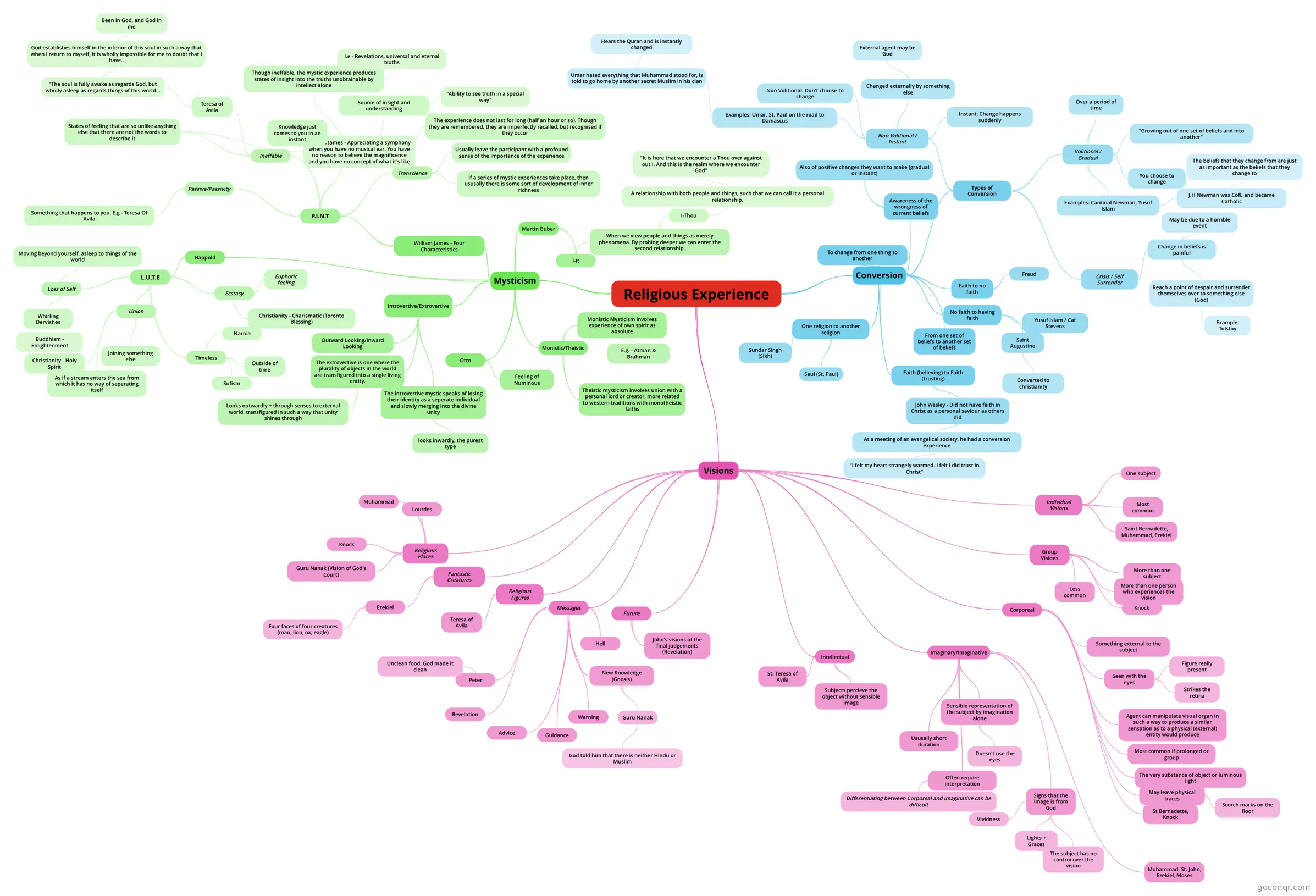
Mind map: religious experience
Contenido del mapa
Religious Experience
Mysticism
- William James - Four Characteristics
- P.I.N.T
- Passive/Passivity
- Something that happens to you. E.g - Teresa Of Avila
- Ineffable
- States of feeling that are so unlike anything else that there are not the words to describe it
- William James - Appreciating a symphony when you have no musical ear. You have no reason to believe the magnificence and you have no concept of what it's like
- Teresa of Avila
- "The soul is fully awake as regards God, but wholly asleep as regards things of this world...
- God establishes himself in the interior of this soul in such a way that when I return to myself, it is wholly impossible for me to doubt that I have..
- Been in God, and God in me
- God establishes himself in the interior of this soul in such a way that when I return to myself, it is wholly impossible for me to doubt that I have..
- "The soul is fully awake as regards God, but wholly asleep as regards things of this world...
- States of feeling that are so unlike anything else that there are not the words to describe it
- Noetic
- Though ineffable, the mystic experience produces states of insight into the truths unobtainable by intellect alone
- I.e - Revelations, universal and eternal truths
- Source of insight and understanding
- "Ability to see truth in a special way"
- Knowledge just comes to you in an instant
- Though ineffable, the mystic experience produces states of insight into the truths unobtainable by intellect alone
- Transcience
- The experience does not last for long (half an hour or so). Though they are remembered, they are imperfectly recalled, but recognised if they occur
- If a series of mystic experiences take place, then ususally there is some sort of development of inner richness
- Usually leave the participant with a profound sense of the importance of the experience
- Passive/Passivity
- P.I.N.T
- Introvertive/Extrovertive
- Outward Looking/Inward Looking
- The extrovertive is one where the plurality of objects in the world are transfigured into a single living entity.
- Looks outwardly + through senses to external world, transfigured in such a way that unity shines through
- The introvertive mystic speaks of losing their identity as a seperate individual and slowly merging into the divine unity
- looks inwardly, the purest type
- Monistic/Theistic
- Monistic Mysticism involves experience of own spirit as absolute
- E.g. - Atman & Brahman
- Theistic mysticism involves union with a personal lord or creator, more related to western traditions with monotheistic faiths
- Monistic Mysticism involves experience of own spirit as absolute
- Otto
- Feeling of Numinous
- Martin Buber
- I-It
- When we view people and things as merely phenomena. By probing deeper we can enter the second relationship.
- I-Thou
- A relationship with both people and things, such that we can call it a personal relationship.
- "It is here that we encounter a Thou over against out I. And this is the realm where we encounter God"
- A relationship with both people and things, such that we can call it a personal relationship.
- I-Thou
- When we view people and things as merely phenomena. By probing deeper we can enter the second relationship.
- I-It
- Happold
- L.U.T.E
- Loss of Self
- Whirling Dervishes
- Buddhism - Enlightenment
- Moving beyond yourself, asleep to things of the world
- Whirling Dervishes
- Union
- Joining something else
- Christianity - Holy Spirit
- As if a stream enters the sea from which it has no way of seperating itself
- Timeless
- Narnia
- Sufism
- Outside of time
- Ecstasy
- Euphoric feeling
- Christianity - Charismatic (Toronto Blessing)
- Loss of Self
- L.U.T.E
- William James - Four Characteristics
Conversion
- To change from one thing to another
- Types of Conversion
- Non Volitional / Instant
- Non Volitional: Don't choose to change
- Changed externally by something else
- External agent may be God
- Instant: Change happens suddenly
- Examples: Umar, St. Paul on the road to Damascus
- Umar hated everything that Muhammad stood for, is told to go home by another secret Muslim in his clan
- Hears the Quran and is instantly changed
- Umar hated everything that Muhammad stood for, is told to go home by another secret Muslim in his clan
- Volitional / Gradual
- Over a period of time
- "Growing out of one set of beliefs and into another"
- You choose to change
- Examples: Cardinal Newman, Yusuf Islam
- J.H Newman was CofE and became Catholic
- The beliefs that they change from are just as important as the beliefs that they change to
- J.H Newman was CofE and became Catholic
- Crisis / Self Surrender
- Change in beliefs is painful
- Reach a point of despair and surrender themselves over to something else (God)
- Example: Tolstoy
- May be due to a horrible event
- Reach a point of despair and surrender themselves over to something else (God)
- Change in beliefs is painful
- Non Volitional / Instant
- From one set of beliefs to another set of beliefs
- One religion to another religion
- Sundar Singh (Sikh)
- Saul (St. Paul)
- No faith to having faith
- Saint Augustine
- Converted to christianity
- Yusuf Islam / Cat Stevens
- Saint Augustine
- Faith to no faith
- Freud
- Faith (believing) to Faith (trusting)
- John Wesley - Did not have faith in Christ as a personal saviour as others did
- At a meeting of an evangelical society, he had a conversion experience
- "I felt my heart strangely warmed. I felt I did trust in Christ"
- At a meeting of an evangelical society, he had a conversion experience
- John Wesley - Did not have faith in Christ as a personal saviour as others did
- Awareness of the wrongness of current beliefs
- Also of positive changes they want to make (gradual or instant)
Visions
- Religious Places
- Guru Nanak (Vision of God's Court)
- Knock
- Muhammad
- Lourdes
- Fantastic Creatures
- Ezekiel
- Four faces of four creatures (man, lion, ox, eagle)
- Ezekiel
- Religious Figures
- Teresa of Avila
- Messages
- Peter
- Unclean food, God made it clean
- Advice
- Revelation
- Guidance
- Warning
- New Knowledge (Gnosis)
- Guru Nanak
- God told him that there is neither Hindu or Muslim
- Guru Nanak
- Hell
- Peter
- Future
- John's visions of the final judgements (Revelation)
- Individual Visions
- One subject
- Most common
- Saint Bernadette, Muhammad, Ezekiel
- Group Visions
- More than one subject
- More than one person who experiences the vision
- Less common
- Knock
- Corporeal
- Something external to the subject
- Seen with the eyes
- Figure really present
- Strikes the retina
- Agent can manipulate visual organ in such a way to produce a similar sensation as to a physical (external) entity would produce
- Most common if prolonged or group
- The very substance of object or luminous light
- May leave physical traces
- Scorch marks on the floor
- St Bernadette, Knock
- Imaginary/Imaginative
- Sensible representation of the subject by imagination alone
- Doesn't use the eyes
- Signs that the image is from God
- Vividness
- Lights + Graces
- The subject has no controi over the vision
- Ususally short duration
- Often require interpretation
- Differentiating between Corporeal and Imaginative can be difficult
- Muhammad, St. John, Ezekiel, Moses
- Sensible representation of the subject by imagination alone
- Intellectual
- Subjects percieve the object without sensible image
- St. Teresa of Avila
- Religious Places
Información
- Descripción
- (Religious Experience) Philosophy And Religion Mapa Mental sobre Religious Experience, creado por ebramhall el 22/04/2013.
- Creado por
- ebramhall
- Visitas
- 219
- Etiquetas
- Valoración